
Assessing the Regulatory and Financial Vulnerabilities in the Crypto ATM Ecosystem


 Aime Summary
The Surge in Fraud: A Case Study in Clay County
Clay County's experience in 2025 exemplifies the vulnerabilities inherent in the crypto ATMATM-- ecosystem. According to a report by , , with victims often instructed to convert cash into Bitcoin via ATMs to avoid detection. These schemes, frequently conducted via phone calls from individuals posing as law enforcement, exploit psychological pressure and the anonymity of crypto transactions to siphon funds irreversibly.
Compounding this issue is the rise of romance scams. A 61-year-old man, for instance, impersonating a 34-year-old woman on TikTok, a tactic that leverages social media to build trust before demanding payments for fabricated expenses. Scammers increasingly use encrypted messaging apps to evade detection, moving conversations off public platforms and deepening the opacity of their operations.
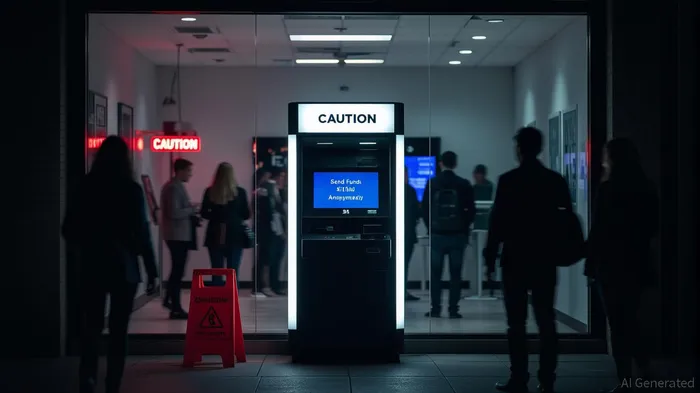 The FBI reported that U.S. , . Clay County, , has become a microcosm of this trend, highlighting how geographic concentration of kiosks correlates with heightened fraud risk.
Traceability Challenges: The Inherent Weakness of Crypto ATMs
A core vulnerability of Bitcoin ATMs lies in their design. Unlike traditional banking systems, which require identity verification and maintain audit trails, these machines often facilitate anonymous transactions. As stated by the St. Paul City Council, this anonymity enables scammers to operate with impunity while victims face near-zero chances of recovering lost funds.
The lack of traceability is not merely a technical limitation but a systemic enabler of criminal activity. In Clay County, scammers exploit this by directing victims to convert cash into Bitcoin-a process that obliterates transactional metadata-and then transfer the funds to offshore wallets. Even when law enforcement identifies suspects, the decentralized nature of cryptocurrencies often renders recovery impossible, leaving victims to absorb losses.
Regulatory Responses: St. Paul's Ban and the Broader Implications
St. Paul's decision to ban cryptocurrency kiosks, effective December 21, 2025, reflects a growing regulatory appetite to mitigate these risks. The City Council voted 6-1 to prohibit kiosks, of crypto ATM fraud in 2024, . Council President Rebecca Noecker emphasized the need to protect vulnerable populations, particularly seniors and low-income individuals, from predatory schemes.
Industry pushback has been swift. Bitcoin DepotBTM--, a major kiosk operator, has sued St. Paul, arguing that the ban is unnecessary given state-level licensing requirements and the kiosks' utility for cash-based transactions. However, the city maintains that local governments possess the authority to regulate public safety under police powers, a legal stance that could set a precedent for similar bans elsewhere.
The ripple effects of such bans are already evident. A prior ban in Stillwater, Minnesota, prompted Bitcoin Depot to file a lawsuit, illustrating the potential for a fragmented regulatory landscape. If more municipalities follow St. Paul's lead, operators may face operational displacement, shifting activity to less-regulated jurisdictions and exacerbating cross-border enforcement challenges.
Investment Implications: Cautious Exposure to Crypto Infrastructure
For investors, the confluence of rising fraud and regulatory uncertainty demands a recalibration of risk assessments. The crypto ATM sector, once viewed as a stable component of the digital asset ecosystem, now faces existential threats. St. Paul's ban and Clay County's proactive measures-including warning flyers near ATMs and law enforcement training-signal a shift toward stricter oversight.
Moreover, the financial vulnerabilities of retail investors are amplified by the lack of consumer safeguards. Unlike traditional financial instruments, crypto ATM transactions are irreversible, and victims of scams have no recourse through chargebacks or insurance mechanisms. This asymmetry of risk-where operators and regulators bear minimal liability-poses a systemic threat to investor confidence.
Investors should also consider the macroeconomic implications. suggests that the problem is not isolated but part of a broader trend of crypto-related crime. As municipalities adopt divergent policies, the sector's long-term viability could be compromised, leading to stranded assets and declining returns for infrastructure providers.
Conclusion: A Call for Prudence
The crypto ATM ecosystem stands at a crossroads. While these machines democratize access to digital assets, their role in facilitating fraud and financial harm cannot be ignored. The cases of Clay County and St. Paul demonstrate that regulatory action is accelerating in response to public demand for accountability.
For investors, the lesson is clear: exposure to crypto infrastructure must be approached with caution. Until robust consumer protections and traceability mechanisms are implemented, the risks of regulatory intervention and reputational damage will likely outweigh the potential rewards. In an environment where trust is the most valuable currency, the current vulnerabilities of Bitcoin ATMs pose a threat not just to individual investors, but to the broader adoption of digital assets.

Delivering real-time insights and analysis on emerging financial trends and market movements.
Latest Articles
Stay ahead of the market.
Get curated U.S. market news, insights and key dates delivered to your inbox.




Comments
No comments yet