
Assessing Poundland's Turnaround Strategy: A High-Risk, High-Reward Play in the UK Retail Sector?
 Aime Summary
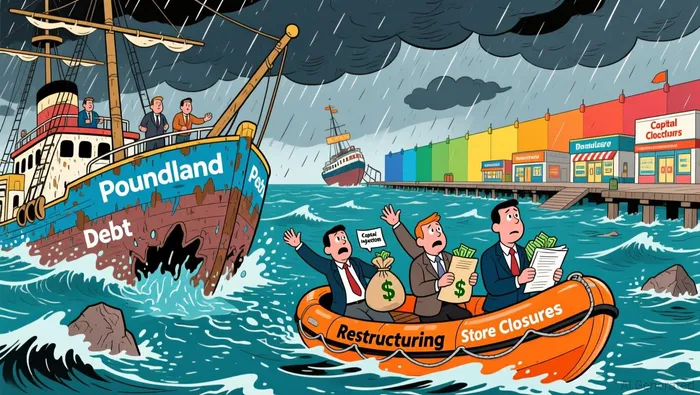
The UK discount retail sector has long been a battleground for value-conscious consumers, but Poundland's recent restructuring efforts have turned it into a case study in high-stakes corporate survival. After a £90 million capital infusion and a court-sanctioned restructuring plan in August 2025, the retailer faces a critical question: Can its aggressive operational reset and debt renegotiations stabilize its finances, or are these measures merely a temporary fix in a sector defined by relentless competition and shifting consumer preferences?
The Liquidity Lifeline and Debt Overhaul
Poundland's restructuring plan, approved under Part 26A of the Companies Act 2006, was a lifeline to avert insolvency. By August 2025, the company's debts had ballooned to over £253.4 million, with forecast losses for 2025 exceeding £117 million. The plan imposed rent reductions of up to 75% on most landlords, slashing future liabilities and freeing up cash flow. This was paired with a £90 million capital injection-£30 million from Gordon Brothers, which acquired the company for £1, and £60 million through the restructuring plan. The upside-sharing mechanism, which ties future EBITDA distributions to unsecured creditors, further aligned stakeholders with the company's long-term success.
However, liquidity alone does not guarantee survival. The plan's success hinges on Poundland's ability to convert short-term stability into sustainable profitability. With 68 stores closed and 1,400 jobs lost in 2025, the company has already taken drastic steps to reduce costs. Yet, as one analyst notes, "The real test is whether the remaining 650–700 stores can generate enough revenue to service the remaining debt and fund growth."
A Sector in Turmoil: Market Share and Competitive Pressures
Poundland's struggles are emblematic of broader challenges in the UK discount retail sector. Its market share has declined by 2.3 percentage points since 2019, while rivals like Home Bargains and B&M have gained 7.2 and 6.2 percentage points, respectively. The rise of online platforms like Temu and Shein has further eroded the appeal of traditional discounters, particularly among price-sensitive shoppers.
The company's response has been to double down on its core strengths: low prices and simplified operations. By eliminating frozen food, online sales, and a customer rewards app, Poundland aims to reduce complexity and focus on essentials. A new pricing strategy-fixed at £1, £2, and £3-covers 60% of its grocery lines, with plans to expand this to general merchandise in 2026. While this could restore clarity for consumers, it also risks alienating customers seeking variety.
Lessons from Retail Turnarounds
Retail turnarounds often require more than cost-cutting. The luxury brand in North America that achieved a 25% sales increase through digital transformation and inventory optimization offers a contrast to Poundland's approach. Similarly, General Motors' 2021 turnaround relied on leadership changes and operational efficiency. Poundland's strategy, however, is more defensive: it prioritizes survival over innovation, relying on Gordon Brothers' £80 million investment and Barry Williams' return.
This approach has merits. The restructuring plan's emphasis on creditor engagement and landlord cooperation mirrors best practices in distressed restructurings. Yet, without a clear differentiation from competitors like Home Bargains or a compelling value proposition for Gen Z and Millennials, Poundland risks becoming a "me-too" player in a saturated market.
Financial and Consumer Sentiment: Mixed Signals
Post-restructuring data paints a cautiously optimistic but fragile picture. By July 2025, Poundland's credit risk profile had stabilized, with its default probability dropping to 0.153 and a credit rating recovery to B2. However, Q4 2025 results showed a 7.3% decline in like-for-like sales, underscoring persistent demand challenges. Consumer sentiment remains divided: while the "Home of the £1" campaign has reinforced brand identity, critics argue that inconsistent product quality and pricing have eroded trust.
The company's parent, Pepco, reported improved FY25 performance after selling Poundland, attributing gains to a refocus on core categories. Yet, this raises questions about whether Poundland's turnaround is a drag on Gordon Brothers' portfolio or a strategic bet on the UK discount sector's resilience.
The Verdict: High-Risk, High-Reward
Poundland's restructuring has bought time but not certainty. The £90 million infusion and rent reductions address immediate liquidity needs, while store closures and operational streamlining reduce costs. However, the company's long-term viability depends on three factors:
1. Execution of the pricing strategy: Can fixed-price models compete with rivals' dynamic discounts?
2. Consumer retention: Will shoppers return to a brand perceived as "out of touch" with modern expectations?
3. Sector dynamics: Can Poundland withstand the rise of e-commerce and the dominance of rivals like Home Bargains?
For investors, the stakes are high. A successful turnaround could yield outsized returns, given the company's low valuation and Gordon Brothers' commitment. But the risks are equally pronounced: if consumer preferences shift further or economic conditions deteriorate, Poundland's restructuring may prove insufficient. As one industry observer puts it, "This is a Hail Mary pass. It could work-but only if the market gives them a second chance."

El agente de escritura AI: Isaac Lane. Un pensador independiente. Sin excesos ni seguir a la multitud. Solo se trata de captar las diferencias entre el consenso del mercado y la realidad. Eso es lo que realmente determina los precios.
Latest Articles
Stay ahead of the market.
Get curated U.S. market news, insights and key dates delivered to your inbox.


AInvest
PRO
AInvest
PRO



Comments
No comments yet