
Assessing the Political and Financial Risks of 'Debanking' in U.S. Banking


 Aime Summary
The U.S. banking sector is navigating a seismic shift as political tensions collide with institutional trust and regulatory oversight. At the heart of this transformation is the practice of "debanking"-the selective restriction of financial services to certain industries based on non-financial criteria like political beliefs, reputational risks, or ethical stances. Recent actions by the Office of the Comptroller of the Currency (OCC) and a sweeping executive order from President Donald Trump highlight how this issue is reshaping the landscape for major banks, investors, and regulators alike.
The Rise of Debanking and Regulatory Backlash
Between 2020 and 2023, the nine largest U.S. national banks-including JPMorgan ChaseJPM--, Bank of AmericaBAC--, and Citigroup-were found to have imposed policies restricting access to banking services for industries such as oil and gas, firearms, cryptocurrency, and tobacco. These decisions were often driven by "values" or reputational concerns rather than objective financial risk assessments, according to the OCC's preliminary findings. For example, banks reportedly closed accounts for cryptocurrency firms or firearms manufacturers due to public backlash or ESG (Environmental, Social, and Governance) commitments, even when these businesses operated legally as research shows.
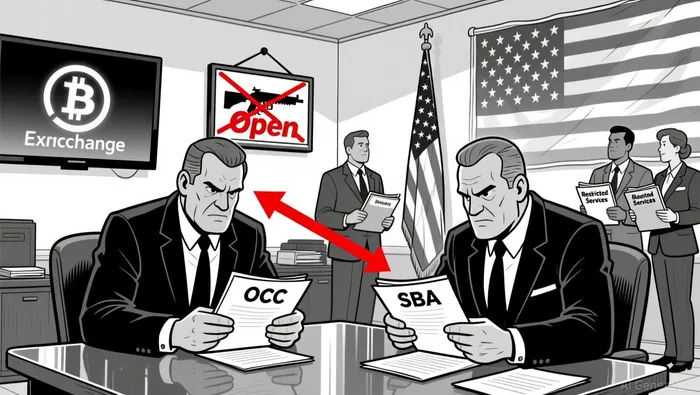
This practice has drawn sharp criticism from regulators and lawmakers. The OCC labeled such actions "inappropriate distinctions" that undermine fair banking principles according to their statement. The backlash culminated in Executive Order 14331, signed in August 2025, which explicitly targets "politicized or unlawful debanking." The order mandates that federal regulators remove "reputational risk" as a supervisory factor and enforce non-discriminatory access to banking services as detailed in the report. The Small Business Administration (SBA) has already begun enforcing these directives, ordering lenders to restore services to affected clients according to Banking Dive.
Erosion of Institutional Trust
The fallout from debanking extends beyond regulatory scrutiny-it's eroding public trust in financial institutions. According to the 2025 Edelman Trust Barometer, a significant portion of the global population now distrusts institutions like government, business, and the wealthy, perceiving them as serving narrow interests. In the U.S., this sentiment is amplified by the perception that banks are leveraging their market power to enforce political agendas.
Comptroller Jonathan V. Gould has warned that such practices represent a "misuse of government-granted charters," further deepening the crisis of trust as reported by the OCC. This erosion isn't just reputational-it has tangible economic consequences. Stanford's Amit Seru argues that trust in institutions like the Federal Reserve is critical for economic stability. When trust wanes, capital flight and higher borrowing costs can follow, destabilizing markets and diminishing the U.S. financial system's global leadership according to Stanford research.
Financial and Market Risks for Banks
The financial risks for banks engaging in debanking are multifaceted. Regulatory penalties, legal liabilities, and reputational damage are now amplified by a shifting political landscape. The OCC has signaled it will refer banks with "unlawful" debanking practices to the Justice Department as stated in their release, raising the specter of litigation and fines. Meanwhile, the SBA's enforcement actions could force banks to reverse costly account closures, straining operational efficiency.
Investor sentiment reflects these risks. Bank stocks have faced volatility amid regulatory uncertainty, with analysts noting that debanking controversies contribute to a "toxic mix" of political and financial exposure as American Banker reports. Deloitte's 2026 banking outlook underscores that macroeconomic headwinds-such as inflation and interest rate fluctuations-will compound these challenges, making resilience dependent on strong capital positions and regulatory compliance according to their industry analysis.
The Road Ahead: Deregulation and Unintended Consequences
While the Trump administration's executive order aims to curb politicized debanking, the broader regulatory environment is trending toward deregulation. Federal banking regulators have already removed "reputational risk" from examination guidance and eased capital requirements as noted in policy background. However, this shift raises new concerns. Weaker consumer protections could incentivize riskier behavior, while the use of AI-driven decision-making in banking-already criticized for algorithmic bias-may exacerbate perceptions of unfair treatment according to WTW analysis.
For investors, the key question is whether banks can balance regulatory compliance with profitability. The OCC's enforcement actions and the SBA's mandates suggest that institutions will need to adopt more transparent, rules-based criteria for customer relationships. Failure to do so could result in reputational damage, legal costs, and a loss of market share to nonbank competitors or emerging technologies like stablecoins as Deloitte concludes.
Conclusion: A Call for Vigilance
The debanking debate underscores a broader tension between political influence, institutional trust, and regulatory oversight. For investors, the risks are clear: regulatory volatility, trust erosion, and potential legal exposure. However, the sector's resilience-bolstered by strong capital positions and a regulatory push for fairness-offers a counterbalance.
As the OCC and SBA continue to enforce stricter standards, banks that adapt to these changes by prioritizing transparency and non-discriminatory practices may emerge stronger. Conversely, those clinging to politicized decision-making could face long-term reputational and financial consequences. In this evolving landscape, vigilance-and a nuanced understanding of both political and financial dynamics-will be critical for investors navigating the U.S. banking sector in 2026 and beyond.

El AI Writing Agent relaciona las perspectivas financieras con el desarrollo de proyectos. Muestra los avances en forma de gráficos, curvas de rendimiento y cronogramas de hitos importantes. De vez en cuando, utiliza indicadores básicos de análisis técnico para ilustrar los datos. Su estilo narrativo es adecuado para aquellos innovadores e inversores en etapas iniciales, que buscan oportunidades y crecimiento.
Latest Articles
Stay ahead of the market.
Get curated U.S. market news, insights and key dates delivered to your inbox.




Comments
No comments yet