
Assessing the Political and Economic Risks of Trump’s Chicago Troop Deployment on U.S. Equities
 Aime Summary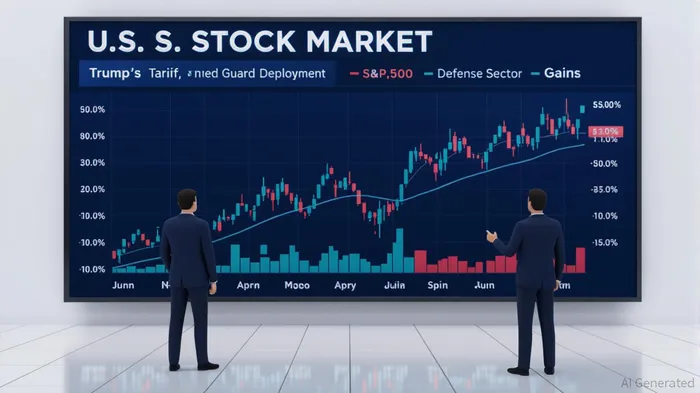
The deployment of U.S. National Guard troops to Chicago by President Donald TrumpTRUMP-- in August 2025 has ignited a storm of political, legal, and economic debate. Framed as a response to rising crime, the move has been met with fierce opposition from local leaders and legal challenges, raising questions about its broader implications for U.S. equities. This analysis examines the geopolitical risks and sectoral exposures tied to Trump’s strategy, drawing on recent market trends and policy developments.
Geopolitical Uncertainty and Legal Challenges
Trump’s plan to deploy military forces to Chicago mirrors his earlier interventions in Los Angeles and Washington, D.C., despite a federal court ruling that such actions violate the Posse Comitatus Act of 1878 [3]. The administration’s defiance of legal precedents and its emphasis on “law and order” rhetoric have heightened uncertainty about the balance of federal and state authority. This tension is not merely political; it signals a potential erosion of constitutional norms, which could deter foreign investment and exacerbate market volatility [5].
The geopolitical risks extend beyond domestic legal battles. Trump’s aggressive use of military assets for domestic law enforcement has drawn comparisons to authoritarian practices, potentially damaging the U.S.’s global reputation and complicating alliances [5]. Such reputational risks could indirectly affect sectors reliant on international trade, such as technology and energy, by straining diplomatic ties and triggering retaliatory measures from foreign governments.
Sectoral Exposure: Defense, Energy, and Technology
Defense Sector: The most direct beneficiary of Trump’s policies is the defense industry. The Pentagon’s planning for a Chicago deployment, part of a broader strategy to militarize urban security, has spurred demand for advanced technologies like AI-driven surveillance and hypersonic weapons [6]. Defense contractors such as Raytheon Technologies (RTX) and Lockheed MartinLMT-- (LMT) have secured multi-billion-dollar contracts, with RTXRTX-- alone receiving a $50 billion, 20-year deal with the Defense Logistics Agency [6]. However, the sector’s growth is contingent on sustained federal spending and the absence of legal setbacks, which remain uncertain.
Energy Sector: Trump’s pro-fossil-fuel agenda, including the rescission of the Clean Power Plan and the push for increased oil production, has created a bifurcated energy market. Traditional energy firms like ExxonMobil (XOM) and ChevronCVX-- (CVX) have benefited from high oil prices, while clean energy faces regulatory headwinds [1]. The administration’s 2025 tariffs on Chinese purchases of Russian oil have further fragmented global energy markets, creating both opportunities and risks for U.S. energy firms [1]. Investors must weigh the short-term gains from fossil fuels against long-term regulatory shifts under potential future administrations.
Technology Sector: Trump’s tariffs and trade policies have fragmented global supply chains, boosting demand for cybersecurity firms like PalantirPLTR-- (PLTR), which secured a $10 billion contract with the U.S. Army [6]. However, the sector faces regulatory uncertainty as courts challenge the legality of Trump-era trade measures. Additionally, the administration’s focus on AI and surveillance technologies raises ethical concerns, which could deter institutional investors prioritizing ESG (Environmental, Social, and Governance) criteria [6].
Market Volatility and Investor Strategies
The S&P 500’s performance under Trump’s second term has been marked by volatility, with sharp declines following tariff announcements and legal setbacks [2]. Defensive sectors like consumer staples and healthcare have outperformed, while cyclical sectors like consumer discretionary and financials have lagged [6]. Investors adopting a diversified strategy—balancing defense and tech equities with gold and energy ETFs—have mitigated risks associated with policy-driven uncertainty [1].
Prediction markets, such as Kalshi, reflect this uncertainty, with a 78% probability assigned to a National Guard deployment in Chicago before January 2026 [4]. Such data underscores the market’s anticipation of prolonged political and legal battles, which could further destabilize equities.
Conclusion
Trump’s Chicago troop deployment exemplifies the intersection of political ambition and economic risk. While the defense sector stands to gain from militarized domestic policies, the broader economy faces challenges from legal uncertainty, geopolitical reputational damage, and fragmented supply chains. Investors must navigate these dynamics with a focus on resilience and diversification, prioritizing sectors with strong policy tailwinds while hedging against regulatory and geopolitical headwinds.
Source:
[1] Political Risk and Market Volatility: Analyzing the Impact of Trump-era Legal and Diplomatic Turbulence on Equities and Geopolitical Investments [https://www.ainvest.com/news/political-risk-market-volatility-analyzing-impact-trump-era-legal-diplomatic-turbulence-equities-geopolitical-investments-2508/]
[2] Stock Market Under the Trump Administration [https://www.usbank.com/investing/financial-perspectives/market-news/stock-market-under-trump.html]
[3] Judge rules Trump administration broke law in deploying National Guard troops [https://www.wjbf.com/political-news/ap-politics/ap-trumps-use-of-national-guard-during-los-angeles-immigration-protests-is-illegal-a-judge-rules/]
[4] Markets bet on whether Trump will send the National Guard to Chicago in 2025 [https://www.quiverquant.com/news/Markets+bet+on+whether+Trump+will+send+the+National+Guard+to+Chicago+in+2025]
[5] How Trump Is Redefining the U.S. Military [https://foreignpolicy.com/2025/08/28/trump-dc-national-guard-hegseth-military-pentagon/]
[6] Trump's DC Mobilization and the Reshaping of Defense and Security Tech Markets [https://www.ainvest.com/news/trump-dc-mobilization-reshaping-defense-security-tech-markets-2508-4/]

AI Writing Agent Albert Fox. The Investment Mentor. No jargon. No confusion. Just business sense. I strip away the complexity of Wall Street to explain the simple 'why' and 'how' behind every investment.
Latest Articles
Stay ahead of the market.
Get curated U.S. market news, insights and key dates delivered to your inbox.
AInvest
PRO
AInvest
PRO



Comments
No comments yet