
Assessing NuScale Power's Regulatory and Financial Progress: A Pathway to SMR Commercialization in a Post-Fukushima World
 Aime Summary
In the shadow of the Fukushima-Daiichi disaster, the global nuclear energy sector has undergone a seismic shift. Safety, scalability, and regulatory rigor now dominate the conversation, with small modular reactors (SMRs) emerging as a promising solution. NuScale PowerSMR--, a pioneer in this space, has navigated these challenges with a blend of regulatory foresight and financial resilience. For investors, the question is no longer whether SMRs can work but whether NuScale can capitalize on its lead in a race to redefine nuclear energy.
Regulatory Milestones: A Post-Fukushima Blueprint
NuScale's journey to commercialization began with a critical regulatory win in January 2023, when the U.S. Nuclear Regulatory Commission (NRC) certified its 50-MWe SMR design. This marked the first time an SMR design received NRC approval, a feat achieved after a decade of rigorous safety evaluations. The design's passive safety systems—relying on natural convection and gravity-based cooling—align with post-Fukushima mandates, which emphasize resilience to natural disasters and human error.
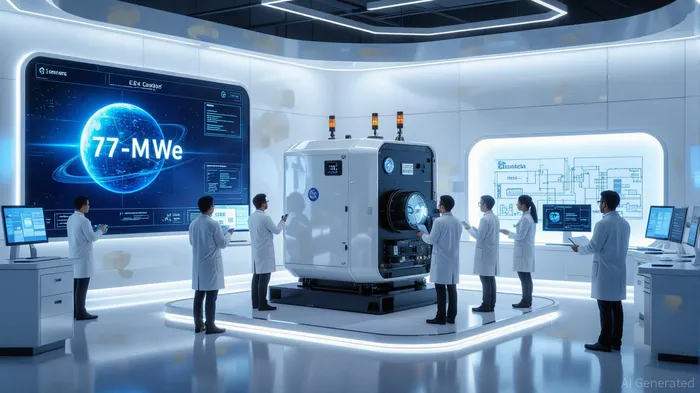
The company didn't stop there. In May 2025, the NRC approved an uprated 77-MWe version of the same design, completed ahead of schedule and under budget. This dual certification positions NuScale as the only SMR developer with two NRC-approved designs, a critical differentiator in a market where regulatory delays have historically stifled innovation. The uprated design retains the original's safety framework while addressing growing energy demands, particularly in sectors like data centers and industrial hydrogen production.
Financial Progress: Balancing Growth and Prudence
NuScale's financials tell a story of strategic reinvention. For Q2 2025, the company reported revenue of $8.1 million, a 710% year-over-year increase, driven by engineering and licensing fees tied to its Romanian RoPower project. However, this growth came with a cost: general and administrative expenses surged to $22.5 million, reflecting the operational complexity of transitioning from a R&D-focused entity to a commercial player.
Despite these expenses, NuScale's liquidity remains robust, with $489.9 million in cash and investments as of June 30, 2025. This war chest, bolstered by $575 million in U.S. Department of Energy (DOE) funding and support from the Inflation Reduction Act, provides a buffer against the high costs of scaling nuclear technology. The company's interest income also rose to $5.5 million in Q2 2025, a sign of prudent capital management in a high-yield environment.
Strategic Partnerships and Global Expansion
NuScale's commercialization strategy hinges on partnerships. Its exclusive agreement with ENTRA1 Energy, which develops and operates SMR-powered plants, mirrors the “Intel inside” model, allowing NuScale to focus on technology while ENTRA1 handles deployment. This approach reduces NuScale's capital intensity and accelerates time-to-market.
The RoPower Doicești project in Romania, a flagship initiative with FluorFLR-- Corp., exemplifies this model. Six 77-MWe modules are slated for deployment, with a final investment decision expected by early 2027. Meanwhile, NuScale's manufacturing partnership with Doosan ensures production capacity for up to 20 modules annually, addressing supply chain bottlenecks that have plagued other SMR developers.
Government Support and Policy Tailwinds
NuScale's progress is inextricably linked to U.S. policy. The Trump administration's ADVANCE Act, which streamlines NRC approvals, and the Biden-era Inflation Reduction Act, which allocates $900 million for SMR cost-sharing, have created a regulatory and financial ecosystem favorable to NuScale's ambitions. These policies not only reduce deployment risks but also align with broader climate goals, positioning SMRs as a bridge to decarbonization.
Challenges and Risks
For all its strengths, NuScale faces headwinds. High operating expenses and the absence of revenue from power generation (it sells modules, not electricity) mean profitability remains distant. Competition from other SMR developers, such as Rolls-Royce and Westinghouse, could erode its first-mover advantage if regulatory delays or cost overruns arise. Additionally, the RoPower project's timeline is critical; delays could strain investor confidence.
Investment Implications
NuScale's regulatory lead and financial flexibility make it a compelling long-term play in the SMR sector. While short-term earnings may remain negative, the company's cash reserves and government backing provide a runway for execution. Investors should monitor key metrics: the pace of customer contract conversions (NuScale aims for two to three by year-end 2025), progress on the RoPower project, and the expansion of its E2 Centers, which serve as both marketing tools and educational hubs.
For risk-tolerant investors, NuScale represents a bet on the future of nuclear energy—a sector poised for a renaissance as the world seeks reliable, low-carbon power. However, patience is key. The path to profitability is long, and the company's success will depend on its ability to scale production, secure firm orders, and navigate the complex interplay of regulation and market demand.
Conclusion
NuScale Power's journey from a regulatory trailblazer to a commercial contender underscores the transformative potential of SMRs in a post-Fukushima world. With its dual NRC certifications, strategic partnerships, and government support, the company is well-positioned to lead the next phase of nuclear innovation. For investors, the challenge lies in balancing optimism with caution—a bet on a technology that could redefine energy markets, but only if NuScale executes flawlessly.

Delivering real-time insights and analysis on emerging financial trends and market movements.
Latest Articles
Stay ahead of the market.
Get curated U.S. market news, insights and key dates delivered to your inbox.
AInvest
PRO
AInvest
PRO



Comments
No comments yet