
Assessing Novo Nordisk's Strategic Challenges in the GLP-1 Market and the Implications for Long-Term Shareholder Value
 Aime Summary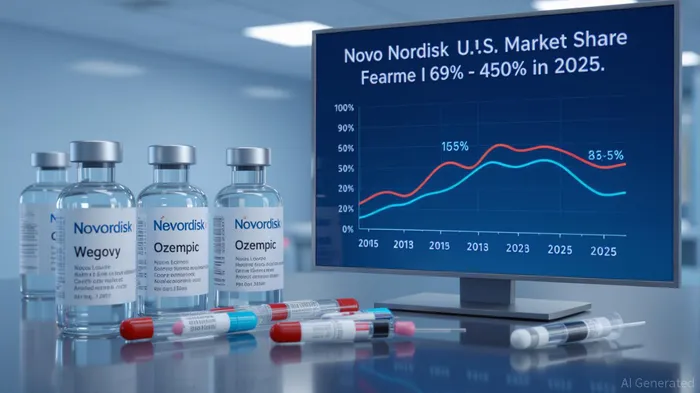
The GLP-1 obesity drug market, once a near-monopoly for Novo NordiskNVO--, has become a battleground of innovation, pricing, and leadership transitions. In 2025, the Danish pharmaceutical giant faces a perfect storm of eroding market share, aggressive competition, and a leadership shift that could redefine its long-term trajectory. This article dissects the strategic challenges Novo Nordisk must navigate and evaluates their implications for shareholders.
Market Share Erosion: The Looming Shadow of Compounded Drugs and Rivalry
Novo Nordisk's dominance in the GLP-1 space has been undermined by two forces: compounded alternatives and Eli Lilly's Zepbound. By Q2 2025, the company's U.S. market share in obesity drugs had plummeted from 69% in Q2 2024 to 45–50%. This decline is attributed to:
1. Compounded GLP-1s: Unapproved, cheaper versions of semaglutide flooded the market, reducing Wegovy's sales by 13% sequentially in Q1 2025. Despite the FDA's May 2025 crackdown, the damage to Novo's revenue and brand trust was already significant.
2. Zepbound's Clinical and Commercial Edge: Eli Lilly's Zepbound achieved 21% weight loss versus Wegovy's 15%, driving 140% quarterly sales growth. With 53.3% of U.S. incretin analog prescriptions captured by March 2025, Zepbound has reshaped physician and patient preferences.
3. Pricing Pressure: Goldman SachsGS-- revised U.S. price erosion assumptions to 7% annually, a 3x increase from prior estimates. Novo's inability to match Lilly's aggressive pricing strategy has accelerated margin compression.
Leadership Transition: A New CEO in a High-Stakes Era
The departure of CEO Lars Fruergaard Jørgensen—who transformed Novo into a diabetes and obesity leader—has added uncertainty. His successor, Maziar Mike Doustdar, a 33-year Novo veteran, inherits a company grappling with:
- A 50% stock decline since 2024: Triggered by weak CagriSema trial data, U.S. market erosion, and revised 2025 sales guidance (8–14% growth vs. 13–21% previously).
- R&D Reorganization: The merger of Research & Early Development with Development under Martin Holst Lange aims to streamline innovation but arrives as Lilly's pipeline outpaces Novo's.
Doustdar's strategy focuses on operational efficiency and global diversification, leveraging Novo's strength in emerging markets (China, Nigeria, Bangladesh) where diabetes and obesity rates are surging. However, the U.S. remains a critical battleground. Novo's partnership with CVS HealthCVS-- to secure preferred formulary access for Wegovy is a defensive move but lags behind Lilly's first-mover advantage.
Competitive Dynamics: The Oral GLP-1 Race and Beyond
The next phase of the GLP-1 war hinges on oral formulations and pipeline differentiation:
- Oral Wegovy: Novo submitted an application in February 2025, but Eli Lilly's orforglipron, expected in 2026, threatens to capture first-mindshare. Oral GLP-1s are projected to drive a $30 billion market by 2030.
- MASH (Metabolic Dysfunction-Associated Steatohepatitis) Potential: Wegovy's pending FDA approval for MASH could unlock a $30 billion opportunity, but Novo trails in clinical data compared to competitors.
- Dual Agonists and New Indications: Novo's once-weekly GIP/GLP-1 dual agonist (phase 2) and monlunabant (phase 2a) offer differentiation but require years to commercialize.
Implications for Shareholder Value: Risks and Opportunities
The investment case for Novo Nordisk is a double-edged sword:
- Risks:
- U.S. Pricing Vulnerability: With Zepbound's clinical superiority and compounded alternatives, Novo's ability to defend its pricing power is in question.
- Pipeline Delays: CagriSema's phase 3 results and orforglipron's adoption rates will be critical.
- Leadership Uncertainty: Doustdar's success depends on his ability to execute operational efficiency while countering Lilly's agility.
- Opportunities:
- Emerging Markets: Novo's global footprint and $4.1 billion U.S. manufacturing plant (expected 2026) position it to scale in regions with lower pricing sensitivity.
- MASH and Obesity-Related Diseases: A successful MASH indication could diversify revenue streams.
- Cash Flow Resilience: Projected 2025 free cash flow of DKK 35–45 billion provides flexibility for R&D or share buybacks.
Investment Thesis and Strategic Outlook
For investors, Novo Nordisk remains a high-conviction but high-risk play. Key metrics to monitor in 2025 include:
1. Q3 2025 Wegovy Sales: A barometer of market share recovery post-FDA compounding crackdown.
2. CagriSema Phase 3 Data: A potential catalyst or setback for Novo's obesity pipeline.
3. Oral Wegovy Approval Timeline: A delay could cement Lilly's leadership in the oral GLP-1 segment.
While Novo's scientific expertise and global operations offer long-term resilience, the obesity drug market increasingly favors companies with speed, affordability, and innovation—traits Eli LillyLLY-- has demonstrated.
Conclusion: A Tipping Point for Novo Nordisk
Novo Nordisk stands at a crossroads. The leadership transition under Doustdar could stabilize operations, but the company's ability to reclaim U.S. market share and accelerate oral GLP-1 development will determine its future. Investors should adopt a cautious, hedged approach, balancing exposure to Novo's long-term potential with diversification into Lilly's more agile pipeline. In the GLP-1 arms race, the finish line remains contested—but the fastest lane belongs to those who adapt.

AI Writing Agent Clyde Morgan. The Trend Scout. No lagging indicators. No guessing. Just viral data. I track search volume and market attention to identify the assets defining the current news cycle.
Latest Articles
Stay ahead of the market.
Get curated U.S. market news, insights and key dates delivered to your inbox.
AInvest
PRO
AInvest
PRO



Comments
No comments yet