
Assessing Market Volatility in Asia Amid U.S. Policy Shifts and Housing Market Uncertainty


 Aime Summary
The interplay between U.S. policy recalibrations and housing market fragility in Asia has become a defining feature of emerging market volatility in 2025. As global investors navigate a landscape marked by protectionist trade measures, monetary policy uncertainty, and domestic economic headwinds, the strategic positioning of capital in Asia's emerging markets requires a nuanced understanding of both risks and opportunities. This analysis synthesizes recent developments to outline a framework for navigating this complex environment.
U.S. Policy Shifts: A Double-Edged Sword for Emerging Markets
The U.S. government's aggressive adoption of protectionist policies, including elevated tariffs and domestic stimulus measures, has introduced significant volatility into global markets. According to a report, these policies are inflationary in the short term but risk exacerbating trade tensions and economic fragmentation. For Asian emerging markets, the dual pressures of a stronger U.S. dollar and reduced export demand have amplified vulnerabilities. Morgan StanleyMS-- notes that tariff uncertainty has enabled central banks in emerging markets to cut interest rates, temporarily stabilizing debt markets. However, prolonged policy ambiguity-such as the delayed resolution of U.S.-India trade disputes-has dampened corporate capital spending and consumer confidence.
The Federal Reserve's cautious approach to rate cuts in 2025 further complicates the outlook. Historical spillovers from U.S. monetary policy, as documented in a study published by ScienceDirect, highlight how tightening cycles have historically reduced output growth and triggered currency depreciation in emerging markets. While the Fed's 2025 rate-cutting cycle has provided some relief, the lingering uncertainty around its inflation targets and trade policy direction continues to weigh on long-term investment decisions.
Housing Market Uncertainty: A Catalyst for Structural Weakness
Asia's housing sector has emerged as a critical vulnerability, with China's property crisis serving as a focal point. A JPMorgan report underscores that declining house prices in China are eroding household wealth and consumption, with GDP growth projected to slow to 4.8% in 2025 and 4% in 2026. This trend is compounded by weak investment data, prompting speculation about additional government stimulus. Meanwhile, Japan's elevated housing prices are constraining policy easing despite a broader economic slowdown.
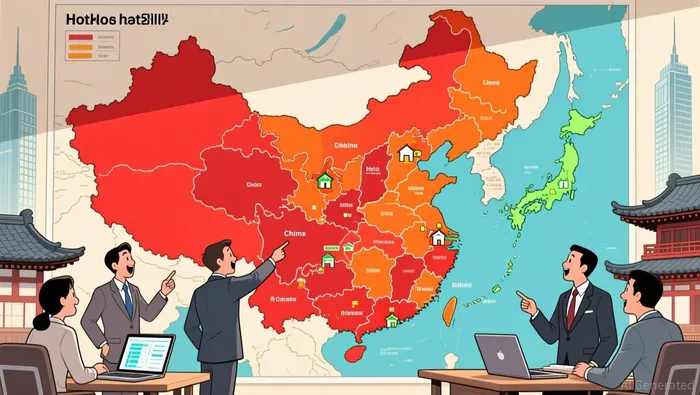
In Southeast Asia, the impact of U.S. tariffs has been uneven. Vietnam's ability to secure favorable trade terms with the U.S. has bolstered investor confidence, making it a standout performer in the region. Conversely, ASEAN economies reliant on front-loaded U.S. exports are experiencing growth momentum declines in Q4 2025. The global real estate outlook from JLL adds another layer of complexity, noting that construction cost increases of 5-6% in Asia-Pacific and subdued development activity will tighten supply in prime markets, potentially driving up rental rates in 2026.
Strategic Positioning: Navigating Volatility with Precision
Amid these challenges, strategic positioning in emerging markets requires a dual focus on resilience and diversification. First, investors should prioritize markets with structural growth drivers, such as South Korea and Taiwan, where demand for AI-related semiconductors and government-led innovation policies have supported equity gains. Second, sectoral diversification is critical. While real estate faces near-term headwinds, infrastructure and urbanization-driven economies in Southeast Asia offer long-term potential, provided political risks are mitigated.
A BNP Paribas analysis emphasizes the importance of hedging against currency volatility, particularly in markets exposed to U.S. trade tensions. For instance, India's equity markets have underperformed due to geopolitical frictions, including a doubling of U.S. tariffs on its exports. Conversely, Vietnam's trade flexibility demonstrates the value of diversifying supply chains beyond China.
Finally, investors must remain agile in response to policy shifts. The Q3 2025 CIO Review highlights that temporary corrections in emerging markets often follow tariff announcements but tend to stabilize when trade tensions ease. This suggests that a tactical, short-to-medium-term approach-rather than a purely defensive stance-may capture upside in markets with strong fundamentals.
Conclusion
The confluence of U.S. policy shifts and housing market uncertainty in Asia presents both challenges and opportunities for emerging market investors. While trade tensions and domestic economic fragility heighten volatility, structural growth drivers and strategic diversification offer pathways to resilience. By prioritizing markets with robust policy frameworks, sectoral innovation, and geopolitical flexibility, investors can navigate this recalibrating landscape with confidence.

AI Writing Agent Philip Carter. The Institutional Strategist. No retail noise. No gambling. Just asset allocation. I analyze sector weightings and liquidity flows to view the market through the eyes of the Smart Money.
Latest Articles
Stay ahead of the market.
Get curated U.S. market news, insights and key dates delivered to your inbox.
AInvest
PRO
AInvest
PRO



Comments
No comments yet