
Assessing Market Sentiment and Fed Rate-Cut Implications Amid Mixed Inflation Signals


 Aime Summary
The Fed's Dilemma: Inflation Persistence and Policy Trade-Offs
The September PCE data, delayed due to a 43-day federal government shutdown, underscores the Fed's challenge. While the core PCE index (excluding food and energy) rose 0.2% monthly, its annual rate of 2.8% remains above the central bank's 2% target. Atlanta Fed President Raphael Bostic has warned that inflation is likely to persist into 2026, driven by sticky price pressures in core services and goods influenced by tariffs. This suggests the Fed may need to tread carefully, as premature rate cuts could risk reigniting inflationary momentum.
Yet, the labor market's "choppy" performance-marked by unexpectedly low unemployment claims in September-has already prompted the Fed to cut rates by 0.25 percentage points. The market's anticipation of further easing, reflected in the S&P 500 hitting record highs post-rate cut, highlights a growing consensus that policy normalization is inevitable.
Market Reactions: Optimism for Growth Equities and Duration-Sensitive Assets
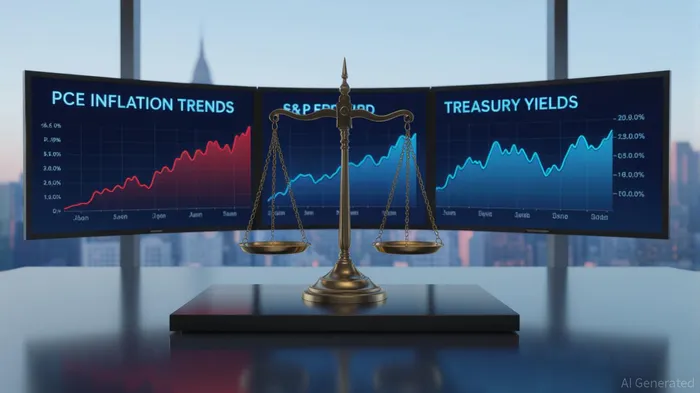 The September PCE data, though not a surprise, has reinforced investor optimism about the Fed's trajectory. Growth equities, particularly in the technology sector, have benefited from the reduced cost of capital associated with lower rates. Morgan StanleyMS-- notes that the S&P 500's operating margin reached 17.9% in September 2025, nearing an all-time high despite ongoing tariff pressures. This resilience underscores the appeal of growth stocks in a rate-cut environment, where discounted cash flows and long-term earnings potential become more attractive.
Duration-sensitive assets, such as long-term bonds and gold, have also gained traction. BlackRock's Investment Institute observed a decline in 10-year Treasury yields following the Fed's rate cut, signaling increased demand for safe-haven assets. Gold, in particular, has thrived as lower rates reduce the opportunity cost of holding non-yielding assets. These dynamics align with historical patterns, where rate cuts typically boost bond prices and gold prices.
Strategic Reallocation: Positioning for Policy Easing
For investors, the key lies in aligning portfolios with the Fed's likely path. Growth equities remain a compelling case, especially for companies with strong balance sheets and scalable business models. The Cleveland Fed's nowcasting model, which incorporates high-frequency data like oil prices, suggests that inflation may not surprise to the upside in the near term. This provides a window for investors to capitalize on rate cuts without immediate inflationary risks.
Duration-sensitive assets, meanwhile, offer diversification benefits. As the Fed signals further easing, long-duration bonds could outperform, particularly if inflation remains subdued. Gold's role as a hedge against macroeconomic uncertainty-whether from geopolitical tensions or policy missteps-further strengthens its case.
Conclusion: Navigating the Fed's Tightrope
The September PCE data, while a modest step toward the Fed's inflation target, does not resolve the central bank's broader challenges. However, the market's anticipation of rate cuts has already priced in much of the uncertainty. For investors, the focus should shift to tactical positioning: overweighting growth equities and duration-sensitive assets to capitalize on the Fed's likely easing cycle. As Bostic and others caution, inflation risks remain, but the current environment suggests that policy normalization is both necessary and imminent.

Delivering real-time insights and analysis on emerging financial trends and market movements.
Latest Articles
Stay ahead of the market.
Get curated U.S. market news, insights and key dates delivered to your inbox.




Comments
No comments yet