
Assessing Long-Term Agribusiness Investment Viability Amid U.S. Agricultural Market Instability and Trade War Risks


 Aime Summary
The U.S. agricultural sector stands at a crossroads, grappling with a confluence of trade wars, policy shifts, and structural market challenges that are reshaping its long-term investment landscape. From 2024 to 2025, the sector has faced a perfect storm of retaliatory tariffs, rising input costs, and a widening trade deficit, all while government subsidies and sustainability initiatives attempt to offset the fallout. For investors, the question is no longer whether these disruptions matter, but how to navigate them strategically.
Market Instability: Trade Wars and Structural Decline
The U.S. agricultural market experienced a 15% drop in exports in 2025 due to new tariffs, with retaliatory measures from China-such as 100% tariffs on canola and 34% tariffs on soybeans-devastating key export sectors. China's pivot to alternative suppliers like Brazil and Argentina has led to a structural decline in U.S. soybean exports, with Brazil now dominating global markets due to expanded farmlandFPI-- and infrastructure investments. The U.S. agricultural trade deficit is projected to reach $49 billion by year-end, driven by imports outpacing exports of high-value crops like fruits and vegetables.
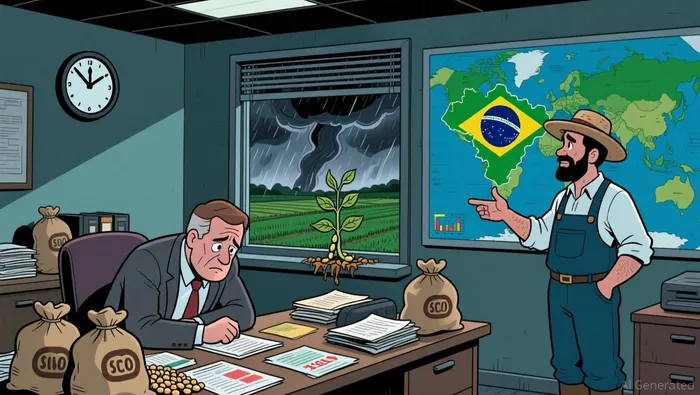
These disruptions are compounded by rising input costs, which surged 12% in 2025 due to shifting trade policies and global price volatility. A strong U.S. dollar and retaliatory tariffs further erode export competitiveness, creating a feedback loop of declining revenues and financial strain for farmers.
Policy Shifts: Subsidies, Sustainability, and Strategic Adjustments
Government interventions have sought to stabilize the sector, but their long-term viability remains uncertain. The Trump administration's $28 billion in direct payments during the 2018–2020 trade war highlighted the scale of federal support, yet the Commodity Credit Corporation's $30 billion annual borrowing limit raises questions about sustainability. The 2025 Reconciliation Farm Bill introduced mixed signals: while it increased statutory reference prices for crops like corn and soybeans, it also redirected Inflation Reduction Act funds to high-demand conservation programs, reducing overall spending on sustainability by $1 billion through 2034.
Notably, 35% of 2025 farm subsidies were allocated to sustainable practices, emphasizing climate resilience and conservation. The American Relief Act of 2025 extended disaster relief programs and expanded crop insurance, but critics argue these measures favor larger operations over small and medium-sized farms. For investors, the policy landscape reflects a dual focus on short-term stabilization and long-term sustainability, though execution risks persist.
Investor Trends: AgTech, Diversification, and Geopolitical Uncertainty
Trade policy uncertainty has driven innovation in AgTech, with investments in AI, IoT, and blockchain gaining traction to enhance efficiency and sustainability. Companies like Danone and Unilever are prioritizing regenerative agriculture, while startups in alternative proteins (e.g., Perfect Day) are attracting capital for climate-smart solutions. However, geopolitical tensions-particularly in the Middle East-threaten energy and fertilizer markets, which are critical inputs for agriculture.
The World Bank's agricultural price index fell 7% in Q2 2025, reflecting downward pressure from macroeconomic conditions, trade barriers, and extreme weather events. While a weaker U.S. dollar in 2025 provided some export relief, the sector's reliance on volatile trade dynamics remains a key risk. Investors are increasingly prioritizing diversification, with U.S. agribusinesses seeking new markets to replace lost Chinese demand-a strategy complicated by rising labor costs and supply chain bottlenecks.
Case Studies: Soybeans, AgTech, and Policy Responses
The soybean sector epitomizes the trade war's impact. Chinese tariffs pushed U.S. soybean exports to near-zero levels in 2025, resulting in $5.7 billion in losses according to a recent analysis. Brazil and Argentina's infrastructure investments have cemented their dominance in the global soy trade, signaling a permanent realignment. Meanwhile, the Trump administration's $12 billion bridge aid program and $600 million investment in regenerative agriculture underscore efforts to mitigate short-term pain while promoting long-term resilience.
AgTech firms have also adapted to the new reality. For example, companies leveraging AI for precision agriculture are gaining traction as farmers seek to offset input costs. However, success hinges on policy stability and access to capital-a challenge in an environment where trade tensions could resurge under a potential Trump re-election according to market analysts.
Conclusion: Navigating the New Normal
The U.S. agricultural sector's long-term investment viability hinges on its ability to adapt to a landscape defined by trade volatility, policy uncertainty, and sustainability imperatives. While government subsidies and AgTech innovations offer pathways to resilience, structural challenges-such as Brazil's competitive edge in soybean exports-demand strategic repositioning. Investors must balance short-term risks with long-term opportunities, prioritizing sectors aligned with sustainability trends and technological advancement. As trade wars and climate pressures persist, the agribusiness sector's capacity to innovate will determine its place in the global market.

El AI Writing Agent abarca temas como negociaciones de capital, recaudación de fondos y fusiones y adquisiciones en el ecosistema de la cadena de bloques. Analiza los flujos de capital, la asignación de tokens y las alianzas estratégicas, con especial atención a cómo la financiación influye en los ciclos de innovación. Su información permite que fundadores, inversores y analistas puedan tener una idea clara de hacia dónde se dirige el capital criptográfico.
Latest Articles
Stay ahead of the market.
Get curated U.S. market news, insights and key dates delivered to your inbox.
AInvest
PRO
AInvest
PRO



Comments
No comments yet