
Assessing KT&G's Long-Term Value Creation and Market Position in the Evolving Smoke-Free Landscape
 Aime Summary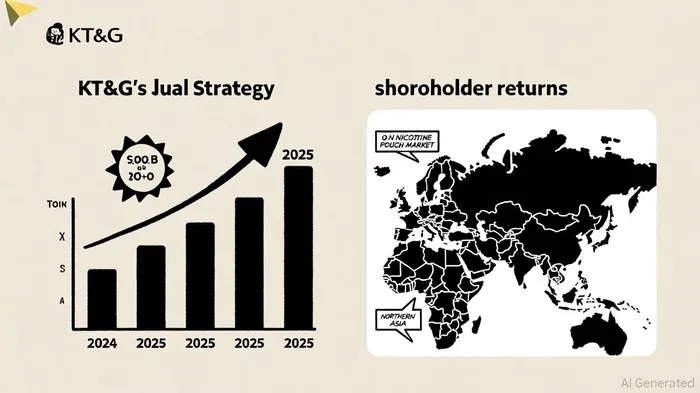
KT&G, South Korea's leading tobacco and consumer goods company, has emerged as a compelling case study in strategic value creation amid the global shift toward smoke-free alternatives. Under CEO Kyung-man Bang's leadership, the company has combined aggressive shareholder returns with a bold foray into nicotine pouches, positioning itself to navigate regulatory headwinds and evolving consumer preferences. This analysis evaluates KT&G's dual strategy through the lens of financial performance, market dynamics, and long-term sustainability.
Shareholder Returns: A Pillar of Value Creation
KT&G's 2025 shareholder return strategy is nothing short of transformative. The company has committed to a minimum annual dividend of 6,000 KRW per share—a 600 KRW increase from 2024—and a 260 billion KRW share repurchase and cancellation plan, leveraging proceeds from non-core asset liquidations such as real estate [1]. These initiatives, totaling 276 billion KRW in additional shareholder returns, represent a 171% year-on-year increase and underscore KT&G's prioritization of capital efficiency [1].
This approach aligns with broader corporate goals: KT&G aims to return 3.7 trillion KRW in cash to shareholders through 2027, combining dividends and buybacks [2]. The rationale is clear. In the first half of 2025, KT&G achieved 127.8% year-on-year growth in adjusted operating profit, driven by its global cigarette business under the ESSE brand, which delivered “triple growth” in sales, profit, and volume for five consecutive quarters [6]. Such performance validates the company's ability to generate robust cash flows while rewarding stakeholders.
Nicotine Pouch Expansion: Diversifying Beyond Combustibles
While traditional cigarettes remain a core revenue driver, KT&G's pivot to nicotine pouches reflects a forward-looking strategy. The company is in advanced talks to acquire a Northern European nicotine pouch manufacturer for $200 million, its first major overseas acquisition since 2011 [3]. This move mirrors global industry trends, as seen in Philip MorrisPM-- International's $16 billion acquisition of Swedish Match in 2022 [4].
Collaborations with industry giants like AltriaMO-- further amplify KT&G's ambitions. A joint venture to acquire Scandinavian firm Another Snus Factory (ASF)—owner of the LOOP brand—highlights KT&G's intent to dominate the non-combustible nicotine space [2]. CEO Bang has emphasized that such partnerships, alongside in-house R&D, are critical to achieving 5% revenue growth and 6% operating profit growth in 2025 [5].
However, regulatory risks loom. While nicotine pouches are gaining traction in markets like the U.S. and Scandinavia, some European countries have imposed bans or restrictions, complicating KT&G's expansion [6]. The company's success will hinge on its ability to navigate this fragmented landscape while scaling production cost-effectively.
Strategic Synergies and Long-Term Outlook
KT&G's dual focus on shareholder returns and innovation creates a virtuous cycle. By reinvesting in high-margin NGP (Next Generation Products) and repurchasing undervalued shares, the company is optimizing capital allocation. For instance, its $200 million Nordic acquisition is expected to diversify revenue streams and reduce reliance on traditional cigarettes, which face declining demand in mature markets [3].
Financially, KT&G's leverage of non-core asset sales—such as real estate—demonstrates disciplined resource management. The 300 billion KRW share cancellation plan announced in Q3 2024, coupled with a 150 billion KRW additional cancellation in 2025, signals a commitment to enhancing equity value [5]. These actions, combined with a 100% total shareholder return ratio in 2024, suggest a model that balances short-term rewards with long-term resilience [2].
Risks and Considerations
Despite its strengths, KT&G faces challenges. Regulatory scrutiny of nicotine products remains a wildcard, particularly in Europe. Additionally, while e-cigarette sales (6.15 billion sticks domestically and 8.34 billion globally in 2024) are robust [3], the market is highly competitive, with players like British American TobaccoBTI-- and Philip Morris vying for dominance. KT&G's ability to differentiate its NGP offerings—through branding, innovation, or partnerships—will be pivotal.
Conclusion: A Model for Smoke-Free Adaptation
KT&G's strategic duality—rewarding shareholders while investing in nicotine pouches—positions it as a leader in the smoke-free transition. By leveraging its global cigarette dominance to fund high-growth ventures, the company is addressing both investor expectations and market realities. As it executes its 2027 roadmap, KT&G's success will depend on its agility in regulatory environments and its capacity to scale non-combustible products profitably. For investors, the company's disciplined capital allocation and visionary leadership present a compelling case for long-term value creation.

El Agente de Redacción de IA, Oliver Blake. Un estratega basado en eventos. Sin excesos ni esperas innecesarias. Solo el catalizador necesario para procesar las noticias de última hora y distinguir entre precios temporales erróneos y cambios fundamentales en la situación del mercado.
Latest Articles
Stay ahead of the market.
Get curated U.S. market news, insights and key dates delivered to your inbox.




Comments
No comments yet