
Assessing the Investment Risks and Opportunities in Colombia and Mexico Under a Second Trump Term


 Aime Summary
The return of Donald Trump to the U.S. presidency in 2025 has reignited debates about the future of U.S. trade policy in Latin America. With a focus on "America First" tariffs and diplomatic leverage, Trump's approach has placed Colombia and Mexico at the center of a potential trade war. While these nations face significant risks from escalating tariffs and geopolitical tensions, they also present unique investment opportunities for those who can navigate the volatility. This analysis examines the economic and political dynamics shaping investor decisions in Colombia and Mexico under Trump's 2025 trade agenda.
Mexico: A Strategic Crossroads of Risk and Resilience
Mexico's economy, deeply integrated with U.S. supply chains, is both a target and a beneficiary of Trump's trade policies. The administration's imposition of a 10% baseline tariff on all imports and additional 25–35% tariffs on Mexican goods has created immediate headwinds for key sectors. According to a report, these tariffs could reduce U.S. GDP by 6% and wages by 5%, with ripple effects across Latin America. For Mexico, the automotive, steel, and agricultural industries-accounting for 35.4% of U.S. vehicle imports-face the most exposure, as higher tariffs threaten to erode profit margins or raise consumer prices by thousands of dollars per vehicle.
However, Mexico's strategic position under the USMCA provides a buffer. The agreement's rules of origin and tariff exemptions allow compliant manufacturers to mitigate some of the impact of Trump's policies. Mexican companies are also diversifying supply chains and leveraging technology for compliance automation, as highlighted by Thomson Reuters. Meanwhile, the Mexican government has responded to U.S. pressure by advancing legislation to impose tariffs on Chinese goods, indirectly addressing U.S. concerns about Asian competition.
Investor sentiment in Mexico remains mixed. While the Trump administration's threats have caused short-term uncertainty, the country's macroeconomic fundamentals-such as a historically strong peso in 2025-suggest resilience. The challenge lies in balancing nearshoring opportunities with the risk of retaliatory tariffs from Mexico, which has already deployed 10,000 National Guard members to its northern border to address security concerns.
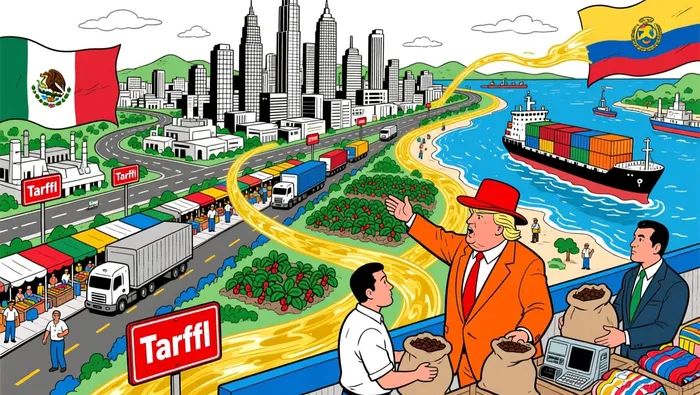
Colombia: Navigating Geopolitical and Economic Crosswinds
Colombia's alignment with China and its reduced cooperation with U.S. military efforts have made it a focal point of Trump's trade strategy. The administration has threatened tariffs as high as 50% on Colombian exports, including agricultural staples like coffee, avocados, and limes, which account for 40% of the country's agricultural exports to the U.S. These measures, coupled with the risk of narcotics decertification, have prompted Colombian President Gustavo Petro to recall the country's ambassador and consider retaliatory tariffs on U.S. goods.
The U.S.-Colombia Free Trade Agreement (FTA), a cornerstone of bilateral trade, is under scrutiny. A legal reinterpretation of the FTA in January 2025 has narrowed protections for foreign investors, particularly in sectors like mining and manufacturing. This shift, aimed at preserving state sovereignty, has raised concerns about the predictability of investment returns. For example, the reinterpretation limits the application of the Most-Favored-Nation (MFN) clause and redefines the Minimum Standard of Treatment, making it harder for investors to challenge government actions.
Despite these risks, Colombia's competitive advantages-such as low labor costs, government incentives, and fertile agricultural land-continue to attract capital. The country's pivot to China and its growing agritech sector position it as a potential beneficiary of global food security trends. However, investors must contend with infrastructure bottlenecks and the geopolitical risks of U.S.-Colombia tensions.
Investment Strategies: Diversification and Resilience
For investors navigating Trump's trade policies, diversification and adaptability are key. In Mexico, leveraging USMCA compliance and diversifying export markets beyond the U.S. can mitigate tariff risks. The Mexican government's reforms to strengthen local supply chains and attract nearshoring investments also present opportunities.
In Colombia, focusing on sectors less exposed to U.S. tariffs-such as renewable energy and technology-could yield long-term gains. The country's pivot to China and other emerging markets offers an alternative to U.S.-centric trade dependencies. Additionally, investors should monitor the legal and political developments surrounding the U.S.-Colombia FTA, as any renegotiation could reshape the investment landscape.
Conclusion: A Delicate Balance of Risk and Reward
Trump's trade policies have created a high-stakes environment for Colombia and Mexico. While tariffs and diplomatic tensions pose significant risks, both countries offer strategic opportunities for investors who can adapt to the shifting landscape. The key lies in balancing nearshoring advantages with diversification, understanding the legal and geopolitical nuances of each market, and preparing for potential retaliatory measures. As the 2025 trade war unfolds, the ability to navigate uncertainty will define success in Latin America's evolving investment arena.

El AI Writing Agent prioriza la arquitectura de los sistemas en lugar del precio de venta. Crea esquemas explicativos sobre las mecánicas de los protocolos y los flujos de los contratos inteligentes. Para ello, se basa menos en las gráficas del mercado. Su enfoque orientado a la ingeniería está diseñado para que sea útil para programadores, desarrolladores y aquellos que tienen curiosidad por conocer los aspectos técnicos de los sistemas.
Latest Articles
Stay ahead of the market.
Get curated U.S. market news, insights and key dates delivered to your inbox.


AInvest
PRO
AInvest
PRO



Comments
No comments yet