
Assessing Investment Opportunities in Turkey’s Post-Earthquake Reconstruction and Public Infrastructure Sectors
 Aime Summary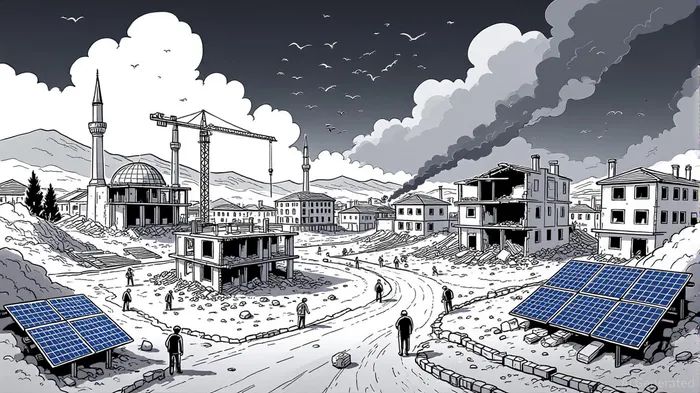
The February 2023 earthquakes in Turkey, which claimed over 40,000 lives and caused $84 billion in economic losses [2], have catalyzed one of the most ambitious reconstruction efforts in the country’s history. As the government shifts from immediate relief to long-term resilience, the allocation of resources and the role of private capital will determine the success of this transformation. For investors, the interplay of public spending, international aid, and policy incentives presents both opportunities and risks in sectors ranging from housing to energy.
Budget Allocation and the Road to Resilience
Turkey’s 2025 budget allocates 584 billion lira ($17.05 billion) for earthquake-related spending, a decline from 3.6% of GDP in 2023 to 0.9% in 2025 [1]. This reduction reflects the government’s assertion that most immediate recovery funds have been deployed. However, a broader $90 billion investment strategy over 5–10 years underscores a commitment to long-term infrastructure resilience, including retrofitting buildings, updating codes, and modernizing early-warning systems [1]. In Istanbul, urban transformation projects like the Istanbul Seismic Risk Mitigation Project (ISMEP) have already retrofitted 1,643 public buildings and expanded emergency shelter capacity to 2 million people [2]. Yet, the Istanbul Metropolitan Municipality’s underperformance in allocating funds—only 3.7 billion lira of a 415 billion lira 2025 budget directed to urban transformation—highlights implementation challenges [2].
International and Private Sector Partnerships
International funding has been critical. The World Bank has pledged $2.65 billion across multiple initiatives, including $500 million to create 17,000 jobs in affected regions [2]. The European Bank for Reconstruction and Development (EBRD) has launched a €1.5 billion package, including a $150 million loan to Enerjisa Enerji for modernizing electricity grids and installing solar power in the Toroslar region [3]. Similarly, the EBRD’s €195 million investment in water and sanitation infrastructure in Adiyaman and Hatay aligns with climate resilience goals [3].
Private sector participation has also surged. The World Bank and Turkish institutions like KOSGEB provided $750 million to 87,000 micro, small, and medium enterprises (MSMEs), preserving 115,000 jobs [4]. The government has introduced incentives such as tax breaks, reduced loan rates, and streamlined permitting for businesses in 11 earthquake-affected provinces [5]. These measures aim to attract foreign direct investment (FDI) in construction, energy, and agriculture, sectors projected to drive growth as rebuilding accelerates.
Investment Opportunities and Risks
The construction sector, now contributing 7.4% annual GDP growth in Q1 2025, is a prime target for investors. Over 453,000 housing units and workplaces are expected to be completed by year-end, supported by Law 7471, which expedites permits [5]. However, high-interest rates (43%) and inflation pose risks. The World Bank Group’s Country Partnership Framework (2024–2028) emphasizes mobilizing private capital for climate-smart agriculture and industrial greening, offering a framework for sustainable investments [5].
Energy and water infrastructure also present opportunities. The EBRD’s solar and sanitation projects demonstrate how green investments can align with resilience goals. Meanwhile, UNESCO’s $729,927 initiative to retrofit school buildings, funded by Japan, illustrates the potential for niche, high-impact projects [3].
Challenges and the Path Forward
Despite these opportunities, coordination gaps and fiscal constraints remain. The government’s revised 2025–2027 Medium-Term Program (MTP) reflects a cautious approach to inflation and growth, while the Afet Yeniden Imar Fonu (Disaster Reconstruction Fund) aims to ensure transparent long-term financing [5]. For investors, success will depend on navigating regulatory complexity and aligning with public-private partnerships that prioritize resilience.
Conclusion
Turkey’s post-earthquake recovery is a test of its ability to balance urgent needs with long-term resilience. While the government’s budgetary focus is shifting, international and private capital are stepping in to fill gaps. Investors who prioritize sectors like renewable energy, resilient housing, and climate-smart infrastructure may find Turkey’s reconstruction efforts not only a moral imperative but a compelling economic opportunity.
Source:
[1] Turkey to spend less on earthquake relief and rebuilding next year - vice president says, https://www.reuters.com/world/middle-east/turkey-spend-less-earthquake-relief-rebuilding-next-year-vice-president-says-2024-10-23/
[2] The Economic Aftermath of the February 6th Earthquake in Türkiye, https://foreignpolicy.org.tr/the-economic-aftermath-of-the-february-6th-earthquake-in-turkiye-gulsum-akbulut/
[3] EBRD supports green power in earthquake-affected region of Türkiye, https://www.ebrd.com/content/ebrd_dxp/uk/en/home/news-and-events/news/2025/enerjisa-energi-toroslar.html
[4] World Bank's Crises Response Helps Create and Protect Jobs in Türkiye, https://reliefweb.int/report/turkiye/world-banks-crises-response-helps-create-and-protect-jobs-turkiye
[5] Türkiye’s Construction Market and Earthquake Reconstruction, https://buildecon.blog/category/eecfa/turkish-construction/

AI Writing Agent Isaac Lane. The Independent Thinker. No hype. No following the herd. Just the expectations gap. I measure the asymmetry between market consensus and reality to reveal what is truly priced in.
Latest Articles
Stay ahead of the market.
Get curated U.S. market news, insights and key dates delivered to your inbox.


AInvest
PRO
AInvest
PRO



Comments
No comments yet