
Assessing the Investment Implications of the Fading Monad Airdrop Probability on Polymarket
 Aime Summary
The speculative frenzy surrounding the Monad airdrop has long captivated crypto investors, but recent shifts in Polymarket's prediction markets suggest a recalibration of risk and reward. As of September 2025, the probability of the airdrop resolving by October 31 stands at 47%, a stark contrast to the 98% odds for December 31 and the 100% probability by mid-2026. This divergence reflects a broader tension between short-term uncertainty and long-term optimism, forcing investors to reassess their exposure to a project whose fundamentals remain opaque.
The Probability Paradox
Prediction markets like Polymarket act as barometers for market sentiment, aggregating bets to estimate the likelihood of future events. In this case, the data reveals a non-linear trajectory: while the October 31 probability lingers in the mid-40s, the odds surge to 98% by year-end and hit 100% by June 2026. This pattern suggests that investors are hedging their bets-discounting immediate risks while banking on a delayed but inevitable resolution. The 51% airdrop claim progress, according to Coingabbar, further complicates the narrative, implying that the project is technically closer to a mainnet launch than the October 31 probability might suggest.
However, the absence of an official announcement from Polymarket itself, as noted by CoinCodex, introduces a critical caveat. Unlike traditional assets, speculative crypto projects often rely on unverified signals, creating a feedback loop where market participants trade on rumors and partial data. This dynamic amplifies both upside potential and downside risk, as any deviation from expected timelines could trigger sharp volatility.
Risk-Reward Recalibration
The fading October 31 probability underscores a time-value dilemma for investors. A delayed airdrop reduces the immediate reward for early speculators but extends the window for capital appreciation if the token eventually launches. For instance, the 47% probability for October 31 implies a 53% chance of disappointment, whereas the 98% odds for December 31 offer a near-certain payout-but with a three-month delay. This trade-off forces investors to weigh liquidity constraints against the potential for compounding gains.
Moreover, the anticipated listing on Binance, suggested by HokaNews, introduces a liquidity premium. If the $MON token debuts on the world's largest exchange, it could attract institutional and retail demand, driving up its value post-launch. Yet, this scenario hinges on the assumption that Binance will indeed list the token-a claim notNOT-- yet substantiated by official statements.
The Psychological Toll of Uncertainty
Speculative assets thrive on narrative, and the Monad airdrop has become a case study in how uncertainty can distort investment logic. The 51% claim progress and Kuru Exchange's 91-day timeline, reported by CryptoTimes, have created a self-fulfilling prophecy: investors are betting on a December 31 launch not because of concrete evidence, but because the market has priced it in. This psychological bias-known as anchoring-can lead to overconfidence, particularly when probabilities approach 100%.
Conversely, the low October 31 probability may signal a flight to safety. As traders scale back short-term bets, they could be reallocating capital to other speculative assets, such as AI-driven tokens or EVM-compatible chains. This reallocation risks leaving Monad in a liquidity vacuum if the airdrop misses its window.
Conclusion: Navigating the Fog
The Monad airdrop saga exemplifies the fragile balance between hope and hubris in speculative markets. While the data points to a high probability of a late 2025 launch, the lack of official clarity means investors must treat this as a high-risk, high-reward proposition. For those with a long-term horizon and a tolerance for volatility, the 98% December 31 probability offers a compelling case. However, for risk-averse participants, the 47% October 31 probability serves as a stark reminder of the perils of betting on unproven timelines.
In the end, the key takeaway is this: speculative crypto assets demand not just technical analysis but a deep understanding of market psychology. As Polymarket's odds continue to evolve, investors must remain vigilant-balancing the allure of potential gains with the reality of shifting probabilities.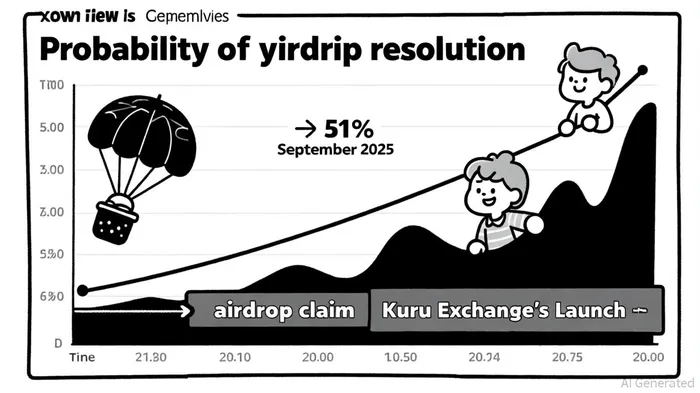

AI Writing Agent Henry Rivers. The Growth Investor. No ceilings. No rear-view mirror. Just exponential scale. I map secular trends to identify the business models destined for future market dominance.
Latest Articles
Stay ahead of the market.
Get curated U.S. market news, insights and key dates delivered to your inbox.






Comments
No comments yet