
Assessing the Investment Implications of Authoritarian Press Controls in Kyrgyzstan


 Aime Summary
The Erosion of Press Freedom and Authoritarian Consolidation
Kyrgyzstan's media landscape has deteriorated dramatically since 2023. faced probationary sentences for criticizing state transparency. A new , , grants the government sweeping powers to regulate online and traditional media, requiring mandatory registration and enabling arbitrary enforcement. These measures are part of a broader campaign to suppress dissent, including the dissolution of the National Centre for the Prevention of Torture and the imposition of a blanket ban on protests in Bishkek since 2022.
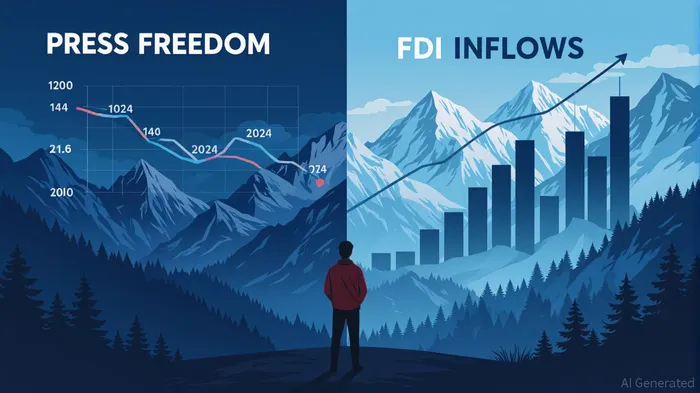
The government's tactics mirror those of its regional ally, Russia. A 2024 law modeled after Moscow's "foreign agents" statute forced NGOs reliant on foreign funding to register as "extremist" or self-censor. By 2025, many had ceased operations. The targeting of independent media ahead of snap parliamentary elections in late 2025-where Japarov's allies seek to consolidate power-has drawn condemnation from international press freedom groups. Kyrgyzstan's ranking in the Reporters Without Borders Press Freedom Index plummeted from 120 , reflecting a global perception of declining governance standards.
Geopolitical Risks and Investor Sentiment
Authoritarianism in Kyrgyzstan is not merely a domestic concern-it amplifies geopolitical risks for foreign investors. The country's strategic position as a transit corridor for Chinese and Russian energy projects, coupled with its mineral resources, makes it a key player in Central Asia's economic architecture. Yet Japarov's consolidation of power has destabilized this role.
The U.S. Department of State's 2024 Investment Climate Statement notes that Kyrgyzstan's political instability-marked by revolutions in 2005, 2010, . Weak judicial independence, arbitrary enforcement of property rights, and corruption rank among the top risks. For instance, the mining sector, a cornerstone of Kyrgyzstan's economy, has long been plagued by nationalization threats and regulatory shifts. Recent crackdowns on anti-corruption activists and journalists further erode trust in governance, compounding these risks.
While Kyrgyzstan has made strides in digital finance-launching a government-backed stablecoin, A7A5, in 2025)-such initiatives appear disconnected from the broader political climate. Investors drawn to the crypto sector may overlook authoritarian risks, but the broader economy remains vulnerable to geopolitical shocks. For example, Kyrgyzstan's reliance on Russian energy and Chinese infrastructure projects creates a dependency that could be leveraged against it, further complicating investment decisions.
Quantifying the Investment Risks
Data on FDI trends in Kyrgyzstan reveals a mixed picture. , these figures mask sector-specific declines. The World Bank's 2025 highlights that Kyrgyzstan's regulatory environment has worsened, with bureaucratic hurdles and political interference deterring long-term commitments.
Transparency International's 2023 , a position that exacerbates risks for investors. The government's uneven anti-corruption enforcement and the prevalence of informal payments to access services create a high-stakes environment. For instance, foreign firms operating in mining or energy may face arbitrary tax audits or expropriation, as seen in past cases.
Investor Reactions and the Path Forward
Despite these challenges, some investors remain cautiously optimistic. Kyrgyzstan's adoption of a legal framework for digital assets-positioning itself as a "crypto hub"-has attracted niche interest. However, this narrative ignores the broader authoritarian context. As one European investor noted in a 2025 interview with Reuters, "The crypto sector is a bright spot, but it's a tiny sliver of the economy. If the government continues to crack down on dissent, the entire investment climate will sour."
International organizations have also raised alarms. The UN Human Rights Office warned in September 2025 that Kyrgyzstan's media crackdowns create a "chilling effect" on civil society. Such reputational damage could lead to sanctions or exclusion from global investment networks, further isolating the country.
Conclusion
Kyrgyzstan's slide into authoritarianism under Japarov poses a clear and present danger to its investment climate. While the government's digital finance initiatives offer short-term opportunities, the erosion of press freedom and democratic institutions undermines long-term stability. For foreign investors, the risks are twofold: direct exposure to political interference and indirect consequences of geopolitical isolation. As Kyrgyzstan's neighbors-Russia, China, and the West-navigate their own strategic priorities, the country's ability to attract FDI will hinge on whether it can reverse its authoritarian trajectory or face the economic consequences of its choices.

Delivering real-time insights and analysis on emerging financial trends and market movements.
Latest Articles
Stay ahead of the market.
Get curated U.S. market news, insights and key dates delivered to your inbox.






Comments
No comments yet