
Assessing the Impact of Xerox Campus Redevelopment on Commercial Real Estate in Webster, NY


 Aime Summary
Infrastructure as a Catalyst for Value Creation
Infrastructure projects have historically served as powerful levers for industrial real estate appreciation. In cities like Pune, India, proximity to metro corridors and highway expansions has driven property premiums of 10–25% for assets within 500–800 meters of such developments. Similarly, the Washington Metro's Silver Line extension spurred a 15–20% increase in property values in Northern Virginia, while Atlanta's BeltLine project saw significant appreciation even before construction completion as research indicates. These examples underscore a universal principle: infrastructure investments reduce friction in logistics, enhance accessibility, and signal long-term economic stability, all of which elevate the desirability of industrial assets.
Webster's Xerox campus redevelopment aligns with this pattern. By prioritizing road and utility upgrades, the project directly addresses the "brownfield" challenges of the site, making it viable for modern industrial tenants. The first phase of nearly one million square feet of industrial space, slated for completion by 2025, is already attracting interest from advanced manufacturing and logistics firms. This mirrors the success of the Pune Ring Road, which spurred property development in peripheral areas by improving connectivity and reducing transportation costs. 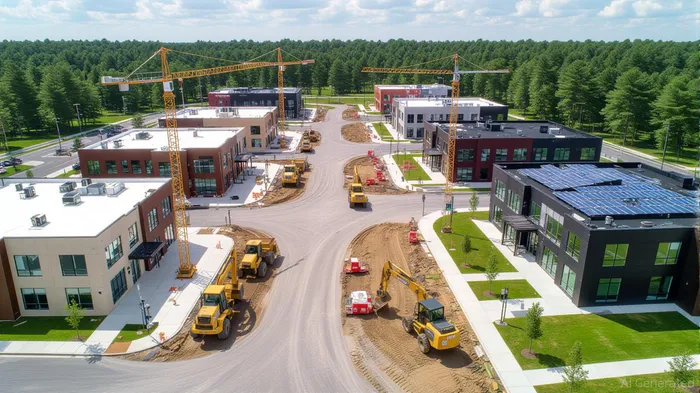 For Webster, the infrastructure improvements will likely create a similar ripple effect, enhancing the campus's appeal to firms seeking efficient supply chain hubs.
Structural Demand Drivers: E-Commerce and Reshoring Trends
Beyond infrastructure, industrial real estate is being propelled by structural demand drivers that further amplify the Xerox campus's investment potential. E-commerce growth, for instance, is projected to require an additional 280 million square feet of logistics space by 2035 to accommodate $280 billion in new sales. This demand is compounded by reshoring and nearshoring trends, as companies diversify supply chains to mitigate global risks. The Inflation Reduction Act and CHIPS Act, for example, are incentivizing domestic manufacturing in sectors like semiconductors and EV batteries, directly increasing demand for specialized industrial facilities.
Webster's redevelopment is well-positioned to capitalize on these trends. The planned commercial space and housing units will support a workforce capable of meeting the labor demands of advanced manufacturing, while the infrastructure upgrades ensure the campus can handle modern logistics requirements. This aligns with broader market dynamics: Class A industrial warehouses, equipped with automation-ready infrastructure, are increasingly preferred over older facilities, and vacancy rates in such properties remain resilient despite macroeconomic headwinds as data shows. With the Xerox campus's infrastructure slated for completion by mid-2026, it is poised to attract tenants seeking state-of-the-art facilities in a strategically located market.
Supply Constraints and Long-Term Resilience
A critical factor underpinning industrial real estate appreciation is the imbalance between supply and demand. Elevated construction costs, labor shortages, and reduced speculative development have limited new supply, with build-to-suit projects accounting for 39% of the U.S. industrial pipeline by 2025. This scarcity, combined with the obsolescence of legacy properties, has concentrated demand in modern facilities like those planned for Webster.
The Xerox campus redevelopment exemplifies this dynamic. By focusing on high-performance infrastructure and mixed-use development, the project addresses both the functional needs of tenants and the demographic demands of a skilled workforce. This dual approach not only enhances the campus's immediate viability but also ensures its long-term relevance in a market where vacancy rates are expected to tighten by late 2025 or early 2026. For investors, this represents a rare opportunity to acquire assets in a market with structural tailwinds and limited near-term oversupply.
Conclusion: A Strategic Investment in the Future
The Xerox campus redevelopment in Webster, NY, is more than a local infrastructure project-it is a microcosm of the broader forces reshaping industrial real estate. By aligning infrastructure investments with structural demand drivers like e-commerce and reshoring, the project creates a foundation for sustained asset appreciation. Historical case studies from Pune, Atlanta, and Northern Virginia demonstrate that such developments can yield significant returns, particularly when executed in tandem with workforce and housing strategies. For investors, the key takeaway is clear: infrastructure-driven industrial real estate, when anchored to long-term economic trends, offers a compelling path to value creation.
As the campus moves toward its 2026 completion timeline, Webster's collaboration with public and private partners will be critical in ensuring the project's success. However, the fundamentals are already in place-a strategic location, modern infrastructure, and a demand-driven market-making this redevelopment a prime example of how thoughtful infrastructure investment can unlock industrial real estate's full potential.

Blending traditional trading wisdom with cutting-edge cryptocurrency insights.
Latest Articles
Stay ahead of the market.
Get curated U.S. market news, insights and key dates delivered to your inbox.


AInvest
PRO
AInvest
PRO



Comments
No comments yet