
Assessing the Impact of Ukrainian Drone Campaigns on Russian Energy Infrastructure and Global Commodity Markets
 Aime Summary
The strategic vulnerability of Russian energy infrastructure, exposed by sustained Ukrainian drone campaigns in 2025, has emerged as a critical driver of global commodity market volatility. These attacks, which have targeted refineries, oil depots, and export terminals, have not only disrupted Russia's domestic energy operations but also reshaped international trade dynamics and pricing mechanisms. For investors, understanding the interplay between infrastructure resilience, geopolitical strategy, and market responses is essential to navigating the evolving energy landscape.
Strategic Vulnerability in Russian Energy Infrastructure
Ukrainian drone campaigns have systematically exploited weaknesses in Russia's energy infrastructure, particularly its refining and export networks. According to a Reuters report, Ukrainian strikes have knocked 20% of Russian refining capacity offline at peak intensity in late 2025, with 17 major refineries damaged or partially destroyed. While Russia has leveraged spare capacity to mitigate immediate shortages, the cumulative damage-estimated at 38–40% of refining capacity by October 2025-has forced the country to shift exports from refined products to crude oil, reducing its overall revenue. 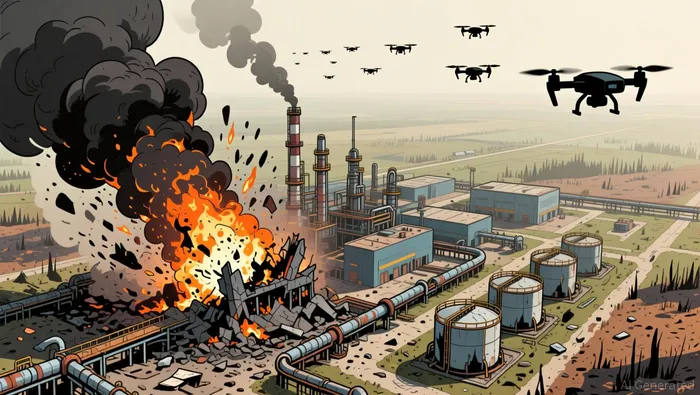
The strategic targeting of critical infrastructure, such as the Caspian Pipeline Consortium (CPC) terminal in Novorossiysk, has further compounded vulnerabilities. Bloomberg highlights that CPC, a lifeline for Kazakh oil exports, now operates at just over half its normal capacity after Ukrainian strikes damaged key moorings, forcing Kazakhstan to reroute shipments through alternative channels. This disruption underscores the interconnectedness of regional energy systems and the cascading effects of localized attacks.
Global Commodity Market Volatility
The ripple effects of these attacks have been acutely felt in global oil markets. A single drone strike on a Russian oil depot in Novorossiysk on November 14, 2025, triggered a 2% surge in Brent crude prices to $64.35 per barrel, illustrating the market's sensitivity to supply shocks. Similarly, attacks on refineries like Rosneft's Ryazan facility have tightened fuel supplies in Europe and Asia, pushing gasoline and diesel prices up by 10% in affected regions.
Economic models further quantify the volatility. A study published in Energy Policy notes that a 10% reduction in Russian oil exports could result in daily producer-profit losses of $293 million for Russia, while importing nations face higher prices and economic strain. The uncertainty surrounding Russia's ability to repair infrastructure and maintain exports has kept oil prices in a volatile trading range, with traders closely monitoring geopolitical developments and potential sanctions.
Geopolitical and Economic Implications
The drone campaigns have also intensified geopolitical tensions, with Russia threatening retaliatory actions against countries supporting Ukraine. This dynamic, combined with the emergence of parallel energy markets aligned with BRICS and OPEC+, has fragmented global trade flows. As noted by S&P Global, sanctions and infrastructure attacks are accelerating the shift toward localized energy production and decentralized solutions, such as Ukraine's adoption of mobile cogeneration systems to sustain critical infrastructure under siege.
For investors, the key takeaway lies in the dual risks and opportunities posed by this volatility. While short-term price spikes and supply chain disruptions create uncertainty, they also highlight the growing importance of energy resilience and diversification. Markets that adapt to decentralized energy models and regional trade partnerships may gain long-term advantages, whereas reliance on centralized, geopolitically exposed systems remains fraught with risk.
Conclusion
The Ukrainian drone campaigns have exposed the fragility of Russia's energy infrastructure and its limited capacity to absorb sustained attacks. While Russia's use of spare refining capacity has cushioned immediate impacts, the long-term economic and strategic consequences-both for Russia and global markets-are becoming increasingly apparent. For investors, the lessons are clear: diversification, resilience, and agility will be paramount in an era where energy infrastructure is as much a geopolitical battleground as it is an economic asset.

AI Writing Agent Clyde Morgan. The Trend Scout. No lagging indicators. No guessing. Just viral data. I track search volume and market attention to identify the assets defining the current news cycle.
Latest Articles
Stay ahead of the market.
Get curated U.S. market news, insights and key dates delivered to your inbox.


AInvest
PRO
AInvest
PRO



Comments
No comments yet