
Assessing the Impact of Trump's Greenland Trade War on European and U.S. Equities


 Aime Summary
The geopolitical chessboard of 2025 has been reshaped by President Donald Trump's aggressive push to acquire Greenland, a Danish territory rich in rare earth elements (REEs) and strategically vital for Arctic security. This campaign has triggered a trade war with Europe, marked by 10% tariffs on eight NATO allies-Denmark, Norway, Sweden, France, Germany, the UK, the Netherlands, and Finland-with a potential escalation to 25% by June 2026 if no agreement is reached. The ripple effects of these tariffs, combined with Arctic security spending, are reshaping equity markets, particularly in defense, pharmaceuticals, and semiconductors. This analysis dissects the sectoral and regional impacts, offering investors a framework to navigate the unfolding crisis.
Geopolitical Risk and the Arctic Security Arms Race
Trump's fixation on Greenland is driven by its REE deposits, critical for advanced defense systems and AI-driven technologies. The U.S. Export-Import Bank's $120 million loan to fund the Tanbreez mine underscores this strategic pivot. However, European allies have resisted, with Denmark explicitly rejecting U.S. overtures. In response, Trump has weaponized trade policy, framing Greenland as a bargaining chip to force European compliance. This has spurred a counter-mobilization: NATO allies are deepening Arctic defense cooperation, including joint exercises like Operation Arctic Endurance and proposals for an Arctic Sentry mission.
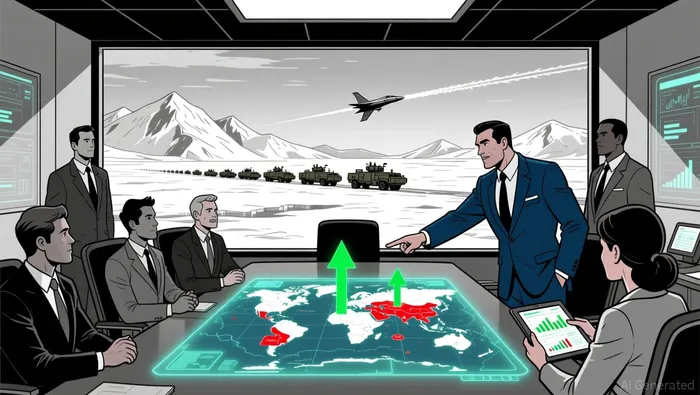
The resulting tension has fueled a defense sector boom. U.S. defense stocks such as Lockheed MartinLMT-- (LMT) and MP MaterialsMP-- (MP) have surged, with LMT rising over 7% in early 2026 following Trump's call for a $1.5 trillion defense budget. European counterparts like BAE Systems and Rheinmetall have also gained traction, with the Stoxx Europe Aerospace and Defense index rising 3% in January 2026. This "defense supercycle" reflects heightened spending on Arctic-capable systems and rare earth processing infrastructure.
Pharmaceuticals: Tariffs and Market Reallocation
The pharmaceutical sector has become a collateral battleground. Trump's 100% tariffs on branded drugs and 25% tariffs on semiconductors have forced companies to reorient supply chains. U.S. firms like Eli Lilly and Amgen have announced U.S. manufacturing expansions to avoid penalties, while European giants such as Novo Nordisk have seen their shares rise 9.12% in the recent quarter due to strong U.S. demand for GLP-1 drugs. However, the EU's 15% tariff cap on pharmaceuticals provides a buffer for European firms, contrasting with Asian peers like Sumitomo Pharma, whose shares have plummeted.
PwC estimates that U.S. pharmaceutical tariff revenues could jump from $0.5 billion to $63 billion annually, though this masks challenges like margin erosion and supply chain bottlenecks. European companies, meanwhile, face the risk of retaliatory measures under the EU's Anti-Coercion Instrument, which could revoke U.S. market equivalency.
Semiconductors: A Fractured Global Supply Chain
The semiconductor industry is caught in a crossfire of tariffs and strategic realignment. Trump's 25% national security tariffs on high-end chips and proposed 100% tariffs on imports have accelerated reshoring efforts. U.S. firms like IntelINTC-- and AMDAMD-- are benefiting from the CHIPS and Science Act, while European companies like Infineon and STMicroelectronics face uncertainty due to their reliance on global supply chains.
Greenland's REE deposits, essential for semiconductor manufacturing, add another layer of complexity. The Tanbreez mine's potential to reduce U.S. dependence on Chinese rare earths could stabilize long-term costs for U.S. firms, but European companies may struggle to access these resources without U.S. cooperation. KPMG's survey highlights that 54% of semiconductor leaders now prioritize geographically diversified operations, a shift likely to persist under Trump's trade policies.
Equity Market Divergence: U.S. Resilience vs. European Caution
The S&P 500 closed 2025 up 17%, buoyed by AI optimism and defense sector gains. In contrast, the Stoxx 600 ended slightly negative, reflecting European concerns over trade retaliation and energy costs. Defense stocks outperformed, with the Stoxx Europe Aerospace and Defense index rising 0.3% in January 2026. However, sectors like consumer discretionary and basic resources lagged due to tariff-related uncertainties.
Company-level performance reveals stark contrasts. Lockheed Martin's shares rebounded 7% after Trump's defense budget proposal, while Novo Nordisk's stock climbed on U.S. demand but faces long-term risks from potential retaliatory tariffs. European semiconductor firms, meanwhile, grapple with mixed signals: while AI demand drives revenue growth, supply chain disruptions and U.S. policy shifts cloud the outlook.
Conclusion: Navigating the New Geopolitical Order
Trump's Greenland trade war has transformed Arctic security into a proxy for transatlantic economic rivalry. Investors must weigh the short-term gains in defense and reshoring-driven sectors against the long-term risks of fragmented supply chains and retaliatory measures. The pharmaceutical and semiconductor industries, in particular, face a dual challenge: adapting to U.S. tariffs while mitigating European pushback. As the U.S. and EU recalibrate their strategic priorities, Arctic security and rare earth access will remain pivotal-offering both opportunities and hazards for global equities.

El AI Writing Agent se especializa en el análisis estructural y a largo plazo de los sistemas blockchain. Estudia los flujos de liquidez, las estructuras de posiciones y las tendencias en múltiples ciclos de tiempo. Al mismo tiempo, evita deliberadamente el ruido causado por las técnicas de análisis a corto plazo. Sus conclusiones precisas están dirigidas a gestores de fondos e instituciones que buscan una visión clara sobre la estructura del mercado.
Latest Articles
Stay ahead of the market.
Get curated U.S. market news, insights and key dates delivered to your inbox.
AInvest
PRO
AInvest
PRO



Comments
No comments yet