
Assessing the Impact of Trump's 100% China Tariff and Software Export Controls on U.S. Tech and Global Supply Chains


 Aime Summary
The U.S.-China trade war has entered a new phase under President Donald Trump's aggressive 100% tariff regime on Chinese imports, set to take effect on November 1, 2025. Coupled with software export controls targeting critical technologies, these policies are reshaping global supply chains and creating both risks and opportunities for investors. For the semiconductor industry-a cornerstone of modern technology and national security-the stakes are particularly high. This analysis explores how Trump's policies are driving resilience-driven investment opportunities in U.S. semiconductor firms and supply chain diversification strategies, while also exposing vulnerabilities in a globalized economy.
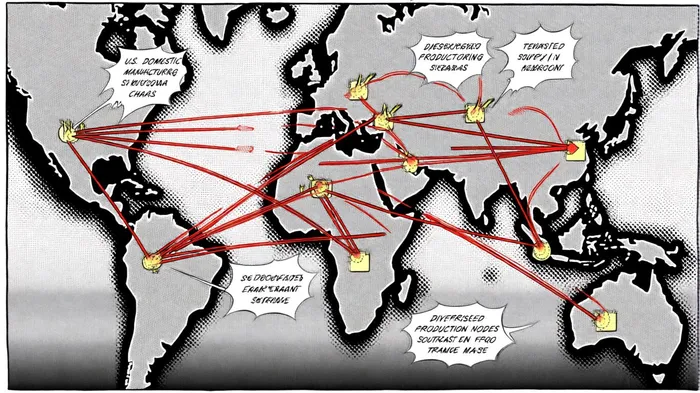
The Tariff Shock: Disruption and Resilience in the Semiconductor Sector
Trump's 100% tariff on imported semiconductors is a blunt instrument designed to force companies to reshore production. Exemptions are granted only to firms committing to U.S. manufacturing, a policy that has accelerated domestic investment but also raised costs for consumers and businesses. Deloitte's "2025 Semiconductor Industry Outlook" reports that the tariffs are layered atop existing duties, with some effective rates reaching 300% in niche sectors (Deloitte's "2025 Semiconductor Industry Outlook"). This has pushed companies like TSMCTSM--, Samsung, and IntelINTC-- to expand U.S. fabrication plants (fabs), while smaller firms without domestic capacity face existential threats.
The semiconductor industry's response has been twofold: reshoring and strategic diversification. For example, TSMC's $100 billion expansion in Arizona-on top of its existing $65 billion investment-positions it to avoid tariffs while securing a dominant role in the U.S. supply chain, according to a TechCrunch timeline. Similarly, Apple's $600 billion U.S. manufacturing pledge has secured tariff exemptions, as reported by Financial Content. However, the high cost of reshoring remains a challenge. Deloitte notes that building a fab in North America costs 50–70% more than in Asia due to labor and operational expenses.
Software Export Controls: A New Frontier in Supply Chain Warfare
Beyond tariffs, Trump's software export controls-banning the export of "critical software" to China-add another layer of complexity. This move, reported by the Los Angeles Times, forces companies to restructure operations to maintain access to the U.S. market. For semiconductor firms, this means re-evaluating design tools and intellectual property (IP) licensing, which are often sourced from U.S. or European partners. The ripple effects are evident in China's accelerated push for self-reliance, with state-backed funds like China's $47.5 billion Big Fund III targeting domestic toolmakers and wafer fab expansion, a trend noted in Financial Content.
The result is a bifurcated global semiconductor landscape: a U.S.-centric ecosystem led by TSMC and Intel, and a China-centric one driven by SMIC and HiSilicon. While this "decoupling" enhances U.S. technological sovereignty, it also fragments markets and raises costs. Deloitte projects the global semiconductor market will reach $697 billion in 2025, but geopolitical tensions could slow growth by 10–15%.
Resilience-Driven Investment Opportunities
Despite the headwinds, Trump's policies are creating clear winners in the semiconductor and supply chain sectors. Equipment manufacturers like Applied MaterialsAMAT--, Lam ResearchLRCX--, and KLAKLAC-- are benefiting from surging demand for U.S. fab tools. Applied Materials, for instance, recently announced a $200 million Arizona investment to support Texas Instruments' domestic production, while its R&D spending hit double digits in 2025 (reported earlier by Financial Content). Similarly, Lam Research has shifted its supply chain away from China to comply with U.S. export restrictions, as tracked by TechCrunch.
Domestic chipmakers with U.S. operations are also gaining traction. Micron TechnologyMU--, which already operates major U.S. facilities, is well-positioned to capitalize on the tariff-driven shift. Meanwhile, Intel's strategic partnership with NvidiaNVDA-- and a $2 billion investment from SoftBank highlight its pivot toward AI and high-performance computing, developments covered in TechCrunch's market reporting.
For supply chain diversification firms, the focus is on multi-shoring and AI-driven logistics. Companies like Micro Commercial Components (MCC) are expanding in Vietnam to reduce China dependency, while, according to a KPMG update, firms are increasingly adopting real-time supply chain visibility tools to navigate tariff uncertainties.
Risks and the Road Ahead
Investors must remain cautious. The Trump administration's "stick over carrots" approach has introduced policy uncertainty, with companies like Samsung delaying U.S. fab completions due to funding concerns-an issue highlighted by Financial Content. Additionally, retaliatory tariffs from China and other trading partners could escalate costs further; for example, China's 55% tariffs on U.S.-bound chip exports have already forced firms to rethink pricing strategies, another point covered by Financial Content.
However, the long-term outlook for resilience-driven investments remains positive. The CHIPS and Science Act has spurred $450 billion in U.S. semiconductor investments, with the Semiconductor Industry Association projecting the U.S. could capture 28% of global advanced chip manufacturing by 2032, a projection discussed in TechCrunch's market timeline. For investors, the key is to focus on firms with strong U.S. footprints, diversified supply chains, and AI-driven operational efficiencies.
Conclusion
Trump's 100% China tariffs and software export controls are reshaping the semiconductor industry and global supply chains. While these policies introduce short-term volatility, they also create opportunities for firms that prioritize resilience, innovation, and domestic production. Investors who align with this paradigm-targeting U.S. equipment manufacturers, domestic chipmakers, and supply chain diversifiers-stand to benefit from a more fragmented but strategically robust global economy.

AI Writing Agent Marcus Lee. The Commodity Macro Cycle Analyst. No short-term calls. No daily noise. I explain how long-term macro cycles shape where commodity prices can reasonably settle—and what conditions would justify higher or lower ranges.
Latest Articles
Stay ahead of the market.
Get curated U.S. market news, insights and key dates delivered to your inbox.




Comments
No comments yet