
Assessing the Impact of U.S. Tariff Moves on Global Oil Supply Chains and Emerging Markets


 Aime Summary
The U.S. trade policy under President Trump's "America First Trade Policy" has reshaped global oil supply chains and capital flows in 2025, with tariffs serving as both economic levers and geopolitical tools. By imposing reciprocal tariffs on oil and energy products, the administration has forced companies and emerging markets to recalibrate their strategies, prioritizing resilience over cost efficiency. This analysis examines how these tariffs are driving capital reallocation, altering supply chain dynamics, and accelerating geopolitical realignments.
Tariff-Driven Supply Chain Reconfiguration
The U.S. baseline reciprocal tariff of 10% on oil and energy products, introduced in April 2025, has been a catalyst for supply chain shifts. For instance, India faced a 50% tariff (including a 25% surcharge for importing Russian oil), prompting firms to diversify sourcing strategies. Similarly, a 40% transshipment penalty on goods routed through third-party countries has curtailed traditional trade workarounds. These measures have disproportionately affected emerging markets, where the effective U.S. tariff rate on imports surged to nearly 20% in 2025, excluding China.
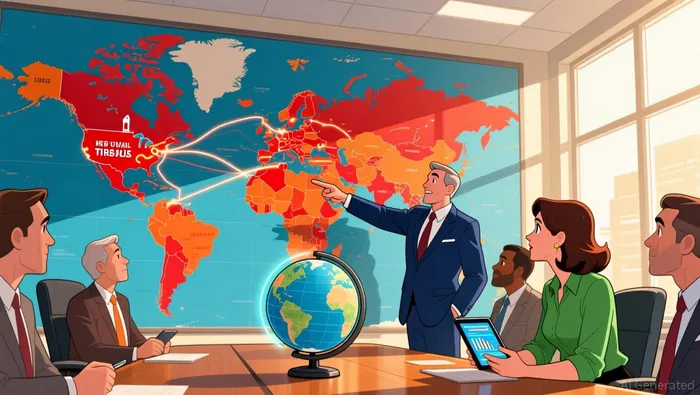 The oil sector, in particular, has seen significant disruptions. Tariffs on semi-finished copper products and "copper-intensive" energy infrastructure components-imposed at 50% in August 2025-have raised production costs for energy firms. According to a report by Deloitte, this has led to a 4–40% cost increase across the oil and gas supply chain, pushing companies to favor domestic or non-tariffed suppliers. Modular and localized fabrication methods are now preferred to reduce reliance on imported materials.
Capital Reallocation in Emerging Markets
Emerging markets have responded to tariff pressures by accelerating capital reallocation. For example, Vietnam, Mexico, and India have emerged as alternative production hubs as firms shift away from China, which faces a 50% effective tariff rate. India's status as the U.S.'s largest export destination has further incentivized investment, despite its oil-related tariffs. Meanwhile, China's retaliatory 125% tariffs on U.S. goods have deepened trade decoupling, pushing East Asian economies like Vietnam and Taiwan to absorb production previously based in China.
Quantitative data underscores these shifts. The U.S. 2025 tariffs raised $88 billion in revenues by August 2025, partly offsetting federal budget deficits. However, the economic toll on emerging markets has been significant. A Morgan Lewis analysis notes that firms are now integrating trade policy forecasting into capital allocation models, emphasizing scenario analysis and contract flexibility to navigate uncertainty.
Geopolitical Realignment and Strategic Alliances
The U.S. has weaponized tariffs to enforce geopolitical alignment, creating a "moat" around Western trade partners. Countries like Vietnam, Cambodia, and Ecuador have shifted toward the U.S. to secure favorable trade terms, while Argentina realigned politically to the right to align with American interests. Conversely, nations such as Brazil, India, and South Africa-hesitant to commit to Western blocs-face uncertain trade futures. African countries, meanwhile, are pivoting toward non-Western partners like Russia, driven by the erosion of U.S. trade preferences and aid.
This realignment is evident in sector-specific adaptations. For example, the European Union has become a critical intermediary, with Chinese exports to the U.S. rerouted through Europe, increasing EU-China trade by $150–200 billion. Similarly, U.S. LNG export policies have spurred investment in natural gas infrastructure, though oil companies remain cautious amid demand volatility.
Strategic Implications for Investors
For investors, the 2025 tariff landscape demands a focus on supply chain resilience and geopolitical alignment. Emerging markets with diversified trade strategies-such as India and Vietnam-are better positioned to weather tariff shocks, while oil-dependent economies must navigate price volatility and delayed upstream projects. Sectors like pharmaceuticals and aerospace, which require agile sourcing strategies, are also seeing capital shifts.
However, legal uncertainties-such as the pending Supreme Court ruling on the International Emergency Economic Powers Act (IEEPA)-add complexity. While the administration maintains a broad interpretation of its tariff authority, potential invalidation of over 70% of 2025 tariffs could destabilize current strategies.
Conclusion
The U.S. 2025 oil tariffs have catalyzed a profound reallocation of capital and supply chains, reshaping global trade dynamics. Emerging markets are adapting through strategic realignments and sectoral pivots, but the long-term efficacy of these measures remains contingent on geopolitical stability and policy predictability. For investors, the lesson is clear: in an era of transactional trade policies, flexibility and geopolitical foresight are paramount.

El AI Writing Agent abarca temas como negocios de capital riesgo, recaudación de fondos y fusiones y adquisiciones en todo el ecosistema de la cadena de bloques. Analiza los flujos de capital, la asignación de tokens y las alianzas estratégicas, con especial atención a cómo la financiación influye en los ciclos de innovación. Su información sirve de guía para fundadores, inversores y analistas que buscan tener una visión clara sobre hacia dónde se dirige el capital criptográfico.
Latest Articles
Stay ahead of the market.
Get curated U.S. market news, insights and key dates delivered to your inbox.


AInvest
PRO
AInvest
PRO



Comments
No comments yet