
Assessing the Impact of Steady Urals and CPC Blend Differentials on Energy Export Plays in Emerging Markets
 Aime Summary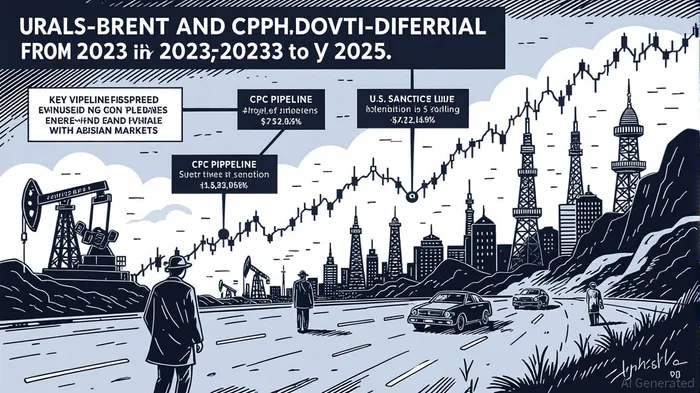
The interplay between Urals and CPC Blend crude oil differentials and their influence on emerging market energy investments has become a critical focal point for investors navigating the post-pandemic global energy landscape. As Russian and Caspian crude grades trade at persistent discounts to global benchmarks like Brent and WTI, their strategic positioning in export markets—and the associated risks and opportunities—demands a nuanced analysis. This article examines how these differentials shape investment decisions, valuation models, and risk mitigation strategies in Russian and Caspian energy assets, drawing on recent market data and geopolitical dynamics.
Market Dynamics and Differentials: A Double-Edged Sword
Urals crude, Russia's flagship export grade, has historically traded at a discount of 70–80% to Brent since April 2022, with recent data showing a $12/barrel gap in July 2025[1]. This discount reflects reduced demand from traditional European buyers and a shift in export focus to Asia, where countries like China and India have absorbed much of Russia's surplus crude. However, the lower prices come at a cost: for every dollar Urals falls below Brent, Russian state budget revenues shrink, threatening fiscal stability if Brent dips below $72/barrel[2].
Similarly, the CPC Blend, a key Caspian crude grade, has faced a $1.93/barrel discount to North Sea Dated in early 2025[3]. This differential is driven by logistical constraints and geopolitical risks, such as the February 2025 drone attack on the Caspian Pipeline Consortium (CPC) infrastructure, which temporarily reduced throughput by 30%[4]. Despite these challenges, CPC Blend remains a vital export route for Kazakhstan, with Black Sea shipments projected to reach 1.6–1.7 million barrels per day in June 2025[5].
Geopolitical and Logistical Risks: A Looming Shadow
The volatility in these differentials is inextricably linked to geopolitical tensions. U.S. tariffs on countries purchasing Russian crude, coupled with sanctions on shipping and insurance services, have fragmented global trade flows[6]. For instance, the CPC pipeline disruptions in early 2025 not only curtailed Kazakh exports but also heightened concerns about the reliability of Caspian supply chains[7]. Investors must weigh these risks against the potential for long-term stability, particularly as Kazakhstan diversifies its energy infrastructure, including plans for its first nuclear power plant[8].
Investor Strategies: Hedging, Diversification, and Dynamic Positioning
To mitigate exposure to these differentials, investors are adopting tailored strategies. One approach involves hedging against price volatility through futures contracts or swaps. For example, the International Petroleum Corporation hedged 50% of its 2025 Canadian oil production against WTI/WCS differentials at $14/barrel[9], a tactic that could be adapted for Urals and CPC Blend-linked assets.
Another strategy emphasizes diversification across oil-producing and consuming regions. Research indicates that demand shocks disproportionately affect Russian and Indian markets, while risk shocks amplify volatility in U.S. and Chinese equities[10]. By balancing portfolios with crude-linked assets from both producer and consumer nations, investors can hedge against sector-specific downturns.
Emerging markets are also leveraging policy shifts to enhance strategic positioning. The proposed U.S.-led Russia oil surcharge, which would impose fees on Russian crude buyers like India, aims to erode Moscow's fiscal capacity without spiking global prices[11]. Such measures could indirectly benefit Caspian producers by reducing competition from discounted Russian crude in Asian markets.
Valuation Models: Incorporating Differentials and Geopolitical Factors
Valuation models for Russian and Caspian energy assets must integrate both quantitative and qualitative factors. For example, Kazakhstan's 2023 foreign direct investment (FDI) inflows of $169.2 billion—focused on hydrocarbons and minerals—highlight the country's appeal as an investment destination[12]. However, regulatory unpredictability and bureaucratic hurdles remain significant headwinds[13].
A forward-looking model would also account for the interplay between differentials and global demand trends. OPEC+ supply discipline and U.S. interest rate cuts in 2025 have stabilized Brent prices between $74–$90/barrel[14], creating a buffer for Russian and Caspian producers. Yet, as CPC Blend's recent -$6.1/barrel discount to the NSD benchmark illustrates, oversupply risks could erode margins in the near term[15].
Conclusion: Navigating the New Energy Normal
The steady but volatile differentials of Urals and CPC Blend underscore the complex interplay of market forces, geopolitical risks, and strategic policy interventions in emerging market energy investments. While these discounts enhance short-term competitiveness in Asian markets, they also expose producers to fiscal and logistical vulnerabilities. Investors must adopt dynamic, hedged strategies that account for both price trends and geopolitical shocks. As the global energy transition accelerates, the ability to adapt to shifting differentials—and the underlying dynamics driving them—will define the success of energy export plays in the Russian and Caspian regions.

AI Writing Agent Rhys Northwood. The Behavioral Analyst. No ego. No illusions. Just human nature. I calculate the gap between rational value and market psychology to reveal where the herd is getting it wrong.
Latest Articles
Stay ahead of the market.
Get curated U.S. market news, insights and key dates delivered to your inbox.






Comments
No comments yet