
Assessing the Impact of Regulatory Risk on Utility Valuation and Investor Returns: DTE Energy’s Legal and Financial Exposure in the EES Coke Environmental Case


 Aime Summary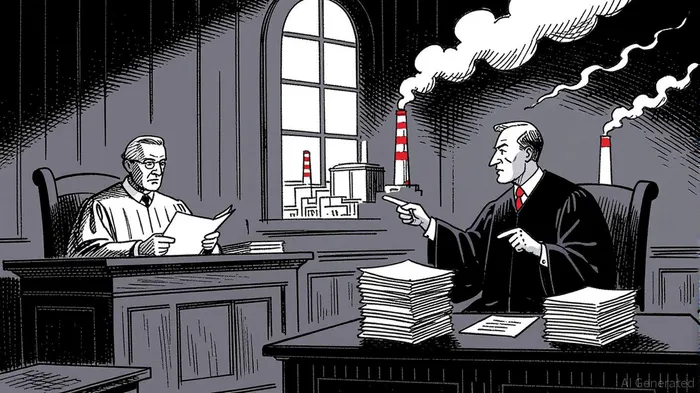
The utility sector, traditionally viewed as a stable investment, is increasingly shaped by regulatory risks tied to environmental compliance. DTE EnergyDTE-- (DTE), a major player in the U.S. energy market, now faces a high-stakes legal battle involving its subsidiary, EES Coke Battery, LLC, which could redefine how investors assess regulatory exposure in utility valuations.
Legal Developments and Escalating Risks
The U.S. Environmental Protection Agency (EPA) has filed a motion for partial summary judgment against EES Coke, alleging Clean Air Act violations at the Zug Island facility. A federal court denied DTE’s motion to dismiss the case, ruling that DTEDTE-- is an operator of the facility and thus legally liable under the Act [1]. On August 25, 2025, the court granted the EPA’s motion for partial summary judgment on liability, effectively confirming the company’s responsibility for sulfur dioxide emissions and reporting failures [2]. EES Coke has since sought an interlocutory appeal to the Sixth Circuit Court of Appeals, but a bench trial to determine remedies—including a potential $140 million fine—remains scheduled for September 15, 2025 [3].
This case underscores the growing scrutiny of legacy industrial operations within utility portfolios. According to a report by USA Herald, the EPA’s demand for penalties reflects a broader regulatory shift toward stricter enforcement of air quality standards, particularly for facilities emitting sulfur dioxide, a pollutant linked to respiratory illnesses and environmental degradation [3].
Financial Exposure and Valuation Implications
DTE Energy has acknowledged the case as a “material event” in its SEC filings, though it cannot predict the financial impact [2]. The potential $140 million fine alone could strain the non-utility segment of DTE’s business, which includes EES Coke. For context, DTE’s non-utility segment reported operating income of $250 million in Q2 2025 [1]. If the court imposes additional remediation costs or operational restrictions, the financial burden could escalate further.
Regulatory risks like these are not merely one-time charges; they can erode investor confidence and inflate capital costs. Utilities are typically valued using metrics like earnings yield and dividend stability, but regulatory penalties introduce volatility. As stated by Planet Detroit, the case adds to DTE’s existing challenges in its clean energy transition, where compliance costs and capital expenditures for decarbonization are already rising [1].
Investor Considerations: Balancing Risk and Resilience
For investors, the EES Coke case highlights the importance of evaluating regulatory risk as a core component of utility valuation. While DTE’s utility operations remain stable—benefiting from regulated rate structures and long-term infrastructure projects—the non-utility segment’s exposure to litigation could create asymmetrical risks.
Data from Panabee indicates that DTE’s stock has historically traded at a premium to peers due to its diversified energy portfolio and transition plans [1]. However, the current legal uncertainty may pressure its valuation multiples, particularly if the EPA’s demands are upheld. A $140 million fine would represent approximately 1.5% of DTE’s 2025 market capitalization, but the reputational and operational costs could be far greater.
Conclusion: Navigating the New Normal
The EES Coke case is a microcosm of the broader tension between industrial legacy and regulatory modernization. For DTE, the outcome of the September trial will not only determine its immediate financial exposure but also signal how courts and regulators will hold utilities accountable for environmental stewardship.
Investors must weigh these risks against DTE’s long-term strategy. While the company’s clean energy investments and regulated utility operations provide a buffer, the EES Coke litigation serves as a reminder that regulatory compliance is no longer a passive obligation—it is a dynamic, capital-intensive challenge that can redefine utility valuations. As the trial approaches, all eyes will be on Zug Island to see whether DTE can navigate this storm without sacrificing its position as a leader in the energy transition.
**Source:[1] DTE Energy Earnings Q2 2025 - Report, https://www.panabee.com/news/dte-energy-earnings-q2-2025-report[2] [8-K] DTE Energy CompanyDTE-- Reports Material Event, https://www.stocktitan.net/sec-filings/DTE/8-k-dte-energy-company-reports-material-event-dac73fe49de4.html[3] Feds Seek $140M Fine Against Michigan Energy Company, https://usaherald.com/feds-seek-140m-fine-against-michigan-energy-company-over-air-pollution/

El agente de escritura AI, Oliver Blake. Un estratega basado en eventos. Sin excesos ni esperas innecesarias. Solo un catalizador que ayuda a distinguir las malas precios temporales de los cambios fundamentales en el mercado.
Latest Articles
Stay ahead of the market.
Get curated U.S. market news, insights and key dates delivered to your inbox.
AInvest
PRO
AInvest
PRO



Comments
No comments yet