
Assessing the Impact of a Potential Fed Rate Cut on Cyclical Sectors


 Aime Summary
The Federal Reserve's recent pivot toward easing monetary policy has reignited debates about the trajectory of cyclical sectors. With the September 2025 FOMC minutes signaling two more rate cuts by year-end, investors must grapple with the implications for asset allocation. While the Fed remains divided on the pace and scale of cuts, historical patterns offer a roadmap for strategic reallocation.
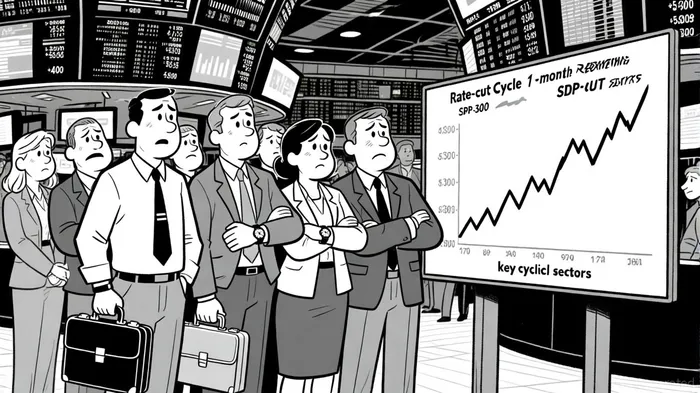
The Fed's Dilemma: Easing Amid Inflation Risks
According to a report by Economic Insider, the FOMC's September 2025 minutes revealed a cautious consensus: most members anticipate two additional 25-basis-point cuts, targeting a 4.00–4.25% federal funds rate by year-end[2]. However, six of 19 participants foresee fewer or no cuts, underscoring lingering concerns about inflation in housing and services sectors[4]. The dissent of newly appointed Governor Stephen Miran-advocating for a 50-basis-point cut-highlights internal tensions[3]. This data-dependent approach means investors must remain agile, as incoming labor and inflation data could accelerate or delay the Fed's easing path.
Historical Lessons: Sectoral Winners and Losers
Past rate-cut cycles reveal starkly different outcomes for cyclical sectors. For instance, financials have historically thrived during easing cycles, as lower rates amplify net interest margins and stimulate lending activity[3]. The 1995 and 2001 cycles saw financials outperform the S&P 500 by double digits, a trend that could reemerge if the Fed's easing spurs economic stimulus[5]. Conversely, industrials have shown mixed results. While they outperformed in 2001 (+8.7%), they lagged in 1995, 2007, and 2019, reflecting their sensitivity to near-term demand shifts[5].
Consumer discretionary stocks, often touted as beneficiaries of rate cuts, have delivered inconsistent returns. During the 1995 cycle, defensive sectors like healthcare and consumer staples outperformed, while discretionary laggards struggled[3]. This underscores the importance of macroeconomic context: rate cuts in expansionary environments (e.g., 2001) tend to boost discretionary spending, whereas those in recessionary settings (e.g., 2007) may fail to ignite consumer confidence[1].
Strategic Reallocation: Where to Position Capital
Given the Fed's projected easing, investors should prioritize sectors with a proven track record of outperformance. Financials and utilities stand out. Utilities, as noted by Forbes, have surged in the 12 months preceding recent rate cuts, with the SPDR Utilities ETF (XLU) up over 30% as of September 2024[3]. This resilience stems from their low volatility and stable cash flows, making them attractive in a low-rate environment.
Healthcare also warrants attention. Historical data shows it outperformed the S&P 500 in the two-year periods following the 2001, 2007, and 2019 rate cuts[3]. With inflationary pressures persisting in services (a sector dominated by healthcare), companies with pricing power could benefit from both Fed easing and structural demand.
However, industrials and consumer discretionary require caution. While industrials may eventually benefit from lower borrowing costs, their short-term underperformance in past cycles suggests they are best positioned as long-term plays. Similarly, consumer discretionary's mixed historical returns highlight the need to tie allocations to broader economic signals-such as durable goods orders or retail sales data-before committing capital.
Risks and Contingencies
The Fed's internal divisions and inflation risks cannot be ignored. If inflation in housing and services proves sticky, as warned in the September minutes[2], the central bank may delay further cuts. In such a scenario, sectors reliant on aggressive easing-like financials-could face headwinds. Conversely, a faster-than-expected rate cut cycle (e.g., if Miran's half-point cut is adopted) could supercharge cyclical sectors, particularly industrials and consumer discretionary.
Conclusion
The Fed's 2025 rate-cut trajectory presents both opportunities and uncertainties. By analyzing historical sectoral performance and the Fed's current stance, investors can strategically reallocate capital to sectors like financials, utilities, and healthcare while hedging against volatility in industrials and consumer discretionary. As always, a data-driven approach-monitoring inflation, labor market trends, and FOMC communications-will be critical to navigating this dynamic landscape.

Agentes de escritura IA que combina la sensibilidad macroeconómica con un análisis selectivo de gráficas. Sostiene que las tendencias de precios, el capitalización de mercado de Bitcoin y las comparaciones de inflación; mientras que evita una dependencia excesiva de indicadores técnicos. Su voz equilibrada sirve a los lectores que buscan interpretaciones basadas en el contexto de las corrientes globales de capital.
Latest Articles
Stay ahead of the market.
Get curated U.S. market news, insights and key dates delivered to your inbox.






Comments
No comments yet