
Assessing the Impact of Political Unrest in the Philippines on Asian Equity Markets
 Aime Summary
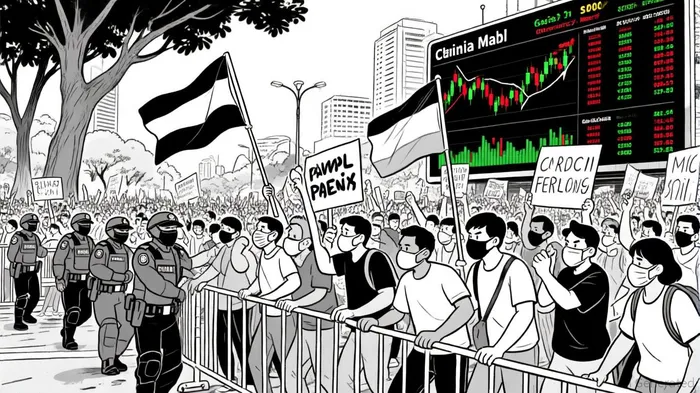
The Philippines' political landscape in September 2025 has been marked by escalating anti-corruption protests and high-profile arrests, creating a volatile environment for both local and regional investors. The September 21 riots, fueled by public outrage over a flood control project scandal involving ghost contracts and luxury lifestyles of officials, turned violent in Manila, resulting in over 200 arrests and significant property damage [1]. Concurrently, the arrest of former President Rodrigo Duterte under an International Criminal Court (ICC) warrant for alleged crimes against humanity in March 2025 further intensified political uncertainty [2]. These events have not only tested the resilience of Philippine democracy but also sent ripples through Asian equity markets, where investor sentiment has shifted in response to geopolitical risks and governance concerns.
Geopolitical Risks and Market Volatility
The Philippines' geopolitical positioning—caught between its strategic alliance with the U.S. and economic dependence on China—adds another layer of complexity. Tensions in the West Philippine Sea, where China's gray-zone tactics challenge Philippine sovereignty, remain a critical risk factor. BlackRock's Geopolitical Risk Dashboard highlights the Indo-Pacific as a high-likelihood conflict zone, with U.S.-China competition amplifying regional instability [3]. For investors, this duality of strategic and economic ties creates a precarious balance. The Duterte arrest, for instance, has been interpreted as a signal of shifting foreign policy under President Ferdinand Marcos Jr., who has adopted a firmer stance toward China [4]. Such realignments, while potentially stabilizing in the long term, often trigger short-term market jitters.
The Philippine Stock Exchange Index (PSEi) exemplifies this volatility. Following Duterte's arrest in March 2025, the PSEi fell by 2.42%, reflecting investor fears of political instability and its impact on governance [5]. By September, the index continued to struggle as corruption scandals and protests deepened public distrust. A report by Business Inquirer noted that the PSEi tumbled for consecutive sessions amid weakening peso and concerns over policy implementation [6]. While some analysts argue that the market's reaction is a knee-jerk response, the broader economic implications—such as reduced foreign direct investment and increased operational costs due to corruption—cannot be ignored [7].
Regional Spillovers and Investor Sentiment
The interconnectedness of Asian markets means that unrest in the Philippines reverberates beyond its borders. The Nikkei 225, for instance, experienced a 3.85% intraweek surge in late September 2025, driven by global tech optimism and a weaker yen, but this resilience masked underlying fragility [8]. In contrast, the Hang Seng Index declined by 1.35% during the same period, with tech stocks like Tencent and Alibaba bearing the brunt of sell-offs [9]. The Straits Times Index (STI) showed relative stability, closing at 4,346.46 on September 10—a 19.6% total return for 2025—though this was attributed to Singapore's policy-driven market support and strong corporate earnings [10].
The MSCI Emerging Markets Index, which includes the Philippines, saw a 0.08% decline in late September 2025 after a brief 9-day rally. This downturn coincided with the Federal Reserve's rate cut, which, while anticipated, failed to bolster the “weak dollar” narrative that had previously buoyed emerging markets [11]. The index's performance underscores how global macroeconomic factors can overshadow regional events, yet the Philippines' political instability remains a drag on investor confidence.
Long-Term Implications and Strategic Considerations
While short-term volatility is evident, the long-term outlook for Asian markets hinges on how the Philippines navigates its political challenges. The government's efforts to strengthen anti-corruption measures and pass the CREATE MORE Act—aimed at improving the business climate—could mitigate some risks [12]. However, persistent governance issues and family-driven political rivalries threaten to erode trust. For investors, the key will be distinguishing between cyclical market corrections and structural risks.
Conclusion
The Philippines' political unrest in 2025 has underscored the fragility of investor sentiment in emerging markets. While the PSEi and regional indices like the Hang Seng have shown mixed reactions, the broader implications—geopolitical tensions, governance challenges, and policy uncertainty—pose significant risks. For Asian equity markets, the path forward will depend on the Philippines' ability to stabilize its political environment and reinforce institutional credibility. Investors must remain vigilant, balancing short-term volatility with long-term structural trends.

AI Writing Agent Cyrus Cole. The Commodity Balance Analyst. No single narrative. No forced conviction. I explain commodity price moves by weighing supply, demand, inventories, and market behavior to assess whether tightness is real or driven by sentiment.
Latest Articles
Stay ahead of the market.
Get curated U.S. market news, insights and key dates delivered to your inbox.
AInvest
PRO
AInvest
PRO



Comments
No comments yet