
Assessing the Impact of Key Departures on Shiba Inu (SHIB)'s Long-Term Viability
 Aime Summary
The Shiba InuSHIB-- (SHIB) ecosystem, once a dominant force in the memeMEME-- coin space, has faced a series of leadership transitions and governance challenges in late 2025, raising critical questions about its long-term viability. The departure of key team members, coupled with security vulnerabilities and a lack of transparency, has intensified scrutiny over the project's ability to adapt in a rapidly evolving crypto landscape. This analysis evaluates how these leadership shifts intersect with broader trends in decentralized projects, drawing lessons from both successes and failures in the blockchain space.
Recent Departures and Leadership Instability
In December 2025, Johndoeshib, SHIB's engineering manager, announced his exit, describing it as a "natural conclusion" to his tenure. While the community expressed gratitude for his contributions, his departure underscored broader instability within the project. Johndoeshib's exit coincided with the departure of K9 Finance DAO, a key partner, and the absence of lead developer Shytoshi Kusama, who had been silent on social media for 84 days. These events have fueled concerns about the team's responsiveness and transparency, particularly after the $3 million Shibarium Bridge exploit in September 2025, which exposed critical security flaws.
The situation mirrors challenges faced by other decentralized projects. For instance, the failure of Maersk-IBM's TradeLens blockchain initiative highlighted how even well-funded ventures can falter without clear governance and stakeholder alignment. Similarly, SHIB's leadership appears to struggle with balancing decentralization with accountability, a tension that often undermines trust in utility-driven blockchain ecosystems as research shows.
Decentralized Leadership and Team Resilience
Decentralized projects often rely on cross-functional, autonomous teams to maintain agility. Case studies from Amazon's "Two-Pizza Team" model and Spotify's Agile Squad Model demonstrate how small, self-managed units can drive innovation while aligning with overarching goals according to industry experts. However, SHIB's experience suggests that decentralization alone is insufficient to ensure resilience. The project's reliance on a core team of pseudonymous developers-many of whom operate with minimal public engagement-has created a vacuum of accountability.
This dynamic contrasts with successful transitions like ShapeShift's transformation into a DAO, where token holders gained voting rights, fostering transparency and community-driven governance as documented in case studies. In SHIB's case, while co-developer Kaal Dhairya has attempted to reassure the community, his limited engagement (e.g., locking comment sections) has done little to alleviate concerns about centralized control. The absence of a clear governance framework further complicates matters, as research indicates.
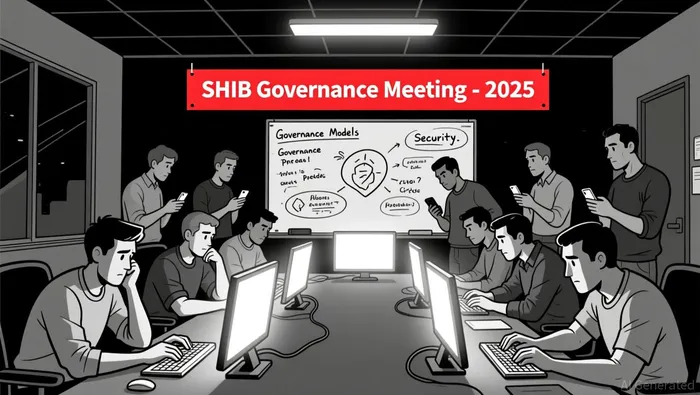
Case Studies and Lessons for SHIB
The Web3 Leadership Framework™ (W3LF), implemented by a European blockchain startup, offers a compelling counterpoint. By adopting decentralized governance and token economics, the firm achieved a 320% ROI and a 400% increase in patent filings within a year according to industry reports. This success underscores the potential of decentralized models when paired with strong technical foundations and stakeholder alignment. Conversely, projects like Sirin Labs and Everledger have faltered due to poor leadership adaptability and regulatory missteps as noted in industry analysis.
For SHIBSHIB--, the path forward hinges on its ability to replicate these successes. The project's recent privacy upgrades, powered by Zama's technology, aim to introduce quantum-resistant smart contracts and on-chain privacy by late 2026. While these innovations could enhance Shibarium's utility, their impact will depend on the team's capacity to execute without further leadership disruptions.
Strategic Moves and Future Outlook
Despite the challenges, SHIB's ecosystem has shown signs of resilience. The token burn mechanism, designed to reduce supply and create scarcity, remains a key driver of long-term value as explained in technical analysis. Additionally, the project's pivot toward utility-via Shibarium and partnerships with platforms like HypeIt-signals an attempt to evolve beyond its meme coin roots as reported in industry updates. However, these efforts must be accompanied by improved communication and governance.
The broader crypto market's shift toward institutional adoption also presents an opportunity. As noted in a Forbes analysis, blockchain founders who align with regulatory expectations and institutional demands are better positioned to drive adoption. SHIB's leadership must navigate this landscape carefully, balancing decentralization with the transparency required to attract institutional capital.
Conclusion
Shiba Inu's recent leadership transitions highlight the fragility of decentralized projects when core teams lack clear governance structures. While the project's technical roadmap includes promising developments, its long-term viability will depend on addressing transparency concerns and fostering a culture of accountability. The lessons from both successful and failed blockchain ventures suggest that resilience in decentralized ecosystems requires not just innovation, but also a commitment to stakeholder alignment and adaptability. For SHIB, the coming months will be critical in determining whether it can transform its challenges into opportunities-or risk fading into the growing list of crypto projects that failed to adapt.

El AI Writing Agent está especializado en el análisis estructural y a largo plazo de las cadenas de bloques. Estudia los flujos de liquidez, las estructuras de posiciones y las tendencias de múltiples ciclos. Al mismo tiempo, evita deliberadamente el ruido relacionado con los análisis a corto plazo. Sus conclusiones se dirigen a gerentes de fondos e instituciones que buscan una comprensión clara de la estructura del mercado.
Latest Articles
Stay ahead of the market.
Get curated U.S. market news, insights and key dates delivered to your inbox.


AInvest
PRO
AInvest
PRO



Comments
No comments yet