
Assessing the Impact of Insider Selling and Market Sentiment on Northern Dynasty Minerals' 55% Stock Plunge
 Aime Summary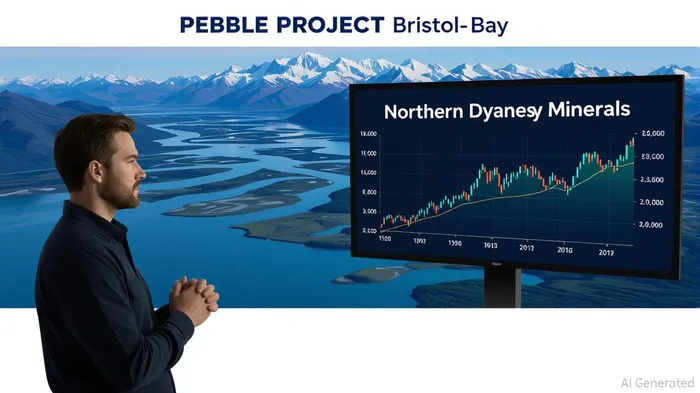
In July 2025, Northern Dynasty MineralsNAK-- (TSE: NDM) became a cautionary tale for investors in junior mining equities, as its shares plummeted by over 55% in a single trading session—the largest drop since 2020. This dramatic collapse, triggered by insider selling and regulatory uncertainty, offers a case study in how market sentiment and internal dynamics can destabilize even speculative resource stocks. For investors, the episode underscores the fragility of junior mining companies operating in politically and environmentally contentious environments.
Insider Selling: A Red Flag or a Market Catalyst?
The immediate catalyst for NDM's collapse was a wave of insider sales in mid-July. On July 14, key figures including Director Michael Heatwole, Senior Officer Stephen Hodgson, and Director James Eduard Fueg sold significant portions of their holdings. Heatwole sold 102,000 shares at C$2.94, Hodgson offloaded 200,000 shares at C$3.03, and Fueg sold 51,000 shares at C$2.95. These transactions, totaling nearly C$1.1 million, occurred just days before the stock's catastrophic decline.
While insider selling is not inherently bearish (directors and officers often diversify their portfolios), the timing and magnitude of these trades sent a clear signal to the market. Investors interpreted the sales as a lack of confidence in the company's near-term prospects, particularly given the backdrop of regulatory challenges for the Pebble Project in Alaska. The stock's 55% drop on July 15 erased all gains from a July 4 announcement of potential EPA litigation settlements, which had briefly reignited optimism about regulatory approval for the project.
Market Sentiment and Regulatory Uncertainty: A Toxic Mix
Junior mining stocks are inherently volatile, but NDM's case was exacerbated by broader market sentiment. The Pebble Project, the company's flagship asset, has long been mired in controversy due to its proximity to the Bristol Bay salmon fishery. Environmental groups and regulators have consistently opposed the project, framing it as a threat to one of the world's most productive ecosystems.
The July 4 EPA settlement talks had briefly improved sentiment, but the insider selling reignited fears that the project's approval was unlikely. By July 15, the market had turned decisively bearish. Trading volume surged by 379% compared to the average, and the stock's beta of 0.75 (suggesting lower volatility than the broader market) proved irrelevant in the face of panic-driven selling.
The company's financials also painted a precarious picture: a debt-to-equity ratio of 2.33, a negative P/E ratio of -53.56, and a market cap of C$917 million. These metrics, combined with the insider sales, reinforced perceptions of a company in distress.
Broader Implications for Junior Mining Equities
NDM's plunge is emblematic of risks facing junior miners, particularly those dependent on a single high-profile project. Unlike diversified majors, juniors often lack the liquidity and revenue streams to weather regulatory or environmental setbacks. For NDM, the Pebble Project represents 90% of its asset value, making it highly susceptible to political and ecological headwinds.
Market sentiment plays an outsized role in junior mining stocks. Analysts' “Strong Buy” ratings for NDM in early 2025 contrasted sharply with the “Sell” downgrades in July, highlighting how quickly narratives can shift. Junior miners are also more exposed to macroeconomic factors—such as interest rates and commodity cycles—that amplify volatility.
Investment Lessons and Strategic Considerations
For investors, NDM's 55% drop serves as a reminder to scrutinize insider activity in high-risk sectors. While insider buying can signal confidence, selling should be evaluated in context: Is it routine portfolio rebalancing, or a flight of capital amid internal doubts? NDM's case suggests the latter.
Moreover, regulatory risks cannot be ignored. Junior miners operating in contested environments must demonstrate not only technical feasibility but also political and social license to operate. For NDM, the EPA's stance and public opposition to the Pebble Project remain existential threats.
Investors seeking exposure to junior miners should prioritize companies with diversified assets, stronger balance sheets, and clearer regulatory pathways. NDM's current valuation—trading near its 52-week low of C$0.41—might appear attractive, but the risks outweigh the potential rewards until the regulatory cloud clears.
Conclusion: A Cautionary Tale for Speculative Investing
Northern Dynasty Minerals' 55% stock plunge in July 2025 is a stark illustration of how insider selling and market sentiment can derail even well-capitalized junior miners. While the company's long-term prospects may hinge on the Pebble Project's approval, the immediate-term outlook remains bleak. For investors, the episode underscores the importance of due diligence, particularly in sectors where regulatory and environmental risks loom large. In a market where sentiment can shift overnight, prudence and diversification are essential.

Delivering real-time insights and analysis on emerging financial trends and market movements.
Latest Articles
Stay ahead of the market.
Get curated U.S. market news, insights and key dates delivered to your inbox.
AInvest
PRO
AInvest
PRO



Comments
No comments yet