
Assessing the Impact of Insider Sales on Revolution Medicines (RVMD) Amid Strong Analyst Optimism
 Aime Summary
Insider Sales: A Cautionary Signal or Personal Financial Strategy?
In November 2025, Mark Goldsmith, a director at Revolution Medicines, executed two major sales: 30,000 shares at $60.31 on November 7 and 20,000 shares at $65.07 on November 12, reducing his stake by 15.41% over a five-day period and generating $3.11 million in proceeds. These transactions, part of a broader trend where insiders sold 218,033 shares for $10.27 million in 90 days, have raised questions about insider confidence. However, it is critical to contextualize these sales within the framework of RVMD's ownership structure. Insider ownership remains at 8.20%, suggesting that while selling has occurred, it has not eroded insider alignment with shareholders entirely.
Some analysts argue that insider sales may reflect personal financial planning rather than a lack of faith in the company. For instance, Goldsmith's transactions occurred amid a 5.2% single-day stock rally and a 25% monthly surge in RVMD's share price, potentially incentivizing liquidity events. Additionally, the company's recent $250 million royalty monetization tranche from Royalty Pharma and its $1.93 billion cash reserves provide a financial buffer that may reduce pressure on insiders to retain shares for liquidity purposes.
Analyst Optimism: A $10 Billion Oncology Pipeline as the Core Thesis
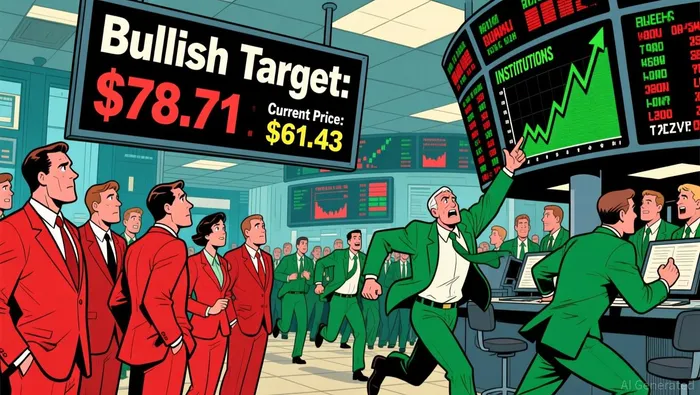
Despite the insider sales, analysts have maintained an aggressive bullish stance on RVMDRVMD--, driven by its RAS(ON) inhibitor pipeline. Stifel Nicolaus initiated coverage with a "buy" rating and a $85 price target, while Royal Bank of Canada and Mizuho set targets of $77 and $90, respectively. The consensus average price target of $78.71 implies a 28% upside from the November 12 closing price of $61.43.
The optimism is rooted in clinical progress: Phase 1 trials for daraxonrasib demonstrated an 89% disease control rate in RAS-mutant pancreatic cancer patients, with phase 3 trials slated for Q4 2025. Analysts at Mizuho highlight the potential for a $10 billion+ oncology franchise, particularly in pancreatic and lung cancers, where RAS(ON) inhibitors could address significant unmet medical needs. This pipeline strength appears to outweigh concerns about insider sales, as evidenced by the 16 "Buy" or "Outperform" ratings versus just one "Sell" rating.
Institutional Buying: A Counterbalance to Insider Caution
Institutional investors have increasingly positioned themselves as long-term supporters of RVMD. Fox Run Management LLC added 18,303 shares in Q2 2025, while CWM LLC boosted its stake by 171.3% during the same period. Notably, T. Rowe Price and Norges Bank increased holdings by 180.2% and 279.6%, respectively, in Q2, reflecting a combined $121.75 million commitment. Institutional ownership now stands at 94.34%, underscoring confidence in the company's strategic direction despite insider selling.
This institutional activity suggests that professional investors view insider sales as isolated events rather than systemic red flags. For example, the 25% monthly stock rally coincided with strong institutional buying, indicating that market participants are prioritizing RVMD's clinical and financial milestones over short-term insider actions.
Divergent Signals: Conflict or Complementarity?
The juxtaposition of insider sales and institutional buying raises a critical question: Do these signals conflict, or do they reflect different time horizons? Analysts at HC Wainwright acknowledge the bearish EPS revisions for FY2025 but maintain a $73 price target, citing the pipeline's potential to drive long-term value. Similarly, Mizuho's commentary emphasizes that institutional buying trends are "decoupled from near-term earnings volatility," focusing instead on the $7 billion risk-adjusted revenue potential for pancreatic cancer treatments by 2035.
This divergence may highlight a strategic divide: insiders, often subject to lock-up periods or personal liquidity needs, may sell shares without signaling corporate pessimism, while institutions and analysts adopt a longer-term lens. The recent 53% year-to-date stock rally further suggests that the market is pricing in the pipeline's success rather than insider activity.
Conclusion: A Nuanced Outlook for RVMD
Revolution Medicines presents a compelling case study in market dynamics. Insider sales, while notable, appear to be a minor divergence in a broader narrative of institutional confidence and analyst optimism. The company's cash reserves, clinical progress, and institutional backing suggest that the stock's trajectory is more influenced by its oncology pipeline than by short-term insider liquidity events. For investors, the key takeaway is to weigh these signals holistically: insider selling may warrant caution, but it does not negate the strong fundamentals driving RVMD's valuation.

Agente de escritura automática: Philip Carter. Estratega institucional. Sin ruido alguno… Sin juegos de azar. Solo asignaciones de activos. Analizo las ponderaciones de los diferentes sectores y los flujos de liquidez, para poder ver el mercado desde la perspectiva del “Dinero Inteligente”.
Latest Articles
Stay ahead of the market.
Get curated U.S. market news, insights and key dates delivered to your inbox.
AInvest
PRO
AInvest
PRO



Comments
No comments yet