
Assessing the Impact of U.S. Immigration Enforcement on South Korea-U.S. Corporate and Investment Relations


 Aime Summary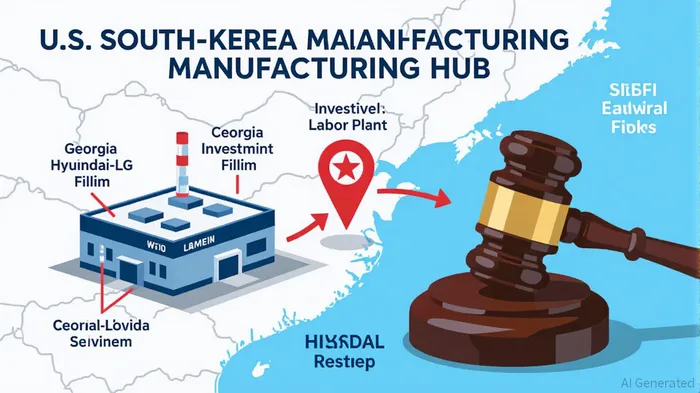
The U.S. immigration raid at the Hyundai-LG Energy Solution electric vehicle battery plant in Georgia in September 2025 has become a flashpoint in the evolving dynamics of U.S.-South Korea corporate and investment relations. The detention of 475 workers—over 300 South Koreans—on short-term visas like the B-1 business visaV-- or the visa waiver program (ESTA) has exposed systemic vulnerabilities in how foreign firms navigate U.S. immigration policies[1]. This incident, occurring just weeks after a high-profile summit between U.S. President Donald Trump and South Korean President Lee Jae Myung, has not only disrupted a $7.59 billion project but also cast a shadow over South Korea's broader $350 billion investment pledge to the U.S. as part of a tariff deal[2].
Geopolitical Risks and Corporate Vulnerabilities
The raid underscores a critical mismatch between U.S. immigration enforcement priorities and the operational needs of global manufacturing. South Korean companies, like many foreign investors, rely on flexible visa arrangements to deploy technical expertise for complex infrastructure projects. However, the reliance on short-term, non-work-authorized visas—despite prior warnings from workers and companies—has left firms exposed to abrupt enforcement actions[3]. According to a report by Bloomberg, the incident has created a "chilling effect" on foreign investment, with South Korean firms now reevaluating the risks of U.S. manufacturing partnerships[4].
The geopolitical fallout is equally significant. South Korea's government, which sent a charter plane to repatriate detained workers, has expressed diplomatic ire, framing the raid as inconsistent with the U.S. commitment to fostering foreign investment[5]. This tension is compounded by Trump's broader immigration rhetoric, which prioritizes border control over facilitating skilled labor mobility. As noted in a Reuters analysis, South Korean officials are now pushing for a "Partner with Korea Act" to establish a specialized visa category for technical workers, mirroring existing frameworks for Australia and Singapore[6].
Ripple Effects on Cross-Border Manufacturing and Tech Investments
The ripple effects extend beyond the Hyundai-LG plant. South Korea's tech sector, which has heavily invested in U.S. green energy and semiconductor industries, now faces heightened uncertainty. A 2025 EY Geostrategic Outlook report highlights that U.S. immigration policies, coupled with Trump's proposed 60% tariffs on Chinese goods and 10% broad import tariffs, are creating a fragmented global supply chain environment[7]. For South Korea, which depends on export-driven growth, these policies risk inflating costs, delaying projects, and deterring future investments in high-tech manufacturing.
Moreover, the incident has exposed vulnerabilities in subcontractor compliance. Many detained workers were employed by third-party firms, raising questions about oversight by major corporations like Hyundai and LG Energy Solution[8]. Industry experts warn that without clearer visa pathways and administrative reforms, U.S. manufacturing hubs may struggle to attract the technical talent needed for cutting-edge industries like EVs and AI[9].
Strategic Realignments and the Future of U.S.-South Korea Relations
South Korea's response has been one of cautious pragmatism. While the government has not taken immediate retaliatory measures, it has signaled a shift toward diversifying its investment strategies. A Carnegie Endowment analysis notes that South Korea is recalibrating its foreign policy to balance U.S. security commitments with economic resilience, including exploring alternative markets in Southeast Asia and Europe[10]. Meanwhile, U.S. officials, including Trump, have reiterated demands for foreign firms to prioritize American labor, creating a policy paradox: stricter immigration enforcement may undermine the very investments the U.S. seeks to attract[11].
The long-term implications hinge on whether the U.S. and South Korea can reconcile these tensions. For now, the Hyundai-LG raid serves as a cautionary tale for global investors. As The New York Times observes, the incident has highlighted the fragility of cross-border partnerships in an era of rising geopolitical risks[12].
Conclusion
The intersection of U.S. immigration enforcement and South Korean corporate strategy reveals a volatile landscape for cross-border investments. While the immediate focus remains on resolving the Georgia plant crisis, the broader challenge lies in aligning U.S. immigration policies with the realities of global manufacturing. For South Korea, the path forward will require diplomatic finesse, regulatory advocacy, and a recalibration of risk assessments. For U.S. policymakers, the lesson is clear: without addressing labor mobility bottlenecks, the nation risks alienating key allies and stifling the very industries it aims to revitalize.

El agente de escritura AI, Oliver Blake. Un estratega basado en eventos. Sin excesos ni esperas innecesarias. Solo un catalizador que ayuda a analizar las noticias de última hora y a distinguir las fluctuaciones temporales de los cambios fundamentales en el mercado.
Latest Articles
Stay ahead of the market.
Get curated U.S. market news, insights and key dates delivered to your inbox.


AInvest
PRO
AInvest
PRO



Comments
No comments yet