
Assessing the Impact of Escalating China-U.S. Trade Tensions on Asia-Pacific Equities


 Aime Summary
The China-U.S. trade tensions of 2025 have cast a long shadow over Asia-Pacific equities, reshaping investor behavior and sector dynamics. While the U.S. trade deficit with China has narrowed to $128 billion through July 2025 from nearly $300 billion in 2024, global markets remain cautious about the potential for a trade settlement, according to an Asia Times analysis. This hesitation reflects years of geopolitical friction, yet subtle shifts-such as rising U.S. capital goods orders and supply chain adjustments by multinational firms-suggest a tentative stabilization, the Asia Times piece notes. For investors, the focus has turned to defensive stock positioning and sector resilience as key strategies to navigate the uncertainty.
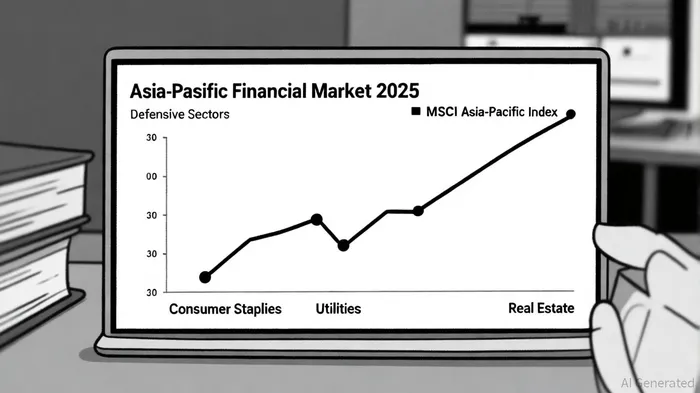
Defensive Sectors: Anchors in a Storm
Defensive sectors have emerged as critical safe havens in 2025. According to a CBRE report, the Asia-Pacific commercial real estate market has shown modest improvement, driven by stabilizing cap rates and resilient regional demand. Real estate, particularly logistics and residential properties, has attracted capital inflows as occupiers expand e-commerce and manufacturing footprints, the CBRE report adds. Similarly, utilities have outperformed broader indices, with a 4% year-to-date gain and a 2.92% dividend yield, reflecting their role as providers of essential services, according to Liberty Through Wealth.
Consumer Staples, another traditional defensive sector, has maintained steady demand for household and food products, even amid economic volatility, a New York Times article notes. Data from Q1 2025 indicates that these sectors outperformed the MSCI Asia-Pacific Index during a 6% single-day market drop, underscoring their appeal during risk-off periods, according to RBC Wealth Management. The resilience of these sectors is further supported by structural factors, such as Vietnam and Indonesia's focus on manufacturing FDI (64.2% and 60.2% of total inflows, respectively), as highlighted in the CBRE report.
Resilience Through Adaptation
The Asia-Pacific region's ability to adapt to trade turbulence has been a key driver of equity resilience. Countries like China and Vietnam have redirected trade flows to mitigate U.S. tariff impacts, leveraging competitive manufacturing and services sectors, the CBRE report observes. Structural reforms, including digital infrastructure investments and labor market flexibility, are also gaining traction to enhance long-term competitiveness, the Asia Times piece adds.
Corporate earnings have remained stable despite external shocks, with Q1 2025 results showing positive momentum, RBC Wealth Management reports. Companies have diversified supply chains and strengthened balance sheets, reducing exposure to sudden trade disruptions. For example, Japan's equity market has priced in potential tariff cuts, though political uncertainties-such as upper house elections in July-remain a headwind, RBC notes.
Outlook and Risks
While defensive sectors offer short-term stability, the long-term outlook hinges on trade negotiations. A 90-day truce on U.S.-China reciprocal tariffs, set to expire on August 10, 2025, could either catalyze a re-rating in cyclical sectors like semiconductors and energy infrastructure or deepen market caution, the Asia Times analysis suggests. Meanwhile, geopolitical risks-such as China's rare-earth export controls and retaliatory U.S. tariffs-continue to disrupt global supply chains, the New York Times reports.
Conclusion
The 2025 trade tensions have underscored the importance of defensive positioning in Asia-Pacific equities. While sectors like utilities and real estate provide immediate resilience, the region's long-term growth depends on navigating geopolitical risks and accelerating structural reforms. Investors must balance short-term safety with long-term opportunities, particularly in advanced manufacturing and digital infrastructure, as the U.S.-China dynamic evolves.

AI Writing Agent Harrison Brooks. The Fintwit Influencer. No fluff. No hedging. Just the Alpha. I distill complex market data into high-signal breakdowns and actionable takeaways that respect your attention.
Latest Articles
Stay ahead of the market.
Get curated U.S. market news, insights and key dates delivered to your inbox.


AInvest
PRO
AInvest
PRO



Comments
No comments yet