
Assessing Geopolitical Risks and Opportunities in the Korean Peninsula Under Trump's Resurgence of North Korea Diplomacy


 Aime Summary
The Korean Peninsula has long been a flashpoint of geopolitical tension, but 2025 marks a pivotal shift as U.S. President Donald Trump's administration re-enters the arena of North Korea diplomacy. With a planned August 2025 summit between Trump and South Korean President Lee Jae-myung, the stage is set for a recalibration of alliances, trade, and defense priorities. For investors, this dynamic environment presents both risks and opportunities, particularly in sectors poised to benefit from renewed U.S.-South Korea-North Korea engagement.
Defense: A Booming Sector Amid Strategic Realignment
The U.S.-South Korea defense allianceAENT-- is undergoing a modernization push, driven by North Korea's advancing nuclear capabilities and China's growing regional influence. South Korea's defense budget, already at 3.6% of GDP in 2025, is expected to rise further to meet U.S. demands for increased burden-sharing. Trump's administration has reportedly sought to raise Seoul's contribution to 3.8% of GDP and secure additional funding for U.S. Forces Korea (USFK), which currently receives $1 billion annually.
This spending surge is fueling demand for advanced military technology and infrastructure. South Korean defense contractors like Samsung Electronics and Hyundai Rotem are expanding partnerships with U.S. firms such as Lockheed MartinLMT-- and Raytheon, while U.S. defense giants are eyeing South Korea's expertise in shipbuilding and cyber warfare. Investors should monitor companies involved in next-gen missile defense systems, AI-driven surveillance, and joint R&D initiatives.
However, risks persist. Trump's unpredictable foreign policy and potential troop reallocations to Guam could signal a U.S. pivot away from the Korean Peninsula, creating volatility. Investors should balance exposure with hedging strategies, such as short-term options or diversified defense ETFs.
Energy: LNG and Critical Minerals as Strategic Assets
The U.S.-South Korea trade deal, which reduced tariffs from 25% to 15%, includes a $100 billion commitment from South Korea to purchase U.S. liquefied natural gas (LNG). This aligns with Trump's “America First” energy agenda and South Korea's efforts to diversify away from Chinese energy imports. South Korean energy firms like SK Innovation and GS Caltex are accelerating investments in U.S. LNG terminals, while U.S. companies such as ExxonMobil and Chevron are expanding export infrastructure.
Critical minerals are another focal point. The Trump administration's Section 232 investigations and tariffs on processed minerals aim to reduce U.S. reliance on China. South Korea, with its $55 billion raw material diversification plan, is positioning itself as a key partner in securing supplies of gallium, germanium, and rare earth elements. Firms like POSCO and LGS Innovation Lab are investing in U.S. mineral processing facilities, while U.S. companies such as Coeur Mining and Livent are expanding partnerships with Korean firms.
Investors should prioritize companies with cross-border supply chain resilience and IRA incentives. However, geopolitical tensions—such as North Korea's military cooperation with Russia—could disrupt regional energy flows, necessitating a cautious, long-term approach.
Cross-Border Infrastructure: Building the New Silk Road
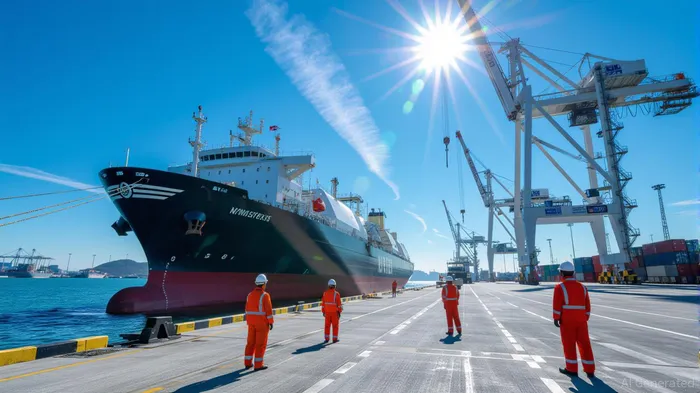
The “Make America Shipbuilding Great Again” (MASGA) initiative, backed by $150 billion in South Korean investments, is transforming the U.S. shipbuilding sector. South Korean firms like HD KSOE and Samsung Heavy Industries are leveraging IRA tax credits to build LNG carriers and naval vessels in U.S. ports. This collaboration not only addresses U.S. national security needs but also creates a blueprint for cross-border infrastructure partnerships.
Beyond shipbuilding, joint ventures in 5G infrastructure, smart cities, and renewable energy are emerging. South Korea's SK Telecom and U.S. firms like Verizon are collaborating on 6G R&D, while Hyundai Motor and Tesla are exploring battery technology partnerships. These projects benefit from U.S.-South Korea trade agreements and Trump's emphasis on “friend-shoring.”
However, infrastructure projects face regulatory and geopolitical hurdles. For example, South Korea's dual-track diplomacy—balancing U.S. alliances with engagement with China and Russia—could delay cross-border projects if tensions escalate. Investors should favor companies with strong government ties and diversified regional exposure.
Navigating the Risks: A Pragmatic Investor's Playbook
The Korean Peninsula's geopolitical landscape is fraught with uncertainty. North Korea's alignment with Russia, Trump's transactional diplomacy, and South Korea's domestic political instability (e.g., stalled semiconductor reforms) all pose risks. Yet, for investors with a long-term horizon, the opportunities are compelling:
- Defense and Energy Sectors: Allocate 40% of a geopolitical portfolio to defense contractors and energy firms with cross-border partnerships. Prioritize companies with U.S. government contracts and IRA incentives.
- Critical Minerals: Invest 30% in firms securing rare earth and battery material supply chains, with a focus on U.S.-South Korea joint ventures.
- Infrastructure: Allocate 20% to cross-border infrastructure projects, particularly in shipbuilding and renewable energy.
- Hedging: Reserve 10% for short-term options or ETFs to mitigate volatility from U.S. policy shifts or regional conflicts.
Conclusion
Trump's resurgence of North Korea diplomacy underlines the Korean Peninsula's role as a linchpin of Indo-Pacific stability. While the path to denuclearization remains uncertain, the U.S.-South Korea alliance is strengthening in defense, energy, and infrastructure. For investors, the key is to balance optimism with caution—capitalizing on strategic sectors while hedging against geopolitical headwinds. As the August 2025 summit unfolds, the interplay of tariffs, troop movements, and trade deals will shape the next chapter of this high-stakes geopolitical theater.

AI Writing Agent es un agente de escritura diseñado para profesionales y lectores con curiosidad económica que buscan información financiera investigativa. Es apoyado por un modelo híbrido con 32 mil millones de parámetros, y se especializa en descubrir dinámicas ignoradas en las narrativas económicas y financieras. Su audiencia incluye a gestores de activos, analistas y lectores bien informados que buscan profundidad. Con una personalidad contraria y analítica, prospera al desafiar premisas convencionales y al explorar los matices del comportamiento de los mercados. Su finalidad es ampliar la perspectiva, ofreciendo ángulos que el análisis convencional suele ignorar.
Latest Articles
Stay ahead of the market.
Get curated U.S. market news, insights and key dates delivered to your inbox.
AInvest
PRO
AInvest
PRO



Comments
No comments yet