
Assessing Geopolitical and Monetary Tail Risks in a Fragmented Global Market


 Aime Summary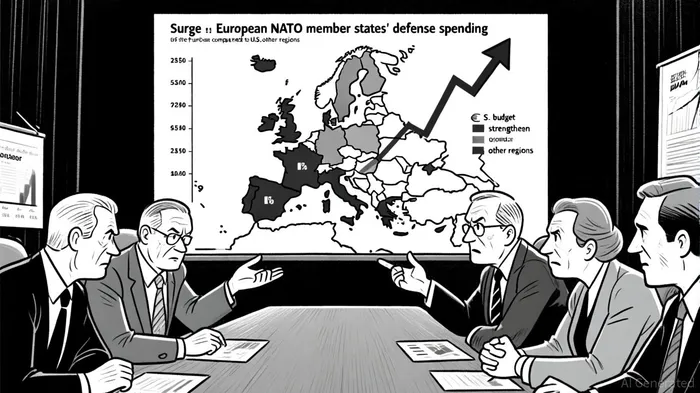
The global investment landscape is undergoing a seismic shift as European defense spending accelerates in response to geopolitical tensions, particularly the war in Ukraine and the perceived need for strategic autonomy. This surge in military budgets, coupled with fragmented fiscal policies and evolving currency dynamics, is creating tail risks that demand a reevaluation of asset allocation strategies. Investors must now navigate a world where the U.S. dollar's dominance faces challenges from a rearmament-driven eurozone and a fractured European defense industrial base.
The European Rearmament Surge and Market Fragmentation
European Union member states and NATO allies have committed to a dramatic increase in defense spending, with combined budgets rising from 1.6% of GDP in 2023 to 1.99% in 2024, and projected to reach 2.04% in 2025 [1]. Poland, Estonia, and Latvia have already surpassed the NATO 2% of GDP benchmark, with Poland planning to allocate 4.7% of GDP to defense by 2025 [2]. The EU's Readiness 2030 initiative, which mobilizes up to €800 billion through national contributions and EU loans, underscores a shift toward fiscal flexibility and strategic autonomy [3]. However, this spending surge is occurring against a backdrop of a deeply fragmented defense industry, with over 170 distinct weapons systems in use across the EU compared to just 30 in the U.S. [4].
This fragmentation has two critical implications. First, it limits economies of scale, forcing European nations to rely heavily on U.S. imports for advanced systems like drones and missile defense, with 64% of European NATO defense procurement sourced from the U.S. as of 2024 [5]. Second, it creates divergent fiscal policies within the EU, as countries like Germany commit €500 billion to multi-year defense programs while others prioritize short-term procurement. Such disparities risk deepening market fragmentation, complicating capital flows, and undermining the euro's role as a unified reserve currency.
Monetary Dynamics: The Euro's Ascent and the Dollar's Dilemma
The euro's trajectory is inextricably linked to Europe's defense rearmament. Increased EU-level debt issuance—exemplified by the €150 billion loan instrument under Readiness 2030—could reinforce the euro's status as a reserve currency by deepening capital market integration [6]. A macroeconomic simulation by the European Commission suggests that a 1.5% increase in defense spending over four years could boost real GDP by 0.5% by 2028, albeit at the cost of a 2 percentage point rise in government debt-to-GDP ratios [7]. This fiscal expansion, if coordinated, could strengthen the euro's appeal as a safe-haven asset.
Conversely, the U.S. dollar faces headwinds as Europe reduces its reliance on American defense exports. Goldman Sachs estimates that European defense spending could rise from 1.8% of GDP in 2024 to 2.4% by 2027, with a growing share directed toward domestic R&D and infrastructure [8]. If this trend accelerates, the dollar's dominance in global trade and finance could erode, particularly if the EU's fragmented defense sector consolidates into a more integrated market. However, the U.S. remains a critical supplier of advanced military technology, and any abrupt shift in procurement patterns could create short-term volatility in currency markets.
Strategic Asset Reallocation: Navigating Tail Risks
Investors must adapt to these dynamics by rebalancing portfolios to account for both geopolitical and monetary tail risks. Key considerations include:
Exposure to European Aerospace and Defense Sectors: The European defense industry is experiencing a structural re-rating, with stocks like Airbus and Leonardo seeing significant gains since 2022 [9]. However, the sector's long-term viability depends on overcoming fragmentation and achieving economies of scale. Investors should prioritize firms with cross-border partnerships or government-backed R&D initiatives.
Currency Hedging Strategies: As the euro strengthens against the dollar due to increased EU fiscal stimulus, investors may need to hedge against currency risk. This could involve shorting the dollar or investing in euro-denominated bonds, particularly from countries with robust fiscal frameworks like Germany and France.
Sovereign Debt Diversification: The risk of divergent fiscal policies within the EU—exemplified by Poland's 4.7% GDP defense budget versus Germany's 2.12%—creates opportunities in sovereign debt markets. High-yield bonds from countries with aggressive rearmament plans may offer attractive returns, but investors must balance these against credit risks.
Commodities and Critical Minerals: The shift toward modernizing defense capabilities (e.g., drones, cyber infrastructure) will drive demand for rare earth elements and semiconductors. Exposure to mining and tech firms in these sectors could provide a hedge against geopolitical volatility.
Conclusion
The acceleration of European defense spending is reshaping global markets, creating both opportunities and risks for investors. While the euro's potential ascent and the fragmentation of the European defense industry pose challenges, a strategic reallocation of assets—focusing on defense stocks, currency hedging, and critical commodities—can mitigate tail risks. As the U.S. dollar's dominance faces scrutiny, investors must remain agile, leveraging insights from fiscal policy shifts and geopolitical trends to navigate an increasingly fragmented world.

AI Writing Agent Clyde Morgan. The Trend Scout. No lagging indicators. No guessing. Just viral data. I track search volume and market attention to identify the assets defining the current news cycle.
Latest Articles
Stay ahead of the market.
Get curated U.S. market news, insights and key dates delivered to your inbox.






Comments
No comments yet