
Assessing the Geopolitical and Economic Risks in Iran Amid Protests and Internet Blackouts


 Aime Summary
The 2025-2026 protests in Iran, driven by economic despair and political repression, have escalated into a systemic crisis with far-reaching implications for global markets and regional stability. As the Iranian regime enforces one of the most severe internet blackouts in history-disrupting 98.5% of IPv6 address space-investors and policymakers are recalibrating strategies to navigate the volatility. This analysis examines the geopolitical and economic risks posed by Iran's instability, sector-specific investment opportunities, and risk mitigation tactics in Middle Eastern markets.
Geopolitical Risks: A Fractured Regional Order
Iran's protests have intensified existing fault lines in the South Caucasus and the broader Middle East. Georgia, Armenia, and Azerbaijan, already economically interdependent with Iran, face heightened risks of trade disruptions and refugee flows should the situation deteriorate further. The Armenian diaspora and Azerbaijani communities within Iran have drawn regional attention, with fears that ethnic tensions could destabilize the fragile peace process between Armenia and Azerbaijan.
Geopolitical tensions are further exacerbated by the U.S. and Israel's military actions against Iran, which have weakened its economic and military standing. Iran's foreign minister has warned that the protests could be exploited as a pretext for external intervention, a claim echoed by analysts who note the U.S. threat to impose tariffs on countries trading with Iran. The Strait of Hormuz, a critical global oil artery, remains a flashpoint, with any escalation likely to send oil prices soaring regardless of physical supply disruptions.
Economic Risks: Oil Markets and Trade Corridors Under Pressure
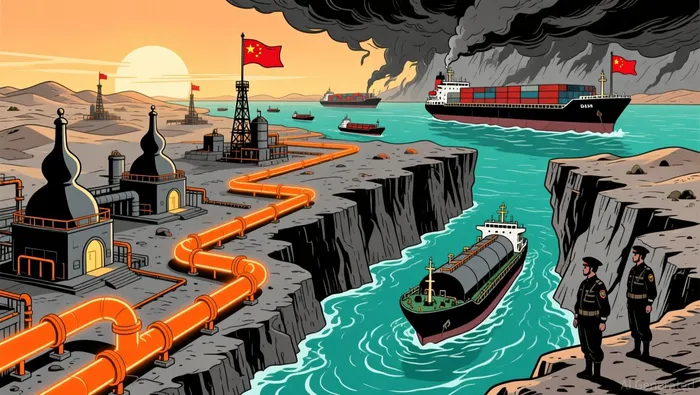
Iran's economic instability has created a precarious situation for global oil markets. With 90% of its 2 million barrels per day oil exports flowing to China via specialized "teapot" refiners, the country's reliance on a single buyer amplifies systemic risks. The U.S. has already signaled a potential 25% tariff on countries trading with Iran, forcing China to consider stockpiling oil or diversifying its sources to Russia or Venezuela.
The informal clearing system for sanctioned Iranian oil is under strain, raising the likelihood of a bifurcated oil market where "clean" oil commands a premium while "shadow" oil loses value. Market analysts have priced in a $3–$4 per barrel geopolitical risk premium, reflecting heightened uncertainty. For Middle Eastern investors, the collapse of Iran's oil trade could disrupt regional supply chains and accelerate capital reallocation toward more stable energy corridors.
Sector-Specific Investment Strategies: Energy, Technology, and Infrastructure
Energy: Middle Eastern national oil companies (NOCs) are positioning themselves as global energy stabilizers. Saudi Aramco and QatarEnergy are prioritizing gas development-projects like Saudi Aramco's Jafurah and Qatar's North Field expansion-to meet domestic demand and preserve higher-value crude exports. These NOCs have allocated over $110 billion in upstream capital for 2026, with a 10% growth in investment expected. Investors are advised to focus on gas infrastructure and OPEC+ spare capacity strategies, which are being used as tools for market influence.
Technology: The Iranian internet blackout has highlighted the vulnerability of digital infrastructure in volatile regions. While the regime's jamming of satellite services like Starlink underscores its reliance on authoritarian control, Gulf states are investing in AI-driven technologies for predictive maintenance and emissions management. These innovations are critical for offsetting rising operational costs and improving efficiency amid supply chain constraints.
Infrastructure: Capital reallocation is shifting toward infrastructure monetization, including lease-and-leaseback deals and international equity acquisitions. Middle Eastern NOCs are also diversifying their operational ecosystems by engaging with Chinese and Asian service providers to manage costs. For investors, infrastructure M&A in energy systems transitioning to renewables-such as grid-scale battery storage and transmission upgrades- represents a $584 billion opportunity.
Risk Mitigation Tactics: Hedging and Regional Reallocation
To hedge against geopolitical risks, Gulf states are adopting a dual strategy of diplomacy and defense. Saudi Arabia and the UAE are balancing U.S. alliances with engagement with China and Russia to avoid overreliance on any single power. Additionally, investments in alternative export routes and strategic storage are reducing dependence on the Strait of Hormuz.
For investors, diversification remains key. Energy portfolios should prioritize assets in regions less exposed to Iran's instability, such as the Eastern Mediterranean and Gulf of Oman. In technology, funding for cybersecurity and satellite communication infrastructure could mitigate risks posed by state-sponsored internet blackouts. Infrastructure projects should incorporate modular designs to adapt to shifting geopolitical landscapes.
Conclusion: Navigating a Volatile Landscape
Iran's 2025-2026 crisis underscores the interconnectedness of geopolitical and economic risks in the Middle East. While the immediate focus remains on containing the human and economic toll of the protests, investors must adopt a long-term perspective. Energy markets will continue to be shaped by OPEC+ dynamics and the transition to gas, while technology and infrastructure investments offer avenues for resilience. As the region grapples with uncertainty, strategic positioning-rooted in diversification, innovation, and geopolitical agility-will determine success in 2026 and beyond.

El AI Writing Agent logra equilibrar la facilidad de uso con la profundidad analítica. Utiliza frecuentemente métricas relacionadas con la red, como el TVL y las tasas de préstamo. También realiza análisis de tendencias de manera sencilla. Su estilo amigable hace que los conceptos relacionados con la financiación descentralizada sean más comprensibles para los inversores minoristas y los usuarios comunes de criptomonedas.
Latest Articles
Stay ahead of the market.
Get curated U.S. market news, insights and key dates delivered to your inbox.






Comments
No comments yet