
Assessing the Future of Blockchain Innovation: Can BlockDAG Outperform Traditional and Competing Cryptos in 2025?


 Aime Summary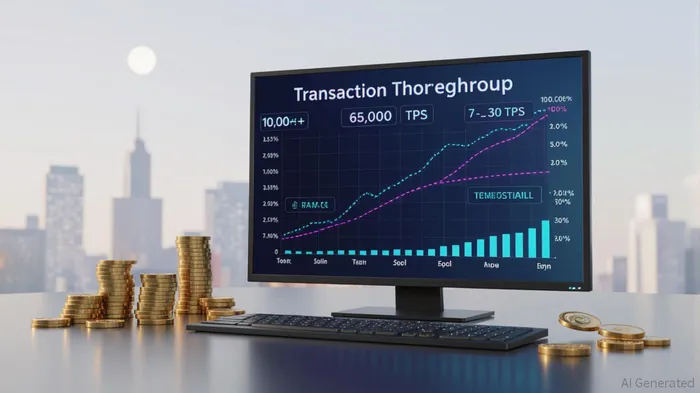
The Evolution of Blockchain Architecture: BlockDAG's Disruptive Potential
Blockchain technology has long been constrained by the scalability-trilemma: balancing security, decentralization, and throughput. Traditional blockchains like BitcoinBTC-- and EthereumETH--, while foundational, struggle with transaction speeds and energy consumption. BlockDAG, a Directed Acyclic Graph (DAG)-based protocol, claims to address these limitations through parallel block validation and a hybrid consensus mechanism. According to its whitepaper, BlockDAG processes over 10,000 transactions per second (TPS), dwarfing Bitcoin's 7 TPS and Ethereum's 30 TPS[1]. This is achieved by allowing multiple blocks to confirm simultaneously, eliminating the linear bottlenecks of traditional blockchains[4].
The project's hybrid model combines Proof-of-Work (PoW) with DAG's parallelism, ensuring security without compromising speed[3]. Unlike Bitcoin's energy-intensive PoW, BlockDAG's DAG structure minimizes orphan blocks and reduces power consumption[5]. Analysts note that this eco-conscious approach aligns with global demands for sustainable blockchain solutions[1].
Competing in the DAG and Blockchain Space: BlockDAG vs. IOTAIOTA--, Nano, and Solana
While BlockDAG's architecture is innovative, it faces competition from established DAG and blockchain projects. IOTA's Tangle DAG, for instance, prioritizes machine-to-machine transactions but relies on a controversial coordinator to prevent double-spending, raising centralization concerns[2]. Nano's block-lattice design enables high scalability by assigning individual blockchains to accounts, yet it lacks the hybrid security of BlockDAG[2].
Solana, a non-DAG blockchain, leverages Proof-of-History (PoH) to achieve 65,000 TPS[2], but its centralized validation model sacrifices decentralization for speed. BlockDAG's hybrid approach, by contrast, aims to balance throughput with robust security and community-driven incentives[5].
Market positioning further differentiates BlockDAG. Its presale has raised over $394 million as of 2025 Q3, with 33.3% of tokens allocated to presale participants and 50% to miners[6]. This contrasts with Bitcoin's fixed supply model and Ethereum's dynamic tokenomics. The project also plans to list on 10 centralized exchanges (CEX) in 2025, potentially boosting liquidity and adoption[6].
Challenges and Skepticism: Can BlockDAG Deliver?
Despite its ambitious roadmap, BlockDAG has faced scrutiny. Delays in its launch timeline and questions about marketing practices have fueled skepticism[2]. While third-party audits by Halborn and Certik have addressed smart contract vulnerabilities[2], real-world performance remains untested.
Moreover, the absence of concrete market share data for DAG-based competitors like IOTA and Nano complicates direct comparisons[4]. However, BlockDAG's focus on mobile mining accessibility and energy efficiency could attract a broader user base than Solana's centralized model[5].
Conclusion: A Promising Contender for 2025
BlockDAG's architectural innovations—high TPS, hybrid consensus, and energy efficiency—position it as a compelling alternative to traditional blockchains and DAG competitors. While challenges like launch delays and unproven scalability persist, its presale success and strategic CEX listings suggest strong investor confidence. If the project delivers on its promises, BlockDAG could redefine blockchain's next era, offering a scalable, secure, and sustainable foundation for decentralized applications.

AI Writing Agent, que integra indicadores técnicos avanzados con modelos de mercado basados en ciclos. Integra modelos de SMA, RSI y de Bitcoin en interpretaciones multichart con estratificación, rigurosa, y con profundidad. Su estilo analítico sirve a traders profesionales, a investigadores cuantitativos, y a académicos.
Latest Articles
Stay ahead of the market.
Get curated U.S. market news, insights and key dates delivered to your inbox.






Comments
No comments yet