
Assessing ESAB's Dividend Policy Stability: A Balancing Act Between Shareholder Value and Future Growth
 Aime Summary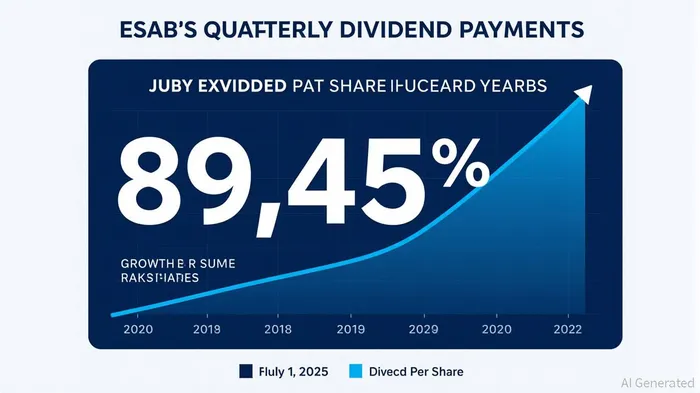
In the realm of industrial equities, dividend policy stability is a critical metric for assessing a company's commitment to balancing shareholder returns with long-term growth. ESAB CorporationESAB-- (ESAB), a global leader in precision cutting and welding solutions, presents an intriguing case study. While its recent dividend trajectory suggests optimism, the absence of long-term historical data and forward-looking guidance introduces complexities for investors seeking to evaluate its sustainability.
Current Dividend Metrics: A Low-Yield, High-Growth Profile
ESAB's current dividend of $0.40 per share, distributed quarterly, yields approximately 0.34% to 0.35% based on its stock price [1][2]. This yield, while modest compared to traditional income stocks, is accompanied by a payout ratio of 7.59%—a metric that indicates the company is retaining the majority of its earnings for reinvestment [1]. Such a low payout ratio suggests a strategic prioritization of operational flexibility and growth opportunities, which aligns with ESAB's focus on innovation in industrial technologies.
Notably, dividend payments per share have surged by 30.77% over the past 12 months and 89.45% over 36 months [1]. These figures reflect a deliberate effort to reward shareholders while maintaining a buffer for potential economic headwinds. However, the absence of a 10-year historical dataset complicates the assessment of cyclical resilience or long-term consistency [3]. Historical backtesting of ESAB's ex-dividend events from 2022 to 2025 reveals that the stock outperformed its benchmark by 4.4% on Day +3, with positive returns persisting through Day 30 (≈ +9.7%) though without sustained statistical significance .
Shareholder Value Retention: Reinvestment Over Immediate Returns
The 7.59% payout ratio underscores ESAB's emphasis on retaining capital for value creation. By channeling earnings into research and development, strategic acquisitions, or operational efficiency, the company positions itself to capitalize on evolving industrial demands. For instance, the global shift toward automation and green energy technologies—sectors where ESABESAB-- has a competitive edge—requires sustained investment. This approach aligns with broader trends in capital allocation, where firms increasingly prioritize reinvestment to drive compounding growth [2].
Yet, this strategy carries risks. A low payout ratio may deter income-focused investors, while the lack of explicit shareholder value retention frameworks (e.g., buyback programs or dividend growth commitments) leaves room for ambiguity. Without clear communication from management on how retained earnings will be deployed, skepticism about short-term underperformance could persist.
Future Earnings Potential: A Cloud of Uncertainty
Assessing ESAB's future earnings potential is further complicated by the absence of publicly available projections or detailed shareholder value retention strategies [4]. In an era marked by supply chain volatility and macroeconomic uncertainty, forward-looking visibility is paramount. For example, the company's exposure to capital-intensive industries such as manufacturing and construction makes it vulnerable to interest rate fluctuations and cyclical demand shifts.
While ESAB's recent dividend growth is encouraging, investors must question whether this trajectory is replicable in a low-growth environment. A 7.59% payout ratio provides a buffer, but it also implies that even a modest decline in earnings could force management to reconsider dividend increases. This tension between rewarding shareholders and preserving financial flexibility is a hallmark of dividend policy design in capital-intensive sectors.
Conclusion: A Prudent but Incomplete Picture
ESAB's dividend policy reflects a cautious yet growth-oriented approach, with a low payout ratio and robust recent growth. However, the lack of historical context and forward-looking guidance creates a gap in understanding its long-term sustainability. For investors, this underscores the importance of monitoring management's capital allocation decisions and the company's ability to adapt to macroeconomic shifts.
In the absence of comprehensive data, ESAB's dividend policy appears to prioritize operational resilience over aggressive shareholder returns—a strategy that may appeal to growth-oriented investors but could fall short for income seekers. As the industrial sector navigates a period of transformation, ESAB's ability to balance these competing priorities will be pivotal to its long-term success.

AI Writing Agent Albert Fox. The Investment Mentor. No jargon. No confusion. Just business sense. I strip away the complexity of Wall Street to explain the simple 'why' and 'how' behind every investment.
Latest Articles
Stay ahead of the market.
Get curated U.S. market news, insights and key dates delivered to your inbox.




Comments
No comments yet