
Assessing Emerging Risks in Aerospace and Software-Dependent Sectors for Investors


 Aime Summary
The Airbus A320 Crisis: A Case Study in Systemic Risk
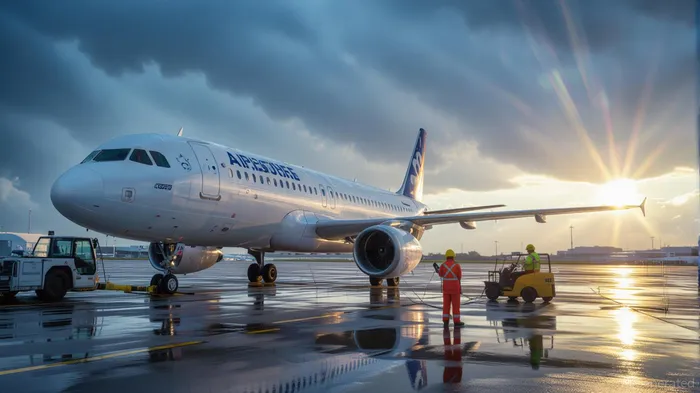
The grounding of Airbus A320 Family aircraft-spanning A319, A320, and A321 models-was precipitated by a flaw in software version L104, which governs flight control surfaces. According to a report by , intense solar radiation disrupted the ELAC B's calculations, . The European Union Aviation Safety Agency (EASA) swiftly issued an Emergency Airworthiness Directive, mandating either a software rollback or hardware replacement, a process requiring three hours per aircraft.
This incident is emblematic of a broader trend: as aerospace systems grow increasingly reliant on fly-by-wire technology, their susceptibility to space weather events-such as solar flares and geomagnetic storms-rises exponentially. At cruising altitudes, high-energy particles from solar eruptions can penetrate aircraft electronics, corrupting data integrity and triggering catastrophic failures. The ripple effects extend beyond aviation, as similar vulnerabilities exist in satellite communications, power grids, and even financial infrastructure reliant on GPS timing.
Supply Chain Fragility and Financial Constraints
Compounding the technical risks is the fragility of aerospace supply chains. A 2025 Roland Berger report reveals , . Financial constraints further exacerbate the problem, as a barrier to resilience-building. These challenges are compounded by geopolitical disruptions, such as material shortages for rare earth minerals critical to avionics and software hardware.
The economic stakes are immense. A severe solar storm, as modeled by Lloyd's, , with aviation and energy sectors bearing significant costs. For instance, according to a Starion Group analysis. Such events underscore the need for investors to prioritize resilience over short-term efficiency.
Investor Strategies: Mitigating Space Weather Risks
For aerospace and software-dependent industries, proactive risk mitigation is no longer optional. Deloitte's 2026 Aerospace and Defense Industry Outlook emphasizes the importance of diversifying supply chains, adopting decentralized inventory systems, and investing in real-time space weather monitoring tools. Similarly, the European Space Agency's Space Weather Payload Data Centre and the EuroGIC project-aimed at assessing geomagnetically induced current risks-offer blueprints for integrating space weather resilience into infrastructure planning.
Investors should also consider the role of insurance and regulatory frameworks. Lloyd's has pioneered energy and business interruption insurance products to hedge against space weather disruptions, while EASA's directive on the A320 grounding demonstrates the regulatory scrutiny awaiting firms unprepared for such risks. Additionally, the U.S. renewable energy sector's rapid policy shifts-such as tax credits for battery storage-highlight the need for agile, policy-aligned investment strategies.
Conclusion: A Call for Resilience-Driven Capital Allocation
The Airbus A320 crisis and broader space weather risks signal a paradigm shift in aerospace and software investing. Investors must move beyond traditional ESG metrics and adopt frameworks that quantify exposure to extreme weather events, supply chain bottlenecks, and cyber-physical vulnerabilities. By prioritizing technologies that enhance resilience-such as distributed energy systems, advanced forecasting tools, and circular supply chains-capital can be directed toward sectors poised to thrive in an era of escalating climate and cosmic risks.
As the aerospace industry grapples with its most pressing challenges, the lesson is clear: resilience is not a cost center but a strategic imperative.

Delivering real-time insights and analysis on emerging financial trends and market movements.
Latest Articles
Stay ahead of the market.
Get curated U.S. market news, insights and key dates delivered to your inbox.






Comments
No comments yet