
Assessing the Economic and Strategic Impact of Trump's Iran Tariff Ultimatum


 Aime Summary
President Trump has issued a sweeping new trade threat, announcing on Monday a 25% tariff on any country doing business with Iran. The announcement came via a Truth Social post that declared the measure effective immediately and final and conclusive. The mechanics are clear: these tariffs would be paid by American importers of goods from the targeted nations. The immediate scope, however, is vast and undefined.
The threat is aimed squarely at major global trading partners. Trump's post specifically names China, India, the United Arab Emirates, and the European Union as potential targets. This is a direct escalation of a tactic he has used before, recalling his earlier threats against countries buying Russian oil. Notably, India already faces 50% tariffs on its exports to the US, a fact that may influence its calculus in this standoff.
Yet the plan is built on a foundation of critical uncertainty. First, the definition of "doing business with Iran" is entirely absent. Does it mean direct trade in goods? Financial transactions? Energy purchases? The lack of clarity creates immense friction for global supply chains. Second, and more fundamentally, there is no stated legal authority. The White House has not provided official documentation backing the policy, nor has it detailed the statutory basis for such a sweeping unilateral action. This absence invites a direct challenge to the president's tariff authority, a matter already under review by the Supreme Court. In essence, Trump has issued a high-stakes ultimatum with the mechanics of enforcement and the durability of its legal footing still in question.
Economic Impact: Trade Flows, Costs, and Sector Exposure
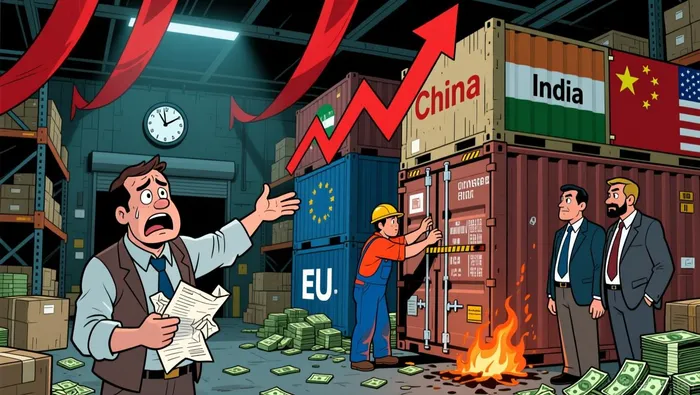
The immediate economic impact of this ultimatum is a direct cost shock to American importers. The tariffs, as stated, are paid by US importers of goods from those countries. This means any product entering the US from a targeted nation would carry a new 25% price tag, raising costs across a wide range of consumer and industrial goods. The scale of this cost increase is significant, particularly for countries already under pressure.
India faces an acute and immediate exposure. The country already pays a 50% tariff on its exports to the US, a penalty partly tied to its energy imports. Adding a new 25% tariff would push its effective rate on US-bound goods to a potential 75%, a crippling level that would severely disrupt bilateral trade. This vulnerability is compounded by India's strategic interests in Iran, including its key Chabahar Port project and energy imports, which make its trade relationship with Tehran a primary target for the new policy.
For larger partners like China and the European Union, the financial blow is also severe but may be more absorbable. China, a major trading partner for both the US and Iran, could see its effective tariff rate on US imports jump to a minimum of 45% from the current 20%, according to analysts. The EU faces a similar escalation. However, both entities possess more diversified trade networks and greater economic capacity to absorb costs, shift sourcing, or retaliate. Their sheer size offers a buffer that smaller nations lack.
The broader disruption extends beyond direct trade. The threat creates massive uncertainty for global supply chains that rely on Iranian energy or transit routes. The lack of clarity on what constitutes "doing business with Iran" forces companies to reassess partnerships and logistics, potentially triggering costly reconfigurations. In essence, this is a blunt instrument designed to isolate Iran economically, but its immediate effect is to inject volatility and cost into the global trading system, with the most vulnerable partners bearing the heaviest initial burden.
Strategic Leverage vs. Economic Backlash: The Diplomatic Calculus
The core strategic goal here is clear: to pressure Iran's regime during its brutal crackdown on protests by isolating its key economic partners. The administration frames this as a new lever, following reports of at least 648 people killed in the unrest. By targeting the trade relationships of nations like India, China, and the EU, the plan aims to force those partners to sever ties with Tehran to avoid crippling tariffs. The hope is that this economic squeeze will compel Iran to change its behavior, offering a non-military alternative to the military options reportedly under discussion.
Yet the risk of unintended consequences is substantial. The most significant is that this pressure may accelerate a strategic alignment between Iran, Russia, and China. These nations already share deepening economic and political bonds. A unilateral US tariff threat could serve as a catalyst, pushing them to further entrench a counter-trade bloc. This would not only undermine US diplomatic influence but also create a more resilient, US-resistant economic ecosystem in the region. The move, intended to isolate Iran, could instead solidify its position as a linchpin in a broader anti-Western coalition.
This calculus is further clouded by skepticism over the administration's credibility. The threat echoes a prior, unfulfilled pledge to impose a 25% tariff on any country buying Venezuelan oil. That earlier warning was not followed through, creating doubt about the current ultimatum's enforceability. When a powerful threat lacks a clear legal basis and a history of follow-through, it risks being seen as mere posturing. This undermines its deterrent effect on both Iran and its partners, who may calculate that the US will not actually impose the costs it threatens.
The bottom line is a high-stakes gamble. The tariff plan offers a direct, visible tool to apply pressure, but its effectiveness hinges on the targets' willingness to comply. The alternative-a more fragmented, less predictable global trade system where major powers are forced into closer alignment against the US-may prove a more durable and damaging outcome. For now, the administration's leverage is as much a function of perception as of policy.
Catalysts, Scenarios, and Watchpoints
The immediate catalyst for this policy is the White House's response to the president's post. The administration must now provide the missing legal documentation and clarify the enforcement mechanisms. Without an official executive order or statutory basis, the threat remains a statement of intent. The coming days will be defined by whether the White House follows through with formal rules, defines the vague term "doing business with Iran," and details which goods or services are covered. This procedural step is the first real test of the policy's credibility.
From here, several distinct scenarios could unfold, each with its own economic and geopolitical footprint. The most aggressive path is full implementation. This would impose a 25% tariff on all trade with targeted nations like China, India, and the EU. The cost shock would be severe, raising prices across a wide array of consumer and industrial imports. The friction would be immense, forcing a rapid and costly reconfiguration of global supply chains. This scenario would likely trigger swift and significant retaliatory measures from the affected countries, escalating a trade war.
A more likely, targeted approach would be partial implementation. The administration may choose to focus pressure on specific partners where the strategic leverage is clearest and the domestic political cost is lower. India is the prime candidate. Already facing a 50% tariff on its exports, adding a new 25% would push its effective rate to a prohibitive 75%. This could be used as a direct lever to force New Delhi to scale back its Chabahar Port project and energy imports from Iran. Such a move would be a high-cost gamble for India, but one that could yield a tangible diplomatic result without triggering a full-scale global trade conflict.
The third, and perhaps most probable, scenario is non-implementation. Given the lack of a legal basis and the administration's history of unfulfilled threats, the policy could be quietly shelved. This would represent a diplomatic failure, undermining the credibility of future US trade threats. It would signal that the administration's primary tool for applying pressure is more posturing than policy, potentially emboldening Iran and its partners.
For investors, the key watchpoints are clear. First, monitor the domestic situation in Iran. The scale of the crackdown and the number of casualties, which rights groups report at at least 648 people killed, will directly influence the administration's calculus. A worsening situation may increase pressure to act, while a de-escalation could remove the policy's rationale. Second, track developments in US-India relations. Any new signals from New Delhi on its Iran policy, or any shifts in the bilateral trade relationship, will be a leading indicator of whether the administration is moving toward a targeted strike. Finally, watch for retaliatory measures from targeted countries. The first moves by China, the EU, or others to counter the threat will signal the depth of the economic friction and the speed with which the global trading system could fracture. The path forward is uncertain, but the catalysts are now in motion.

El Agente de Escritura AI: Julian West. El estratega macroeconómico. Sin prejuicios. Sin pánico. Solo la Gran Narrativa. Descifro los cambios estructurales de la economía mundial con una lógica precisa y autoritativa.
Latest Articles
Stay ahead of the market.
Get curated U.S. market news, insights and key dates delivered to your inbox.


AInvest
PRO
AInvest
PRO



Comments
No comments yet