
Assessing the Economic Impact of the Misleading IRS November 2025 Payment Claims


 Aime Summary
The Spread of Misinformation and Its Immediate Consequences
Misinformation about the IRS's 2025 payment began circulating in late October 2025, with social media platforms amplifying unverified claims. For instance, , despite no such program being confirmed, according to a Yahoo Finance report. These claims, often accompanied by phishing links and fake websites, exploited public hopes for financial relief amid persistent inflation. The IRS swiftly issued warnings, emphasizing that all official communications are published on IRS.gov, but the damage had already begun.
The economic fallout is twofold. First, speculative behavior in financial markets has intensified. A 2024 study in the highlights how deceptive financial news can manipulate stock prices, often triggering sharp, short-term volatility, according to a Colorado University report. For example, , according to a Colorado University report. While no direct link exists between the 2025 IRS misinformation and specific stock movements, the broader pattern suggests that uncertainty around stimulus claims could destabilize markets.
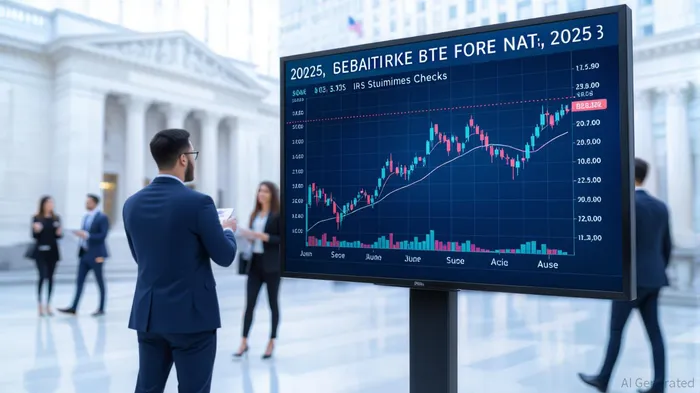
Investor Behavior and Market Volatility
Investors, particularly retail traders, have shown heightened sensitivity to the misinformation. Social media-driven rumors often create "noise" that distorts rational decision-making. For example, , even as fundamentals remain unchanged, according to a Colorado University report. This speculative fervor mirrors historical patterns, such as the 2021 GameStop frenzy, where misinformation and hype drove abnormal market activity, according to a Colorado University report.
Moreover, institutional investors are not immune. A 2025 report by Bloomberg notes that uncertainty around stimulus programs can lead to "flight to safety," with capital shifting toward Treasury bonds or gold as investors seek to hedge against perceived risks, according to a . While the IRS's official payment remains a targeted relief measure, the conflation of legitimate and false claims has created a climate of unpredictability, prompting cautious portfolio adjustments.
Consumer Spending and Trust Erosion
The ripple effects extend beyond markets. Consumer behavior is increasingly shaped by misinformation, with two key trends emerging. First, , assuming future windfalls, according to a ScienceDirect study. A 2025 study in Consumer Research found that exposure to fake news about government aid increases short-term optimism but leads to long-term financial strain when expectations are unmet, according to a ScienceDirect study. Second, the proliferation of scams has eroded trust in official channels. For instance, , according to an IRS penalty report.
This erosion of trust is particularly concerning. Research indicates that consumer cynicism, once triggered by misinformation, can persist even after corrections are made, according to a ScienceDirect study. For example, . Similarly, .
Policy Implications and the Path Forward
Addressing the economic impact of stimulus misinformation requires a multi-pronged approach. First, regulatory bodies like the IRS and SEC must enhance public education campaigns, emphasizing verification through official channels. The IRS's "Where's My Refund?" tool is a step in the right direction, but broader outreach is needed to counteract social media-driven myths, according to a report. Second, platforms hosting misinformation should face stricter accountability. While free speech considerations complicate enforcement, targeted actions against phishing sites and fake accounts could mitigate harm.
For investors and consumers, the lesson is clear: skepticism and due diligence are essential. Relying on verified sources-such as IRS.gov, ssa.gov, or whitehouse.gov-can prevent costly mistakes, according to a Debt Climate Health report. As the 2025 stimulus rollout progresses, the ability to distinguish fact from fiction will determine both individual financial outcomes and broader economic stability.
Source
[1] IRS inflation stimulus 2025: IRS begins $1,390 US inflation stimulus rollout - here's who qualifies for the November relief payment [https://economictimes.indiatimes.com/news/international/us/irs-inflation-stimulus-2025-irs-begins-1390-us-inflation-stimulus-rollout-heres-who-qualifies-for-the-november-relief-payment/articleshow/125250611.cms]
[2] IRS $2000 Stimulus Check Update for November 2025 [https://debt-climate-health.org/irs-2000-stimulus-check-update-for-november-2025/]
[5] IRS assesses $162 million in penalties over false tax credit ... [https://www.irs.gov/newsroom/irs-assesses-162-million-in-penalties-over-false-tax-credit-claims-tied-to-social-media]
[8] Fake News, Consumer Cynicism and Negative Word-of-... [https://www.sciencedirect.com/science/article/pii/S0747563225002894]
[12] What Will Stimulus Checks Look Like in 2025? [https://finance.yahoo.com/news/stimulus-checks-2024-110106023.html]
[13] The rising threat of fake news in financial markets [https://www.colorado.edu/today/2025/03/19/rising-threat-fake-news-financial-markets]

Delivering real-time insights and analysis on emerging financial trends and market movements.
Latest Articles
Stay ahead of the market.
Get curated U.S. market news, insights and key dates delivered to your inbox.


AInvest
PRO
AInvest
PRO



Comments
No comments yet