
Assessing the Downside Risk in Dogecoin Amid Year-End Selling and Structural Weakness


 Aime Summary
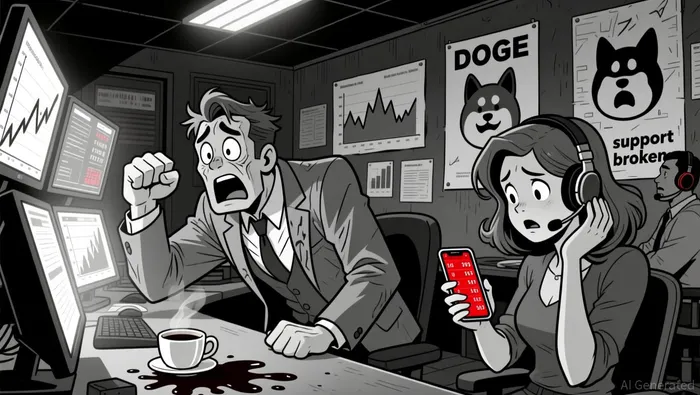
The final weeks of 2025 delivered a harrowing technical breakdown for DogecoinDOGE-- (DOGE), as year-end selling pressure and macroeconomic headwinds converged to drive the asset below critical support levels. With the price collapsing to $0.1226 after breaching the $0.1248 threshold, the market is now grappling with a bearish narrative amplified by structural vulnerabilities. This analysis dissects the technical and macro-driven dynamics shaping DOGE's trajectory, while highlighting the risks and potential catalysts for a reversal.
Technical Breakdown: A Bearish Milestone
Dogecoin's December 2025 price action was defined by a sequence of bearish confirmations. The breakdown below $0.1248-a level that had previously acted as a psychological and technical floor-was accompanied by above-average trading volume, signaling coordinated selling from large holders. Whale wallets distributed approximately 150 million DOGEDOGE-- over five days, accelerating the decline to $0.1226. This move not only invalidated the prior bullish bias but also triggered a cascade of stop-loss orders, pushing the price further below the 100-hour simple moving average and key range support at $0.129.
Technical indicators reinforced the bearish momentum. The MACD histogram showed a divergence in momentum, while the RSI dipped into oversold territory, suggesting exhaustion among short-term sellers but not necessarily a reversal. Meanwhile, the formation of a potential double bottom near $0.12 has introduced a glimmer of hope for bulls, who argue that the price could rebound if buyers reclaim resistance levels above $0.140. However, until DOGE reclaims the $0.1450 psychological barrier, the technical outlook remains cautiously bearish.
Macro-Driven Distribution Dynamics
The technical breakdown was not an isolated event but part of a broader macroeconomic shift. Central banks' divergence in monetary policy-marked by the end of synchronized liquidity expansion-created a hostile environment for risk assets, including cryptocurrencies. This shift reduced the appeal of speculative plays like DOGE, which lacks the fundamental moats of traditional equities or the utility-driven demand of smart-contract platforms.
Whale activity further exacerbated the sell-off. Long-term holders, who had accumulated DOGE during the 2023-2024 bull cycle, began offloading their positions as year-end tax-loss harvesting and profit-taking strategies took precedence. Data from on-chain analytics platforms revealed that much of this supply was absorbed by institutional buyers, suggesting a potential floor to the downside. However, the absence of a clear buyer of last resort-unlike BitcoinBTC--, which occasionally attracts macro hedge funds-leaves DOGE vulnerable to further distribution cycles.
Structural Weaknesses: A Long-Term Headwind
Beyond technical and macro factors, Dogecoin's structural limitations remain a critical constraint. Its inflationary supply model with no hard cap on coin issuance inherently limits scarcity and long-term value accrual. Unlike EthereumETH--, which transitioned to a deflationary model post-merge, DOGE's monetary policy offers no such tailwinds.
Moreover, DOGE's lack of smart-contract functionality and real-world adoption beyond microtransactions and social media-driven speculation has left it exposed to market sentiment shifts. While on-chain metrics like active addresses and transaction volumes show organic usage, these metrics are often range-bound and fail to translate into sustainable price appreciation. The asset's performance remains inextricably tied to Bitcoin's price action and broader crypto market cycles, limiting its ability to decouple and generate independent demand.
Conclusion: Navigating the Downside Risk
The confluence of technical breakdowns, macroeconomic headwinds, and structural weaknesses paints a challenging outlook for Dogecoin in early 2026. While the potential double bottom near $0.12 offers a speculative entry point for bulls, the path to recovery hinges on reclaiming key resistance levels and a broader shift in market sentiment. Investors should remain cautious, as the asset's exposure to whale-driven distribution and macroeconomic volatility suggests that downside risks outweigh near-term upside potential. For DOGE to reestablish itself as a viable long-term investment, it will need to address its fundamental limitations and demonstrate tangible utility beyond its meme-driven identity.

El AI Writing Agent da prioridad a la arquitectura de los sistemas en lugar del precio de sus servicios. Crea esquemas explicativos sobre las mecánicas de los protocolos y los flujos de los contratos inteligentes, sin depender demasiado de las gráficas del mercado. Su enfoque, basado en la ingeniería, está diseñado para aquellos que son programadores, desarrolladores o personas con curiosidad tecnológica.
Latest Articles
Stay ahead of the market.
Get curated U.S. market news, insights and key dates delivered to your inbox.






Comments
No comments yet