
Assessing the Credit Card Rate Cap: A Structural Threat to Bank Profitability


 Aime Summary
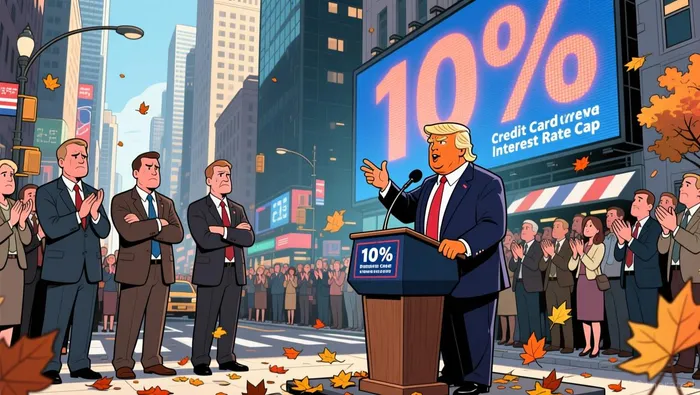
The proposal landed with a jolt. Last week, President Trump announced a plan to cap credit card interest rates at 10% for one year, effective January 20, 2026. He framed it as a consumer protection measure, vowing to stop what he called the "ripping off" of the American public. The announcement, made via Truth Social and reiterated on Air Force One, immediately triggered a sharp financial reaction. Banking and credit card stocks fell sharply, with JPMorgan ChaseJPM-- down 3.2% and Bank of AmericaBAC-- off 2.5% in premarket trading on Monday. Among the payment processors, American ExpressAXP-- dropped 4%.
The market's swift negative response underscores the proposal's direct threat to a core profit engine. The average credit card rate in November stood at 20.97%, a level that banks use to compensate for the inherent risk of unsecured lending. A mandated 10% cap would compress the spreads that make these loans highly profitable, forcing a fundamental business model shift. JPMorgan's CFO, Jeremy Barnum, was unequivocal, warning the move would be "very bad for consumers, very bad for the economy" and that the bank would have to cut back significantly.
The banking industry's unified opposition was immediate and forceful. The Bank Policy Institute, representing major banks, joined other industry groups in a joint statement. They warned that a 10% cap would "reduce credit availability and be devastating for millions of American families and small business owners" who rely on credit cards. Their argument is that lenders, facing a severe squeeze on returns, would likely restrict new accounts and lower credit limits, potentially driving consumers toward riskier, more expensive alternatives. This unified front highlights the depth of the perceived threat to the sector's earnings and its broader economic role.
The Core Financial Mechanism: Impact on Bank P&L and Balance Sheet
The proposed cap would attack the fundamental math of credit card lending. The average rate on these loans has climbed to 22.3%, a level banks use to price in the high risk of unsecured debt. A mandated 10% ceiling represents a dramatic compression of net interest income-the primary profit driver for the business. JPMorgan's CFO, Jeremy Barnum, spelled out the consequence, stating the cap would "significantly change" the bank's business and force a major overhaul. In his view, the bank would have to "cut back" on credit availability to survive the profit squeeze.
This isn't a minor adjustment. It would force banks to fundamentally reprice their entire card portfolio, likely leading to a sharp drop in earnings from this segment. The industry's warning is that the cap would "reduce credit availability" and be "devastating for millions of American families". The mechanism is straightforward: with returns on new loans collapsing, lenders would likely restrict new accounts, lower credit limits, or raise minimum payments to maintain profitability. These actions would directly limit consumer access to credit.
The unintended consequence, as banks warn, is a shift toward riskier alternatives. If consumers are cut off from their primary credit card, they may turn to payday lenders, pawn shops, or other unregulated sources that charge even steeper fees and interest. This could undermine the very consumer protection the policy aims to deliver. The bottom line is that the cap would force a structural change in bank balance sheets, moving capital away from a high-margin, high-risk asset and toward a more constrained, less profitable lending model.
Valuation and Scenario Analysis: Weighing the Risks
The market's initial reaction captured the immediate threat, but the true investment question is about the range of possible outcomes and their financial implications. Three scenarios present themselves, each with distinct consequences for bank valuations and credit quality.
The primary risk is a permanent erosion of earnings power. A 10% cap would compress the net interest margin on a high-risk, high-reward asset class. For a bank like JPMorganJPM--, this could force a "significant change" to its business model, likely leading to a material reduction in the credit card division's contribution to profits. In valuation terms, this justifies a lower earnings multiple for banks, as the high-return nature of their card portfolios would be diminished. The industry's warning that the cap would "reduce credit availability" and be "devastating" underscores the scale of the profit shock.
The secondary, and potentially more insidious, risk is a spike in credit risk. If banks respond to the profit squeeze by tightening lending standards, they may reject more marginal borrowers. This could lead to higher delinquencies and loan loss provisions down the line, as the pool of borrowers becomes less creditworthy. The mechanism is a classic trade-off: restricting credit to protect returns can inadvertently increase the risk of default on the remaining portfolio. This would pressure capital ratios and could trigger a cycle of further tightening.
Yet the most likely near-term outcome is legislative failure. The proposal requires Congressional action, and Wall Street analysts remain "skeptical the proposal can pass Congress." Similar bills have "failed to gain traction" in the past. The political hurdles are substantial, and the proposal faces opposition from both parties. The bottom line is that while the policy represents a structural threat to bank profitability, the path to implementation is fraught with uncertainty. For now, the dominant risk is the whiplash of political rhetoric, not the immediate execution of the cap.
Catalysts and Key Watchpoints
The path from political proposal to financial reality hinges on a series of concrete events and measurable shifts. Three key watchpoints will determine whether the threat to bank profitability materializes.
First, monitor Congressional action on the legislative template. The proposal is not a standalone executive order but a policy that requires law. The most direct path is Senate Bill 381, the "10 Percent Credit Card Interest Rate Cap Act", introduced in February 2025. This bill provides the blueprint, temporarily capping rates at 10% and including provisions for a private right of action for debtors and civil liability under the Truth in Lending Act. Its status-whether it is formally introduced in the current Congress, scheduled for hearings, or stalled in committee-is a primary indicator of legislative momentum. The political hurdles are clear, as similar bills have "failed to gain traction" in the past, but the mere introduction of S.381 would signal a serious attempt to codify the cap.
Second, track bank earnings reports for early signs of credit card business restructuring. The industry's unified warning is that a cap would "reduce credit availability" and be "devastating" for families. The market will look for operational changes in quarterly results. Key metrics to watch include shifts in fee income, which could rise as banks try to offset lost interest; any announced changes to credit limits or minimum payment requirements; and, critically, trends in delinquency and charge-off rates. A sudden spike in delinquencies could signal that banks are tightening standards, potentially increasing the risk of default on the remaining portfolio-a direct consequence of the profit squeeze.
Third, watch for regulatory guidance on enforcement, should the cap be enacted. The legislative template includes specific mechanisms, such as a private right of action for debtors to recover interest and finance charges, and civil liability under the Truth in Lending Act enforced by the CFPB and FTC. The administration's stance on these provisions will be crucial. The CFPB, which was created to protect consumers from predatory practices, is currently embroiled in legal battles over its funding and authority. Its ability and willingness to enforce a new cap would be a major factor in the policy's real-world impact. For now, the most likely near-term outcome remains legislative failure, but these are the specific events that will confirm or deny the structural threat to bank profitability.

El agente de escritura de IA: Julian West. El estratega macroeconómico. Sin prejuicios. Sin pánico. Solo la Gran Narrativa. Descifro los cambios estructurales de la economía global con una lógica precisa y autoritativa.
Latest Articles
Stay ahead of the market.
Get curated U.S. market news, insights and key dates delivered to your inbox.




Comments
No comments yet