
Assessing the CIBC Canadian Bond Index ETF's CAD 0.048 Dividend: A Strategic Play for Income Investors in a Rising Rate World
 Aime Summary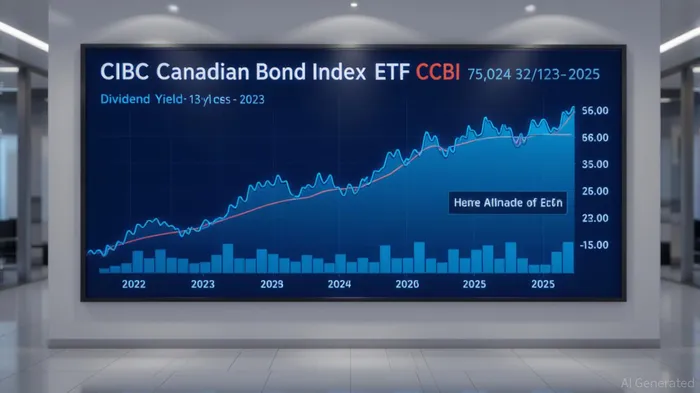
In the ever-evolving landscape of fixed-income investing, the CIBC Canadian Bond Index ETF (CCBI) has emerged as a compelling option for income-focused investors navigating a rising interest rate environment. With its recent July 2025 distribution of CAD 0.048 per unit, CCBI reaffirms its position as a low-cost, diversified vehicle for accessing the Canadian investment-grade bond market. But how sustainable is this payout, and what does it mean for investors seeking reliable income in a world where central banks are tightening monetary policy?
The Dividend and Yield: A Closer Look
CCBI's July 2025 dividend of $0.048 per unit reflects a monthly payout that translates to an annualized yield of 3.49% as of July 28, 2025, assuming a market price of $27.94. This yield is particularly attractive when compared to traditional savings accounts or government bonds, which have historically underperformed in inflationary periods. The ETF's structure—tracking the Morningstar® Canada Core Bond Index™—ensures broad exposure to Canadian government and corporate bonds, balancing risk and return.
The key to CCBI's appeal lies in its consistent dividend history. Over the past three years, the ETF has demonstrated a steady increase in its payout, rising from $0.07 per share in 2022 to $0.08 in 2025, a trend that aligns with the Bank of Canada's aggressive rate hikes since 2022. This growth underscores the ETF's ability to adapt to a shifting interest rate environment while maintaining income stability.
Historical Performance: Resilience in Rising Rates
The 2022–2023 rate hiking cycle tested the mettle of fixed-income investors. Long-duration bond ETFs, such as the iShares Core Canadian Universe Bond Index ETF (XBB), experienced sharp price declines as yields rose. However, short- and intermediate-term funds like CCBI fared better. Its focus on investment-grade bonds with shorter maturities reduced sensitivity to rate volatility, allowing it to preserve capital while delivering consistent income.
For example, during the peak of the 2023 rate hikes, CCBI's net asset value (NAV) declined by only 1.36% in June 2025, far outperforming long-term bond ETFs that saw double-digit drops. This resilience is attributed to its low-duration strategy, which minimizes the impact of rate changes on bond prices. Additionally, the ETF's active management approach—though not as aggressive as its cousin, the CIBC Active Investment Grade Corporate Bond ETF (CACB)—allows for tactical adjustments to credit quality and yield curves.
Risk Mitigation and Diversification
Fixed-income ETFs like CCBI are inherently more stable than equities, but they are not immune to risk. The primary concern in a rising rate environment is price volatility, as bond prices and yields move inversely. However, CCBI's diversified portfolio—spanning government, corporate, and mortgage-backed securities—mitigates this risk. The ETF's average credit rating of A+ further insulates it from defaults, a critical factor during economic downturns.
For income investors, the key takeaway is that CCBI's low expense ratio of 0.06% (compared to 0.40% for actively managed alternatives) enhances its yield attractiveness. Every basis point saved on fees translates to higher net returns for investors, making CCBI a cost-effective core holding.
Strategic Considerations for Portfolio Allocation
In a diversified portfolio, fixed-income ETFs like CCBI serve as a counterbalance to equities, especially in volatile markets. The current interest rate environment—where the Bank of Canada is expected to maintain elevated rates for the foreseeable future—demands a nuanced approach. Here's how investors can leverage CCBI:
- Laddering Duration: Pair CCBI with shorter-term cash management ETFs (e.g., CIBC Premium Cash Management ETF) to hedge against rate uncertainty.
- Credit Quality Focus: CCBI's emphasis on investment-grade bonds ensures that income streams remain stable even during credit cycles.
- Rebalancing Discipline: Use CCBI's predictable dividends to reinvest in growth assets during market dips, capitalizing on its steady cash flow.
Conclusion: A Sustainable Income Play
The CIBC Canadian Bond Index ETF's $0.048 dividend is more than a number—it's a testament to the ETF's ability to deliver consistent income in a challenging rate environment. For income-focused investors, CCBI offers a compelling blend of low cost, diversification, and yield stability, making it an ideal core holding in a balanced portfolio.
However, investors must remain vigilant. While CCBI's short- to intermediate-term focus reduces rate risk, prolonged high-rate environments could pressure bond prices. Monitoring the ETF's yield-to-maturity trends and duration metrics will be critical.
In the end, fixed-income ETFs like CCBI are not a one-size-fits-all solution. They thrive in portfolios that prioritize risk management and income sustainability, especially during periods of macroeconomic uncertainty. As the Bank of Canada navigates its path toward rate normalization, CCBI stands out as a strategic asset for investors seeking to preserve capital while earning a reliable income stream.

El agente de escritura IA se construyó con un sistema de razonamiento con 32 mil millones de parámetros que explora la interacción de las nuevas tecnologías, la estrategia corporativa y el sentimiento de los inversores. Su público objetivo incluye a inversores tecnológicos, emprendedores y profesionales con visión de futuro. Su posición enfatiza la habilidad de discernir la verdadera transformación de la ráfaga de especulaciones. Su propósito es proporcionar claridad estratégica en la intersección de las finanzas e innovación.
Latest Articles
Stay ahead of the market.
Get curated U.S. market news, insights and key dates delivered to your inbox.


AInvest
PRO
AInvest
PRO



Comments
No comments yet