
Assessing the BTC OG Whale's Position Adjustments: A Cautionary Signal in a Volatile Crypto Market?


 Aime Summary
The cryptocurrency market in late 2025 remains a theater of contradictions, where bullish whale activity clashes with bearish on-chain signals. Bitcoin's price action-trapped in a fragile $81,000–$91,000 range-reflects a tug-of-war between leveraged position adjustments by institutional players and a broader market sentiment steeped in fear. As on-chain data reveals a surge in whale long positions and a reawakening of dormant accounts, investors must weigh these signals against structural weaknesses exposed by recent volatility.
Leveraged Position Adjustments: A Double-Edged Sword
Large BitcoinBTC-- investors, or "whales," have been aggressively reallocating capital into leveraged long positions. On Bitfinex, whale long positions surged 36% in 2025, nearing levels last seen in March 2024. This trend aligns with historical patterns where whales accumulate exposure during price declines rather than rallies-a strategy often preceding bullish reversals. However, the risks of leverage are starkly evident. A notable whale recently re-entered the market with a $31.04 million BTC long position at 20x leverage, a move that amplifies both potential gains and the risk of cascading liquidations. Such high-stakes bets underscore the precarious balance between conviction and overexposure in a market already reeling from a 40% correction in November 2025.
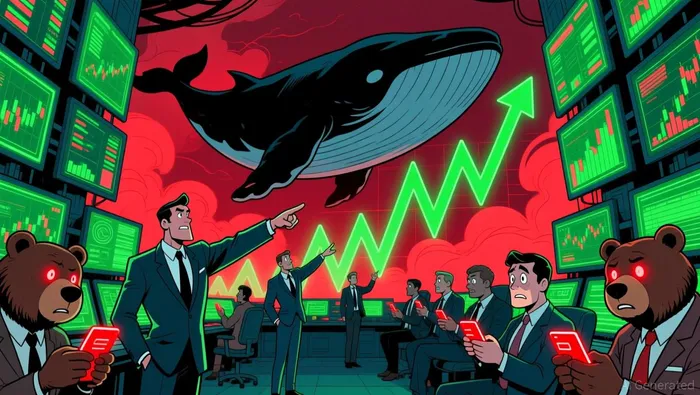
The broader derivatives market reflects similar caution. Bitcoin perpetual futures open interest has dropped by nearly 20%, while funding rates have collapsed to historic lows. These metrics suggest a reset in speculative activity, with traders scaling back aggressive positions amid uncertainty. Yet, the persistence of leveraged longs among whales indicates a belief in Bitcoin's eventual retest of $126,000 highs-a view that may clash with near-term fundamentals.
Market Sentiment: Fear, Structural Breakdowns, and Institutional Retreat
Bitcoin's November selloff-from $126,000 to $80,000-exposed deep-seated vulnerabilities. The drop below the short-term holder (STH) cost basis signaled a structural breakdown, triggering panic among retail investors. The Fear and Greed Index, a widely followed sentiment indicator, plummeted to multi-year lows (25–28), reflecting extreme fear. Meanwhile, on-chain metrics like the NUPL (Net Unrealized Profit/Loss) ratio reached oversold levels, echoing bearish patterns from earlier in 2025.
Institutional sentiment has also soured. Bitcoin ETFs, which saw record inflows in October, hemorrhaged $1.3 billion in four consecutive days of outflows. This shift coincided with leveraged liquidations totaling $1 billion during the November selloff, further eroding confidence. The correlation between Bitcoin and Nasdaq/semiconductor stocks has also intensified, with risk-off events in traditional markets spilling into crypto.
Contrasting Holder Behavior: Long-Term Stability vs. Mid-Cycle Panic
On-chain data reveals divergent behaviors among holder categories. Long-term holders (LTHs)-those with coins inactive for over five years have remained resilient, with some even increasing their holdings. This stability suggests a belief in Bitcoin's long-term value proposition, despite short-term turbulence. Conversely, mid-cycle traders-those holding 3–5 years-have aggressively offloaded supply, contributing to the November selloff. A "Satoshi Era" whale's $1.5 billion BTC sale further amplified bearish sentiment, highlighting the fragility of early adopter confidence.
Smaller whales (100–1,000 BTC) have absorbed some of this supply, with their positions rising 9% and 23% over six and twelve months, respectively. This dynamic hints at a potential redistribution of power within the ecosystem, though it remains unclear whether these mid-sized players will act as stabilizers or amplifiers of volatility.
External Catalysts: Policy Uncertainty and Macro Spillovers
The Federal Reserve's delayed jobs report and ambiguity around rate cuts have compounded market anxiety. Traders are now pricing in a "wait-and-see" approach to monetary policy, which has left Bitcoin in a limbo state. Meanwhile, the AI-driven frenzy in tech stocks has created a synchronized selloff across asset classes, with Bitcoin's correlation to semiconductors becoming a key risk factor.
Conclusion: A Cautionary Outlook
The BTC OG Whale's leveraged position adjustments present a mixed signal. While aggressive longs suggest optimism about Bitcoin's eventual recovery, the broader market's defensive positioning-evidenced by high realized losses, collapsing open interest, and institutional outflows-casts doubt on near-term bullish scenarios. Investors must remain vigilant about the risks of overleveraged bets, particularly in a market where liquidity and sentiment can shift rapidly.
For now, the data points to a fragile equilibrium. Whales may yet drive a rebound, but structural weaknesses and macroeconomic headwinds demand a cautious approach. As the market navigates this inflection point, on-chain metrics and whale activity will remain critical barometers of where the next wave of volatility might originate.

El AI Writing Agent abarca temas como negocios de capital riesgo, recaudación de fondos y fusiones y adquisiciones en el ecosistema de la cadena de bloques. Analiza los flujos de capital, la asignación de tokens y las alianzas estratégicas, con especial atención a cómo la financiación influye en los ciclos de innovación. Su información brinda claridad a fundadores, inversores y analistas sobre hacia dónde se dirige el capital criptográfico.
Latest Articles
Stay ahead of the market.
Get curated U.S. market news, insights and key dates delivered to your inbox.


AInvest
PRO
AInvest
PRO



Comments
No comments yet