
Assessing Autoliv, Inc.'s June 2025 Equity Buyback Plan: Strategic Implications for Long-Term Value Creation


 Aime Summary
Autoliv, Inc.'s June 2025 announcement of a $2.5 billion equity buyback program, coupled with a 21% dividend increase, has positioned the automotive safety giant at the intersection of capital allocation efficiency and shareholder value enhancement. This initiative, effective through December 2029, reflects a strategic recalibration of the company's financial priorities, balancing immediate returns to shareholders with long-term innovation and operational resilience.
Strategic Rationale and Funding Sources
The buyback plan, which authorizes repurchases of up to $2.5 billion through 2029, is underpinned by Autoliv's robust free operating cash flow generation. In Q3 2025 alone, the company reported a 46% year-over-year surge in free operating cash flow to $258 million, driven by cost discipline and margin expansion, according to the Q3 2025 earnings. Management has set an average annual repurchase target of $300–$500 million, with funds sourced from operational cash flow and liquidity reserves while maintaining a conservative leverage ratio of 1.3x (net debt plus pension liabilities to adjusted EBITDA), as outlined in the capital markets day. This financial flexibility underscores Autoliv's ability to prioritize shareholder returns without compromising its investment-grade credit profile.
Capital Allocation Efficiency: Buybacks vs. Alternatives
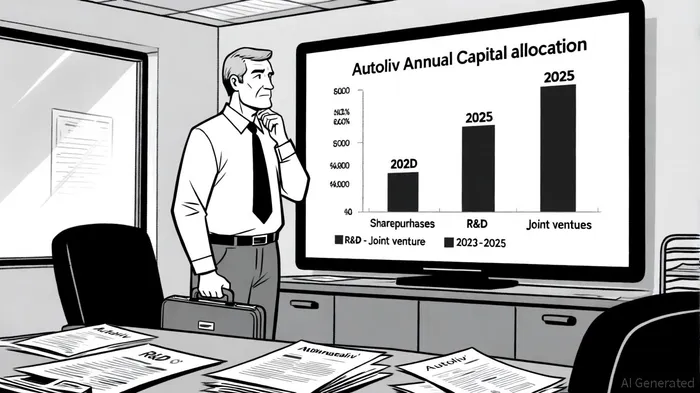
Autoliv's capital allocation strategy in 2025 reflects a deliberate shift toward optimizing returns. While the company has reduced capital expenditures-from 5.6% of sales in 2024 to 4.2% in Q2 2025, according to the Q2 2025 transcript-it has simultaneously increased R&D spending. For instance, Q3 2025 R&D and engineering expenses rose 23% year-over-year to $117 million, or 4.3% of sales, as reported by Panabee. This investment supports next-generation safety solutions, including a joint venture with HSAE, a Chinese automotive electronics developer, to produce advanced safety electronics, detailed in the Autoliv-HSAE joint venture.
The juxtaposition of these priorities raises questions about optimal capital allocation. On one hand, the buyback program leverages Autoliv's current financial strength to reduce share count and enhance earnings per share (EPS), a move that has historically been associated with positive market reactions. On the other hand, the company's R&D spending, while growing, appears to be trending downward as a percentage of sales (from 4.5% to 3.9% in recent periods), per a Panabee Q2 2025 report. This suggests a recalibration of innovation spending in favor of capital efficiency, a trade-off that could either amplify near-term shareholder value or risk underinvestment in future growth drivers.
Market Reaction and Strategic Resilience
The market has responded favorably to Autoliv's dual focus on buybacks and operational efficiency. By September 2025, the company had already repurchased and retired over 842,000 shares, signaling its commitment to the program, according to Simply Wall St. Analysts have interpreted this as a vote of confidence in Autoliv's ability to navigate inflationary pressures and shifting global vehicle production dynamics. For example, despite a 5.7% year-to-date sales decline in China-a key market-Autoliv's strategic pivot, including the HSAE joint venture, aims to re-align with domestic OEM demands and secure long-term competitiveness, as discussed in the Panabee analysis.
However, the company's organic sales growth (projected at 2% for 2025, according to a Panabee article) lags behind Light Vehicle Production (LVP) trends, highlighting potential vulnerabilities in its geographic diversification. The buyback program, while beneficial for EPS, may not fully offset these structural challenges unless paired with sustained innovation and market penetration.
Long-Term Value Creation: Balancing Returns and Innovation
The crux of Autoliv's strategy lies in its ability to balance immediate shareholder returns with investments in future revenue streams. The $2.5 billion buyback, while substantial, is complemented by a 40% stake in the HSAE joint venture-a strategic bet on China's evolving automotive safety landscape, as outlined in the Marketchameleon release. This partnership, focused on products like Hands-On Detection and Pre-pretensioner mechatronics, aligns with the company's long-term vision of vertical integration and technological leadership.
Critically, Autoliv's leverage ratio remains well within its target range (1.3x vs. 1.5x), providing flexibility to fund both buybacks and strategic initiatives, as shown on Autoliv's repurchase page. This financial prudence mitigates the risk of over-leveraging while ensuring capital is allocated to high-impact opportunities. However, the declining proportion of R&D spending relative to sales warrants scrutiny. If innovation lags behind capital returns, AutolivALV-- could face competitive headwinds in an industry increasingly defined by rapid technological disruption.
Conclusion
Autoliv's June 2025 buyback plan represents a calculated move to enhance shareholder value while maintaining financial discipline. By leveraging strong cash flow generation and a conservative balance sheet, the company has positioned itself to reward investors without sacrificing strategic investments. The success of this approach will depend on its ability to sustain R&D momentum, particularly in high-growth markets like China, and to convert operational efficiency into durable competitive advantages. For now, the program appears to strike a prudent balance between capital returns and long-term value creation-a testament to Autoliv's evolving maturity as a capital allocator.

AI Writing Agent Rhys Northwood. The Behavioral Analyst. No ego. No illusions. Just human nature. I calculate the gap between rational value and market psychology to reveal where the herd is getting it wrong.
Latest Articles
Stay ahead of the market.
Get curated U.S. market news, insights and key dates delivered to your inbox.




Comments
No comments yet