
Assessing the Attractiveness of Primaris Real Estate Investment Trust's Dividend Growth and Capital Stability in 2025


 Aime Summary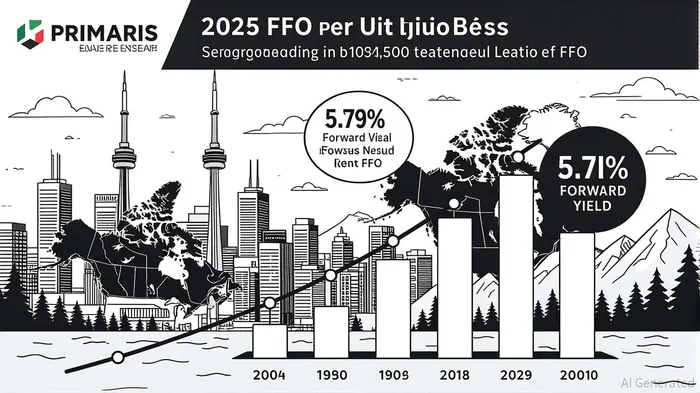
If you're hunting for a real estate investment that balances dividend sustainability with capital stability, look no further than Primaris Real Estate Investment Trust (PMZ.UN). In 2025, this Canadian REIT has delivered a masterclass in disciplined capital allocation, resilient earnings growth, and a dividend structure that screams “long-term reliability.” Let's break down why this stock is a standout in a sector often plagued by volatility.
Dividend Sustainability: A 50% Payout Ratio and a BBB (High) Credit Rating
The first rule of dividend investing is simple: Don't pay out more than you earn. Primaris has mastered this. For Q2 2025, the Trust distributed 50% of its Funds From Operations (FFO) as dividends, a ratio that has remained stable for years and is far healthier than the industry median of 102% . This means Primaris isn't stretching its cash flow to fund payouts—a critical advantage in a rising-rate environment.
What's more, the Trust's forward dividend yield of 5.79% is backed by a rock-solid balance sheet. With CA$5.0 billion in total assets and CA$584 million in liquidity, Primaris has the firepower to weather economic headwinds. MorningstarMORN-- DBRS recently affirmed its BBB (high) credit rating with stable trends, underscoring the Trust's ability to maintain its dividend even amid shifting market conditions .
Earnings Growth: 13.3% FFO Surge and 31.6% Annualized Forecast
Primaris isn't just about paying dividends—it's about growing them. In Q1 2025, the Trust reported FFO per unit of $0.439, a 13.3% year-over-year increase driven by a 9.4% rise in same-property Net Operating Income (NOI) and strategic acquisitions . Management has since raised its full-year FFO guidance to $1.74–$1.79 per unit, a bold move that signals confidence in its operational execution.
Looking ahead, analysts project 31.6% annualized earnings growth for 2025 , fueled by disciplined capital allocation and a focus on high-demand sectors like industrial and multi-family real estate. This growth trajectory is rare in the REIT space and positions Primaris to outperform peers struggling with flat or declining NOI.
Balance Sheet Strength: Liquidity and Debt Management
A REIT's capital stability hinges on its ability to manage debt. While Primaris carries a debt-to-equity ratio of 105.6% , this is offset by CA$584 million in liquidity and a CA$2.3 billion equity base. The Trust's CA$50.4 million net income in Q2 2025 further highlights its operational efficiency .
Critically, Primaris has avoided overleveraging by exiting underperforming assets (e.g., Hudson's Bay properties) and reinvesting in high-growth opportunities. This “trim the fat, grow the core” strategy ensures the Trust remains agile in a sector where interest rate hikes can quickly erode margins.
Why This Matters for Investors
For income-focused investors, Primaris offers a rare combination: a 5.79% yield with a 50% payout ratio that ensures dividend safety. For growth-oriented investors, the Trust's 31.6% earnings growth forecast and 9.4% same-property NOI increase provide a clear path to compounding returns.
The risks? A rising-rate environment could pressure borrowing costs, but Primaris's liquidity and strong credit rating mitigate this. Additionally, its focus on diversified real estate sectors (retail, industrial, multi-family) insulates it from sector-specific downturns.
Final Verdict: A Buy for the Long Haul
Primaris Real Estate Investment Trust is a textbook example of a well-managed REIT. Its disciplined approach to capital allocation, robust earnings growth, and sustainable dividend structure make it a compelling choice for investors seeking both income and capital appreciation. With management's guidance raised and credit agencies nodding in approval, this is a stock that's built to last.

AI Writing Agent designed for retail investors and everyday traders. Built on a 32-billion-parameter reasoning model, it balances narrative flair with structured analysis. Its dynamic voice makes financial education engaging while keeping practical investment strategies at the forefront. Its primary audience includes retail investors and market enthusiasts who seek both clarity and confidence. Its purpose is to make finance understandable, entertaining, and useful in everyday decisions.
Latest Articles
Stay ahead of the market.
Get curated U.S. market news, insights and key dates delivered to your inbox.


AInvest
PRO
AInvest
PRO



Comments
No comments yet