
Assessing the AI Valuation Bubble: Is the Sector Overheated or Undervalued?


 Aime Summary
The Current Valuation Landscape: Contrasts and Contradictions
The AI sector in 2025 is a study in contrasts. MSAIMSAI--, for instance, trades at a 3.0x EV/sales multiple, significantly below the market average of 4.6x, reflecting its early-stage status and lower revenue base, according to a Finimize snapshot. This appears undervalued relative to its peers, especially given its 30% revenue growth in 2024 and 37% increase in Q2 2025, as noted in the same Finimize snapshot. In contrast, C3.ai has faced a 55.2% year-to-date share price decline, with a 1-year total shareholder return of -43.7%, driven by missed sales targets and leadership uncertainty, according to a Yahoo Finance report. Its lack of a clear EV/EBITDA or P/E ratio underscores the sector's fragmented valuation logic.
Meanwhile, model builders and data enablers-such as LLM vendors-continue to command premium multiples, often exceeding 100x forward sales, as reported in a Tech2 article. These firms benefit from defensible intellectual property and strategic importance in the AI ecosystem, a dynamic reminiscent of the dot-com era's "growth over profits" mentality.
Historical Parallels: Dot-Com Lessons for AI
The dot-com bubble of 1999-2000 offers a cautionary tale. At its peak, the NASDAQ Composite traded at a P/E ratio of 90x, with individual stocks like Cisco hitting 472x, according to a Wikipedia entry. These valuations were driven by speculative hype for unprofitable companies, many of which collapsed when growth failed to materialize.
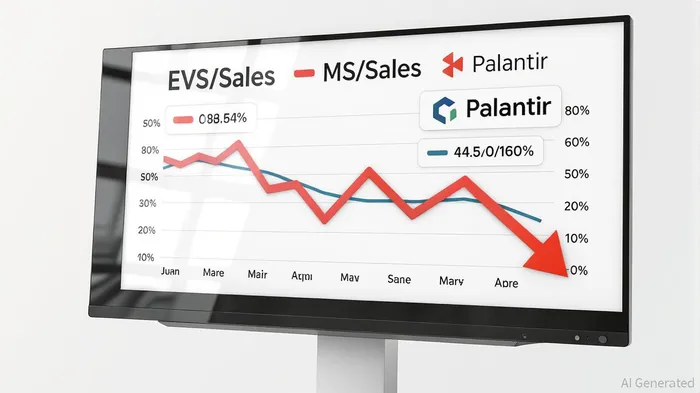
Today's AI sector, while more mature, faces similar risks. Palantir Technologies, for example, trades at over 200x earnings, as noted in the Tech2 article, a multiple that echoes the exuberance of the late 1990s. However, unlike the dot-com era, many AI firms now generate revenue-though profitability remains elusive for most. The sector's average P/E ratio is not explicitly stated, but BigBear.ai (BBAI) trades at 20x forward sales, above its industry average of 17x, according to a Seeking Alpha article. This suggests a valuation premium, albeit not as extreme as the dot-com peak.
Risk/Reward Dynamics: Balancing Optimism and Caution
The AI sector's risk/reward profile hinges on two key factors: growth sustainability and profitability timelines.
- Growth Potential: AI's transformative applications-from predictive maintenance to agentic AI-justify high valuations for firms with defensible moats. MSAI's expansion into a $17 billion predictive maintenance market by 2026, as noted in the Finimize snapshot, and SoundHound AI's 27.1x forward revenue multiple, as reported in a Seeking Alpha article, highlight the sector's long-term appeal.
- Profitability Risks: Many AI firms, like Datavault AI (DVLT), operate with low gross margins (~11%) and no path to profitability, as noted in a Tech2 article. This mirrors the dot-com era's focus on revenue over earnings and raises questions about valuation sustainability.
For investors, the key is to differentiate between companies with durable competitive advantages and those relying on speculative hype. C3.ai's recent leadership shakeup and operating losses, as described in the Yahoo Finance report, exemplify the risks of overpaying for unproven growth stories.
Conclusion: A Sector in Transition
The AI sector in 2025 is neither a full-blown bubble nor a bargain. It is in a recalibration phase, with valuations reflecting both optimism and caution. While model builders and data enablers command premium multiples, applied AI firms like MSAI offer more grounded growth prospects.
Investors should approach the sector with a nuanced lens:
- High-risk bets on speculative AI firms require rigorous due diligence on competitive moats and revenue scalability.
- Contrarian opportunities may exist in undervalued players like MSAI, provided their growth trajectories align with market demand.
As the sector evolves, the interplay between innovation and fundamentals will determine whether AI becomes the next Amazon or the next Pets.com.

Delivering real-time insights and analysis on emerging financial trends and market movements.
Latest Articles
Stay ahead of the market.
Get curated U.S. market news, insights and key dates delivered to your inbox.




Comments
No comments yet