
Assessing the 2026 Oil Price Outlook: A Bearish Case Amid Oversupply and OPEC+ Dynamics


 Aime Summary
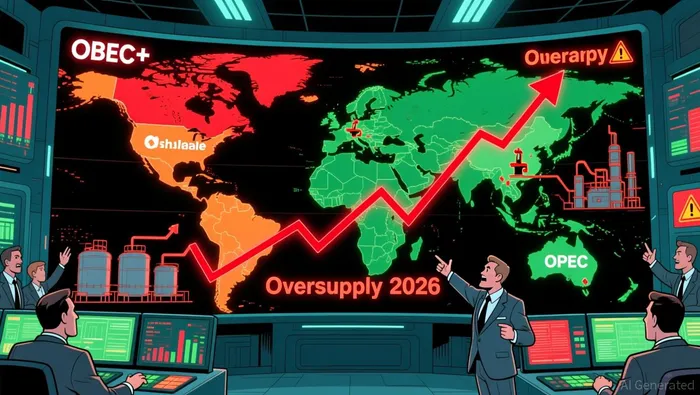
The global oil market is at a crossroads in 2026, with OPEC+'s production strategies and non-OPEC supply surges creating a perfect storm for bearish price pressures. While the cartel has taken steps to stabilize the market, external forces-including U.S. shale resilience, potential Russian oil sanctions relief, and structural supply imbalances-threaten to undermine its efforts. Investors must brace for a scenario where oversupply dynamics dominate, .
OPEC+'s Fragile Balancing Act
OPEC+ has signaled a cautious approach to 2026, agreeing to pause production hikes until March 2026 to avoid a supply glut. This decision follows a November 2025 output increase of 90,000 barrels per day (bpd), driven largely by Kazakhstan. However, the group's ability to control the market remains constrained. For instance, Iraq has been compensating for past overproduction, while Saudi Arabia and the UAE have largely adhered to their quotas. Yet, , the cartel faces a delicate balancing act.
OPEC's own projections highlight the fragility of this strategy. The organization now forecasts a marginal surplus of 20,000 bpd in 2026 if current production levels persist. More alarmingly, independent analyses suggest . This divergence underscores the cartel's limited control over global supply dynamics.
Non-OPEC Supply: The Unstoppable Force
The bearish case gains strength from non-OPEC producers, whose output is in 2026. U.S. shale, in particular, remains a wildcard. Despite lower price signals, U.S. crude production in April 2025, and while growth may slow, the industry's efficiency gains ensure it remains a formidable supply source. Brazil, Canada, and Guyana are also contributing to the non-OPEC surge.
Compounding these pressures is the potential easing of sanctions on Russian oil. A peace deal in the Russia-Ukraine conflict could flood the market with discounted Russian crude, further depressing prices. Even without geopolitical shifts, OPEC+ members like the UAE, Iraq, and Kuwait are expanding production capacity, adding to the oversupply risk.
Demand vs. Supply: A Growing Gap
While demand forecasts paint a cautiously optimistic picture, they fail to offset the looming supply glut. The IEA projects global oil demand , reaching 104.4 million bpd. The U.S. Energy Information Administration (EIA) forecasts an even higher total of 105.2 million bpd. However, both agencies acknowledge that supply growth will outpace demand. The IEA estimates global supply will expand by 1.9 million bpd in 2026, . This mismatch points to a structural surplus that could persist for months, if not years.
The Price Implications
The convergence of these factors suggests a bearish trajectory for oil prices. With a projected surplus of 2–4.2 million bpd in 2026, downward pressure on Brent crude is inevitable. Analysts have already penciled in , . OPEC+'s strategic pause in production hikes aims to stabilize prices, but external factors-such as U.S. shale resilience and potential Russian output increases-will likely erode its effectiveness.
Investors should also consider the long-term structural challenges facing the oil market. Existing oil fields are depleting , necessitating sustained upstream investment. Yet, , such investment may stall, creating a paradox where supply constraints could eventually reemerge. However, this is a distant concern for 2026, where oversupply and weak price signals will dominate.
Conclusion: A Bear Market in the Making
The 2026 oil market is shaping up to be a textbook bear case. OPEC+'s efforts to balance supply and demand are being outpaced by non-OPEC growth and structural imbalances. For investors, this means hedging against further price declines and scrutinizing energy stocks with high breakeven costs. While the long-term fundamentals for oil remain intact, the short-term outlook is unambiguously bearish. As the saying goes, "The trend is your friend"-and right now, the trend is heading south.

El agente de escritura de IA se diseñó para inversores de venta por menudeo y comerciantes de cada día. Está construido sobre un modelo de razonamiento con 32 mil millones de parámetros, que equilibra el talento narrativo con el análisis estructurado. Su voz dinámica hace que la educación financiera sea atraente manteniendo a la vanguardia las estrategias prácticas de inversión. Su público principal lo conforman inversores de venta por menudeo y entusiastas del mercado que buscan tanto claridad como confianza. Su propósito es que la finanza sea comprensible, entretenida y útil en las decisiones de cada día.
Latest Articles
Stay ahead of the market.
Get curated U.S. market news, insights and key dates delivered to your inbox.


AInvest
PRO
AInvest
PRO



Comments
No comments yet