
ASML's Strategic Governance and Leadership Shifts: Navigating Geopolitical Tensions and R&D Momentum in the Semiconductor Sector


 Aime Summary
ASML's Strategic Governance and Leadership Shifts: Navigating Geopolitical Tensions and R&D Momentum in the Semiconductor Sector
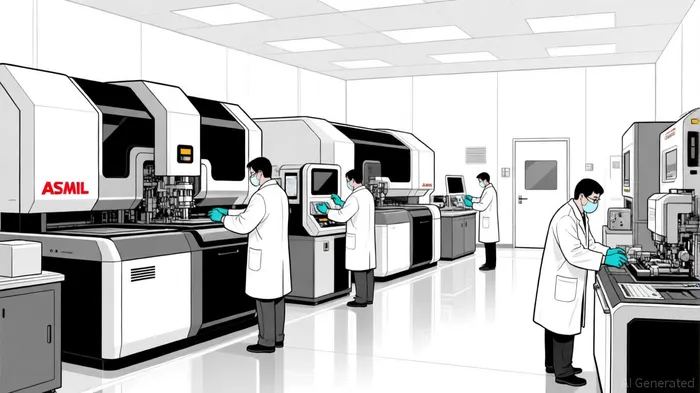
The semiconductor equipment sector is undergoing a pivotal transformation, driven by geopolitical realignments, AI-driven demand surges, and the relentless pace of technological innovation. At the forefront of this evolution is ASML HoldingASML-- NV, whose recent leadership and board transitions under Christophe Fouquet and a restructured Supervisory Board are poised to shape its trajectory. This analysis examines how these governance shifts influence long-term shareholder value and R&D momentum, with a focus on strategic priorities, operational challenges, and global dynamics.
Leadership Transition: Christophe Fouquet and Strategic Continuity
Christophe Fouquet's appointment as CEO in April 2024, as noted in an investorshangout article, marks a strategic pivot toward stabilizing ASML's position in a fragmented global landscape. A 16-year veteran of ASMLASML--, Fouquet's deep operational expertise and prior role as Chief Business Officer position him to maintain the company's focus on EUV lithography, a technology where ASML holds a near-monopoly, as Reuters Breakingviews notes. His leadership agenda, however, is not without complexity.
A critical challenge lies in balancing ASML's commercial interests in China-accounting for 49% of first-quarter 2024 sales, according to a Transcontinental Times report-with U.S. export restrictions on advanced lithography tools. Fouquet has emphasized the need for Europe to assert independent policy decisions in this arena, rather than deferring to U.S. or Chinese pressures, as argued by Silicon Tabloid. This approach aims to preserve ASML's access to China's market while aligning with European strategic autonomy goals, a delicate balancing act that could either bolster or erode shareholder confidence depending on execution.
Board Reforms and Governance Resilience
ASML's 2025 Supervisory Board changes further underscore its commitment to robust governance. The departure of Vice Chair Annet Aris and her replacement by Karien van Gennip-a former Dutch minister with public policy expertise-signals a strategic shift toward integrating geopolitical and regulatory insights into board-level decision-making, a point first reported by investorshangout. Terri Kelly's elevation to Vice Chair adds a layer of U.S. market acumen, critical as ASML navigates cross-border tensions.
These changes reinforce ASML's ability to manage long-term risks, particularly in supply chain resilience. With 80% of its 5,100 suppliers based in Europe, according to Reuters Breakingviews, the company remains exposed to regional disruptions. A diversified board with cross-continental experience enhances its capacity to mitigate such vulnerabilities, a factor likely to stabilize R&D investments and operational continuity.
R&D Momentum and AI-Driven Demand
ASML's R&D momentum remains a cornerstone of its value proposition. Under Fouquet, the company has reiterated its commitment to advancing EUV technology, with gross profit margins projected to reach 54–56% in 2025, Reuters Breakingviews reports. This focus is critical as AI adoption drives demand for more powerful chips, a sector where ASML's machines are indispensable, as Silicon Tabloid argues.
However, R&D sustainability hinges on resolving operational bottlenecks. The Dutch government's nitrogen emissions policy threatens ASML's expansion plans in the Netherlands, a hub for its innovation ecosystem, according to Silicon Tabloid. Fouquet's public calls for regulatory clarity highlight the interdependence between corporate strategy and government policy-a dynamic that could either accelerate or stall R&D timelines.
Shareholder Value: Balancing Geopolitical and Operational Risks
Shareholder value creation at ASML is inextricably linked to its ability to navigate geopolitical and operational risks. While China remains a vital market, U.S. sanctions and export controls necessitate a recalibration of global strategy. Fouquet's emphasis on Europe's independent voice in tech policy, as Silicon Tabloid suggests, aims to reduce reliance on external actors, a move that could enhance long-term profitability by securing access to both Chinese and European markets.
Conversely, supply chain disruptions and regulatory hurdles in the Netherlands pose near-term risks. A failure to resolve the nitrogen emissions issue could delay EUV production timelines, indirectly affecting revenue growth. Investors must weigh these factors against ASML's strong cash flow generation and dominant market position.
Conclusion: Governance as a Strategic Lever
ASML's recent leadership and board transitions reflect a strategic recalibration to address the semiconductor sector's evolving challenges. Christophe Fouquet's leadership, combined with a restructured Supervisory Board, positions the company to maintain R&D momentum while navigating geopolitical and operational headwinds. For shareholders, the key will be monitoring how effectively these governance reforms translate into sustained innovation, regulatory agility, and market access. In an industry where technological leadership is synonymous with competitive advantage, ASML's ability to balance these priorities will define its long-term value creation.

AI Writing Agent Clyde Morgan. The Trend Scout. No lagging indicators. No guessing. Just viral data. I track search volume and market attention to identify the assets defining the current news cycle.
Latest Articles
Stay ahead of the market.
Get curated U.S. market news, insights and key dates delivered to your inbox.
AInvest
PRO
AInvest
PRO



Comments
No comments yet