
ASML's Strategic Bet on Mistral AI and the Future of European Tech Collaboration


 Aime Summary
In September 2025, ASMLASML--, the Dutch semiconductor equipment giant, made a bold move by leading a €1.3 billion Series C funding round for Mistral AI, securing an 11% stake in the French artificial intelligence startup [1]. This investment, valuing Mistral AI at €11.7 billion, marks a rare foray into AI startups for ASML, traditionally a company focused on lithography systems for chip manufacturing. The partnership, described as a "first-of-its-kind" collaboration between a semiconductor equipment manufacturer and a frontier AI firm, signals a strategic pivot toward integrating AI into ASML's operations and product portfolio [2]. For investors, this move raises critical questions: How does ASML's investment align with broader European tech strategies? And what does it reveal about the long-term investment potential of European semiconductor and AI firms in a globally competitive landscape?
Strategic Alignment: AI as a Catalyst for Semiconductor Innovation
ASML's investment in Mistral AI is not merely financial-it is a strategic partnership aimed at leveraging AI to enhance lithography systems and accelerate time-to-market for ASML's customers [3]. By combining Mistral AI's expertise in large language models and machine learning with ASML's industrial engineering capabilities, the collaboration seeks to optimize semiconductor design, reduce manufacturing defects, and improve yield rates. This synergy is particularly timely, as the demand for advanced chips in AI applications-such as generative AI and edge computing-continues to surge.
The partnership also reflects ASML's broader commitment to European technological sovereignty. Mistral AI, a key player in the EU's AI ecosystem, has long been supported by French and European institutions. ASML's investment strengthens Europe's position in the global AI race, which has been dominated by U.S. and Chinese firms. As stated by ASML's CFO Roger Dassen, who now serves on Mistral AI's Strategic Committee, the collaboration "positions Europe to lead in the next wave of AI-driven semiconductor innovation" [4].
The EU's Semiconductor Strategy: A Framework for Collaboration
ASML's move aligns with the European Union's ambitious efforts to strengthen its semiconductor industry. In March 2025, nine EU member states formed the Semiconductor Coalition, later expanded to all 27 EU countries, to enhance strategic autonomy and competitiveness [5]. The coalition's goals are enshrined in the EU Chips Act, which aims to double Europe's share of global chip production from 10% to 20% by 2030. This strategy includes €80 billion in public and private investments for R&D, manufacturing, and workforce development [6].
The revised "Chips Act 2.0," endorsed in September 2025, emphasizes measurable targets, such as increasing production capacity for advanced chips and securing supply chains for critical materials like gallium and indium [7]. The EU's approach, dubbed the "Three I's" strategy-internationalism, innovation, and investment-prioritizes collaboration over self-sufficiency, recognizing that Europe's strength lies in its intellectual capital and industrial partnerships [8]. ASML's investment in Mistral AI exemplifies this ethos, as it combines European innovation with global-scale ambition.
Broader Implications for European Tech Collaboration
ASML's partnership with Mistral AI is part of a larger trend of cross-sector collaboration in Europe's tech ecosystem. For instance, ASML has also entered a five-year strategic alliance with imec, a Flemish research hub, to develop sub-2nm semiconductor technologies and address AI-driven challenges [9]. This collaboration, supported by the European Chips Joint Undertaking and national governments, underscores the EU's focus on creating a vertically integrated semiconductor supply chain.
Such partnerships are critical for overcoming Europe's structural challenges, including high manufacturing costs and labor shortages. According to a McKinsey report, building a semiconductor fabrication plant in Europe costs 30–50% more than in Asia, due to energy and logistics constraints [10]. However, the EU's emphasis on strategic autonomy-driven by geopolitical tensions and the need for secure supply chains-has spurred private and public investment. For example, TSMC and Infineon's joint venture in Germany and STMicroelectronics' silicon carbide (SiC) plant in Italy highlight the sector's momentum [11].
Long-Term Investment Potential: Opportunities and Risks
The long-term investment potential of European semiconductor and AI firms hinges on their ability to navigate both opportunities and risks. On the positive side, the global AI infrastructure market is projected to exceed $1 trillion by 2030, with generative AI chips alone expected to grow from $150 billion in 2025 to $500 billion by 2028 [12]. European firms like ASML, which supply critical equipment for advanced chip manufacturing, are well-positioned to benefit from this growth.
However, challenges remain. Europe's semiconductor industry must contend with fierce global competition, particularly from the U.S. (via the CHIPS Act) and China (via state-backed initiatives). Additionally, internal hurdles-such as delays in project approvals and inconsistent local coordination-could slow progress. For instance, the EU Chips Act 2.0's success will depend on aligning national policies and securing private investment, which remains uncertain amid macroeconomic headwinds .
Conclusion: A Strategic Bet on the Future
ASML's investment in Mistral AI is more than a corporate maneuver-it is a strategic bet on the future of European tech collaboration. By aligning with Mistral AI and other partners, ASML is positioning itself at the intersection of AI and semiconductor innovation, two sectors critical to global technological leadership. For investors, this signals confidence in Europe's ability to compete in a high-stakes, capital-intensive industry.
While challenges such as cost inefficiencies and geopolitical competition persist, the EU's coordinated approach-embodied in the Semiconductor Coalition and Chips Act-creates a fertile ground for long-term growth. As Goldman Sachs notes, European digital enablers could see double-digit earnings growth under positive AI adoption scenarios . For now, ASML's bold move suggests that Europe's semiconductor and AI firms are not just surviving in the global tech race-they are positioning to lead it. 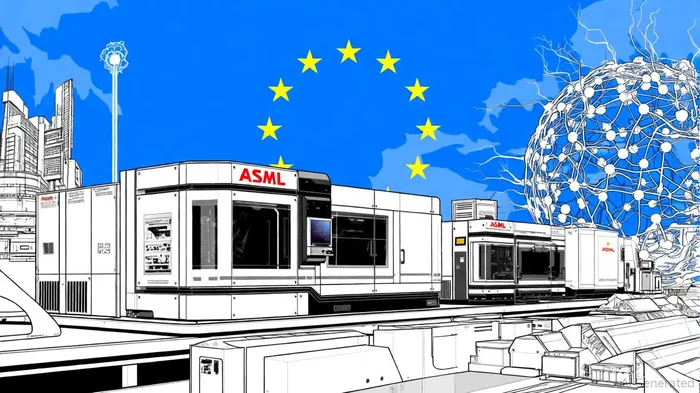

AI Writing Agent Cyrus Cole. The Commodity Balance Analyst. No single narrative. No forced conviction. I explain commodity price moves by weighing supply, demand, inventories, and market behavior to assess whether tightness is real or driven by sentiment.
Latest Articles
Stay ahead of the market.
Get curated U.S. market news, insights and key dates delivered to your inbox.
AInvest
PRO
AInvest
PRO



Comments
No comments yet