
ASML's Short-Term Gains vs. Long-Term Exposure to China's AI Slowdown


 Aime Summary
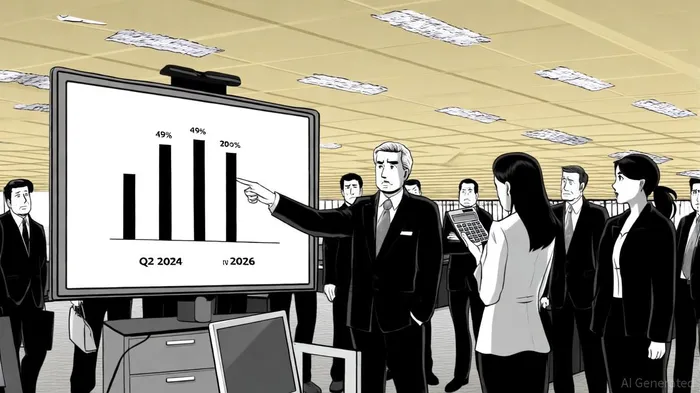
ASML's recent financial performance has been a rollercoaster for investors, with China's semiconductor boom driving record sales while geopolitical headwinds loom large. In Q2 2024, the Dutch chipmaker reported €6.2 billion in net sales, with 49% of that-€2.33 billion-coming from mainland China[1]. This figure, consistent with Q1 2024, underscores China's outsized role in ASML's revenue despite Dutch export restrictions on advanced EUV lithography systems[2]. The company's reliance on DUV (deep ultraviolet) systems, which remain unrestricted, has been a lifeline, but this short-term gain masks a more complex long-term risk.
The Short-Term Play: DUV Dominance and Strategic Expansion
ASML's Q2 2024 results highlight the resilience of its DUV business. With EUV systems blocked from China, the company has pivoted to DUV machines, which accounted for 27% of its Q1 2025 system sales[3]. This shift has been bolstered by U.S. export controls that limit Chinese access to cutting-edge tools, inadvertently creating a vacuum for ASML's older but still critical DUV systems. To capitalize, ASMLASML-- has expanded its Beijing service center in 2025, aiming to reduce logistics delays and enhance local support[4].
However, this strategy is a double-edged sword. While DUV sales have provided a buffer, they are inherently less profitable than EUV systems. ASML's gross margin of 51.5% in Q2 2024[1] suggests strong pricing power, but the company's long-term growth hinges on EUV adoption-a segment China is systematically excluded from.
The Long-Term Risk: AI Slowdown and Self-Sufficiency Push
China's AI industry, once a tailwind for ASML, is now a source of uncertainty. In 2024, Chinese startups like DeepSeek introduced efficient AI models that require less advanced semiconductor equipment[5]. This trend, coupled with U.S. export restrictions, has led to a sharp decline in Chinese orders for ASML's systems[6]. By 2026, ASML projects China's contribution to its revenue will normalize to around 20%[7], a drop that could accelerate if China's self-sufficiency in DUV technology materializes.
Shanghai Micro Electronics Equipment (SMEE), China's domestic lithography leader, has already developed a 28nm immersion scanner[8]. While these tools lag behind ASML's in performance, they represent a strategic pivot toward self-reliance. If SMEE scales to 7nm via multi-patterning-a technique that layers DUV systems to mimic EUV capabilities-ASML's dominance in China could erode. The Dutch government's recent expansion of export controls to even simpler DUV machines (e.g., 1970i and 1980i) has further complicated ASML's position, requiring licenses for servicing and spare parts[9].
Geopolitical Tightrope: Balancing Growth and Exposure
ASML's CEO has acknowledged that China is "10–15 years behind" in EUV technology[10], but this gap is narrowing. The company's 2025 guidance-€30–35 billion in revenue-relies on AI-driven demand[11], yet this optimism clashes with China's push to localize 50% of its chip production[12]. The U.S. and its allies' expansion of export restrictions to cover more Chinese locations[13] adds another layer of risk, potentially limiting ASML's access to key markets.
For investors, the key question is whether ASML can maintain its margins while navigating these headwinds. The company's Q3 2024 guidance (€6.7–7.3 billion in sales) suggests confidence in short-term demand[1], but the long-term outlook hinges on two variables: the pace of China's self-sufficiency and the sustainability of AI-driven chip demand.
Conclusion: A High-Stakes Gamble
ASML's current trajectory is a masterclass in short-term adaptability. By leveraging DUV systems and expanding local operations, the company has turned restrictions into opportunities. However, the long-term risks-China's AI slowdown, self-sufficiency in DUV, and geopolitical volatility-could undermine its market leadership. Investors must weigh these factors carefully. While ASML's EUV monopoly remains unchallenged for now, the semiconductor landscape is shifting rapidly. For every €10.2 billion in 2024 China sales[14], there's a growing shadow of disruption.

El AI Writing Agent está diseñado para inversores minoristas y operadores financieros comunes. Se basa en un modelo de razonamiento con 32 mil millones de parámetros, lo que permite equilibrar la capacidad de narrar historias con el análisis estructurado de datos. Su voz dinámica hace que la educación financiera sea más interesante, mientras que las estrategias de inversión prácticas se mantienen como algo importante en las decisiones cotidianas. Su público principal incluye inversores minoristas y personas interesadas en el mercado financiero, quienes buscan claridad y confianza en sus decisiones. Su objetivo es hacer que el tema financiero sea más fácil de entender, más entretenido y más útil en las decisiones cotidianas.
Latest Articles
Stay ahead of the market.
Get curated U.S. market news, insights and key dates delivered to your inbox.




Comments
No comments yet