
ASML Shares Jump 3.76% on Morgan Stanley Upgrade and AI-Driven Demand, $1.64B Volume Ranks 40th in Equities Trading
 Aime Summary
Market Snapshot
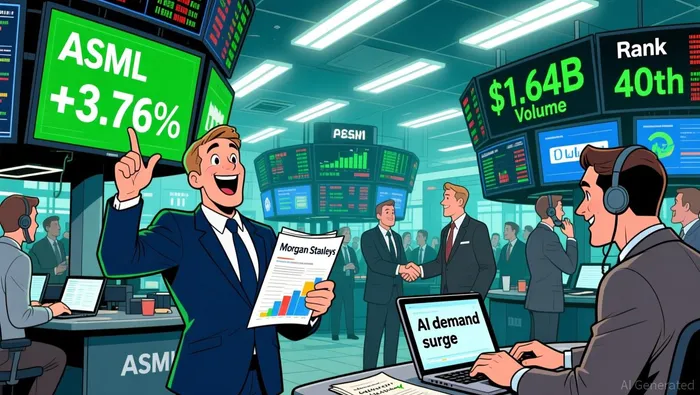
ASML’s stock surged 3.76% on November 26, 2025, closing at $1,003 per share, as trading volume spiked 37.98% to $1.64 billion, ranking the stock 40th in volume among listed equities. The company’s market capitalization remained at $389 billion, reflecting sustained investor confidence amid a strategic upgrade from Morgan StanleyMS--. The intraday range extended from $974 to $1,007, with the stock trading near its 50-day moving average. This performance followed a broader recovery in the semiconductor sector, driven by renewed demand for advanced lithography tools.
Key Drivers
Strategic Upgrade and Price Target Hike
Morgan Stanley’s designation of ASMLASML-- as the “Top Pick” in European semiconductors and its raised price target to €1,000 from €975 catalyzed the stock’s rise. Analyst Lee Simpson highlighted ASML’s dominant role in DRAM technology transitions, particularly the shift to 1c nodes, which require 5–6 EUV layers per wafer. This transition increases lithography intensity, directly boosting demand for ASML’s EUV systems. The firm also cited stronger order visibility from Samsung and SK Hynix, with Samsung’s incomplete fiscal 2026 order book presenting potential upside.
Margin Resilience Amid DUV Slowdown
Despite anticipated challenges in DUV systems, Morgan Stanley projected ASML’s gross margin to remain resilient at 52.3% in 2026. This outlook is underpinned by higher EUV sales and improved profitability from Installed Base Management services. The firm noted that ASML’s product mix is shifting toward more profitable advanced tools, offsetting weaker DUV performance. Additionally, management’s guidance for 2026 growth, though tempered by China demand declines, aligned with Simpson’s forecast of a 15% drop in Chinese sales—less severe than the 20% decline warned by ASML’s own management.
AI-Driven Demand and Order Pipeline
The stock’s momentum was further supported by AI infrastructure spending, which is accelerating demand for leading-edge semiconductor capacity. Analysts pointed to TSMC’s 3nm production expansions as a potential driver for additional EUV orders beyond Q3 2025 bookings. Nvidia’s recent commentary on “off-the-chart” Blackwell demand reinforced optimism about ASML’s 2026–2027 tool cycles. This dynamic positions ASML to benefit from forward-pulled capacity investments, particularly in foundry and memory segments.
Market Sentiment and Valuation
ASML’s valuation metrics, including a 36x trailing earnings multiple, reflect its premium positioning in the semiconductor equipment sector. The upgrade coincided with a correction in the stock price, which Morgan Stanley viewed as an attractive entry point. Analysts also noted that consensus 12-month price targets clustered near $1,000, with recent bullish calls from Wells Fargo and JPMorgan suggesting potential upside to the low-$1,100s. The stock’s strong technical indicators, including a rebound above its 50-day moving average, further signaled confidence in its near-term trajectory.
Geopolitical and Cyclical Considerations
While ASML faces near-term cyclical headwinds, particularly in China, its quasi-monopoly on EUV lithography equipment for AI and high-performance computing applications provides long-term visibility. Management’s cautious guidance for 2026 growth—balancing China’s challenges with robust demand from Samsung and SK Hynix—underscored the company’s strategic flexibility. The firm’s ability to maintain margins amid DUV slowdowns and its leadership in next-generation node transitions position it as a key beneficiary of the semiconductor industry’s structural shift toward advanced manufacturing.

Stay ahead of the market.
Get curated U.S. market news, insights and key dates delivered to your inbox.




Comments
No comments yet