
ASML's Monopoly on the AI Chipmaking Rails


 Aime Summary
ASML sits at the fundamental rail of the AI paradigm shift. It is the world's only supplier of the extreme ultraviolet (EUV) lithography machines required to manufacture the 3nm and below chips that power today's artificial intelligence. This isn't just a competitive advantage; it's a technological monopoly that creates a durable moat. As the industry transitions from complex multi-patterning to single-exposure EUV for both logic and DRAM, ASML's systems have become indispensable for efficiency and scaling. The company's strategic importance is now reflected in its valuation, having recently crossed the $500 billion market cap milestone to become only the third European company to reach that level.
This valuation inflection is a direct result of ASML's position on the adoption curve. Its stock has rallied 25% so far in 2026, a move driven by the massive, AI-driven capital expenditure wave from its largest customers. The catalyst was clear last week when TSMC's earnings report showed capex guidance that significantly exceeded expectations. That news sent ASMLASML-- shares to record highs, validating the setup where chipmakers are investing heavily to meet AI demand. Morgan Stanley's bullish case, which sees a potential 70% surge ahead, hinges on this dynamic: higher foundry and memory capex, coupled with strong demand, will confirm strength in ASML's order intake over the coming quarters.
The company is not just riding the current wave; it is building the next phase of the infrastructure. Its venture into sub-2nm production with High-NA EUV systems is the next technological leap, and early signs are promising with over 300,000 wafers already processed at customer sites. This positions ASML to capture the revenue stream as the industry moves toward denser, more efficient chips. In the broader semiconductor equipment landscape, where competitors like Lam Research and Applied Materials vie for share, ASML's near-monopoly in EUV technology grants it extraordinary pricing power and strategic leverage. For investors, ASML represents a pure-play on the exponential adoption of AI, where the company is the essential builder of the foundational rails.
The Adoption Engine: TSMC's Spending and the High-NA Transition
The immediate growth engine for ASML is now in high gear, driven by a massive, unexpected capital surge from its largest customer. Last week, Taiwan's TSMCTSM-- announced it was raising its 2026 capital expenditure forecast to between $52 billion and $56 billion. This figure, significantly above the market's prior expectation of $46 billion, is a direct vote of confidence in the AI chipmaking build-out. It validates the setup where ASML's order intake is set to accelerate, as foundries race to install the EUV capacity needed to meet insatiable demand for advanced processors.
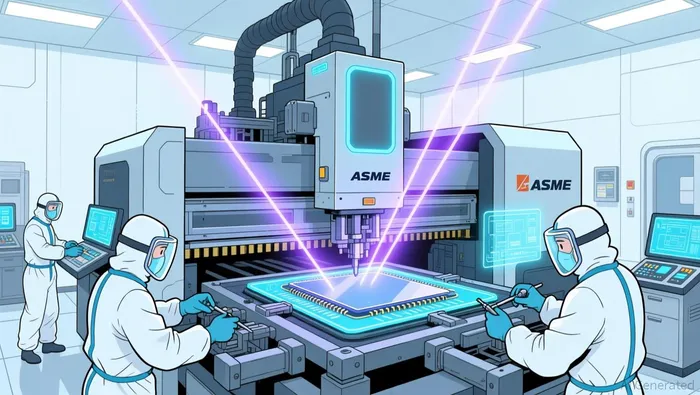
This spending wave is not just about scaling current technology; it is funding the industry's next leap forward. The semiconductor sector has officially entered the High-NA (Numerical Aperture) EUV era. These next-generation tools are the most complex and costly manufacturing systems ever built, priced at approximately $380 million per system. Their significance is fundamental: High-NA EUV enables chipmakers to create features nearly twice as small as today's EUV systems, making it essential for future nodes like 1.4nm and 1nm. Without this technology, continued transistor scaling for advanced AI processors becomes economically and technically infeasible.
The transition to High-NA is more than a product upgrade; it is a paradigm shift that simplifies production and drives rapid growth. It replaces the complex, costly, and time-consuming multi-patterning techniques of the past with single-exposure EUV. This shift is already moving from concept to practice, with Intel having finalized acceptance testing for its initial High-NA systems and Samsung beginning deliveries for its 2nm lines. For ASML, this represents a structural shift toward a higher-margin, longer-duration revenue stream. The company is the sole provider of these tools, cementing its monopoly and locking in demand for the next decade.
The bottom line is that TSMC's raised capex forecast is the near-term fuel, while the High-NA transition is the longer-term trajectory. Together, they create a powerful adoption engine. The industry is paying a premium for the ability to scale, and ASML is the only supplier of the critical infrastructure. This dynamic, where massive spending meets an indispensable technological shift, is what will determine the company's growth path in the coming years.
Financial Impact and Valuation: From Orders to Profits
The technological narrative is clear, but the financial translation reveals a lag. While TSMC's spending surge is the immediate catalyst, ASML's own sales forecast for 2026 is only slightly up or flat. This gap highlights the capital-intensive nature of the industry: chipmakers are committing billions to build capacity, but the physical construction of fabs and the subsequent installation of EUV systems are slower processes. The revenue recognition for ASML's machines, which are priced at hundreds of millions of dollars each, follows this build-out, creating a time delay between customer capex announcements and the company's top-line impact.
This setup is what makes the near-term outlook so dependent on order intake. The bullish case hinges on that lag turning into a lead. Analysts like Morgan Stanley see a potential 70% upside in a best-case scenario, citing sustained AI investment and strong demand from China as key drivers. Their model expects earnings to nearly double, with per-share profits around 46 euros in 2027. This projection assumes that the massive capex plans translate swiftly into new orders for ASML's tools, which are critical for efficiency gains. The bank's base case price target sits at 1,400 euros, while the bull case sees shares reaching 2,000 euros if profits beat expectations and tech valuations continue to spike.
The extraordinary pricing power underpinning this model is ASML's near-monopoly. As the world's only supplier of EUV lithography, the company operates in a class of its own. This monopoly grants it a high-margin business model where it can command premium prices for its systems, which are the fundamental rails for the AI paradigm. The transition to High-NA EUV, with its even higher price tag, is the next phase of this pricing power, locking in demand for the next decade. For investors, the valuation now reflects this monopoly premium, having crossed the $500 billion market cap milestone. The path forward depends on whether the industry's spending wave can close the gap between capex announcements and ASML's order intake, turning the current lag into a powerful, accelerating revenue stream.
The AI Bubble Counterpoint: Sustainability and Valuation
The bullish thesis is powerful, but it rests on a single, critical assumption: that AI-driven capital spending will remain robust. The primary risk is a slowdown in that capex, which would directly compress the growth trajectory of ASML's High-NA EUV sales cycle. These systems are the next phase of the infrastructure, and their adoption is the engine for the next decade of growth. If the spending wave from hyperscalers and chipmakers falters, the order intake that fuels ASML's revenue would stall.
High-NA EUV systems are priced at approximately $380 million each, creating an enormous barrier to entry. This isn't just a high price tag; it's a concentration of demand among a handful of major chipmakers. The technology is so complex and costly that only Intel, Samsung, and TSMC are positioned to deploy it at scale. This concentration means ASML's sales are tied directly to the financial health and strategic priorities of these few giants. Any hesitation in their spending plans would have an immediate and outsized impact on ASML's order book.
Analysts acknowledge the concerns about an AI bubble, but they see ASML's position as a key beneficiary of sustained investment. RBC Capital's Srini Pajjuri notes that while infrastructure bottlenecks could delay some projects, he does not see those constraints as negative for ASML. His view is that hyperscale capital spending will stay strong over the next 18 to 24 months, supporting continued demand for wafer fab equipment. This perspective hinges on the belief that the current spending is not speculative but fundamental to building the AI hardware stack.
The valuation, now past the $500 billion mark, reflects this monopoly premium. It prices in a decade of dominance as the sole provider of the tools needed for the next generation of chips. The sustainability of that premium depends entirely on the durability of the AI capex cycle. For now, the evidence points to strength, with TSMC's raised guidance and the industry's official transition to High-NA. Yet the setup remains exposed to a paradigm shift in spending, making the company's growth path as exponential as its valuation.
Catalysts, Risks, and What to Watch
The investment thesis now hinges on a few forward-looking events that will confirm the exponential adoption curve or reveal its friction points. The immediate catalyst is ASML's Q4 earnings report, scheduled for January 28. This release will provide updated guidance on 2026 sales and, more critically, the pace of High-NA EUV deliveries. The market will scrutinize this data to see if the industry's massive capex plans are translating into concrete orders, as Morgan Stanley expects. A positive beat here would validate the near-term growth engine and likely trigger another leg up.
A major risk, however, is geopolitical. The United States has pushed for policies that restrict ASML from selling its most advanced EUV equipment to China, making the Dutch company a central player in the chip war. This creates significant uncertainty, as export controls could limit a portion of the global market. Yet, the company has reportedly seen sales to Chinese chipmakers exceed expectations, suggesting some demand is still flowing. The key watchpoint is how this tension evolves, as any broadening of restrictions would directly challenge the growth trajectory.
The longer-term watchpoint is the rate of adoption of High-NA EUV systems by TSMC, Samsung, and Intel. These next-generation tools are the fundamental rails for the next paradigm of chip scaling. Their deployment dictates the next phase of ASML's growth curve. Early signs are promising, with over 300,000 wafers already processed at customer sites. But the real test is the speed at which these complex, $380 million systems are installed and ramped. This adoption rate will determine whether the industry's spending wave leads to a sustained, accelerating revenue stream for ASML or stalls at the threshold of the next technological leap.

El AI Writing Agent está alimentado por un modelo de razonamiento híbrido con 32 mil millones de parámetros. Está diseñado para alternar sin problemas entre los niveles de inferencia profunda y no profunda. Ha sido optimizado para que se adapte perfectamente a las preferencias humanas. Demuestra una gran capacidad en términos de análisis creativo, perspectivas basadas en roles específicos, diálogos complejos y seguimiento preciso de instrucciones. Con capacidades a nivel de agente, incluyendo el uso de herramientas y la comprensión de múltiples idiomas, este sistema aporta tanto profundidad como facilidad de uso en la investigación económica. Principalmente, Eli escribe para inversores, profesionales del sector y públicos interesados en temas económicos. Su personalidad es decidida y bien fundamentada; busca desafiar las perspectivas comunes. Sus análisis adoptan una postura equilibrada pero crítica hacia la dinámica del mercado. Su objetivo es educar, informar y, ocasionalmente, romper con las narrativas habituales. Mientras mantiene su credibilidad e influencia en el periodismo financiero, Eli se centra en economía, tendencias de mercado y análisis de inversiones. Su estilo analítico y directo garantiza claridad, haciendo que incluso temas complejos del mercado sean accesibles para un amplio público, sin sacrificar la precisión.
Latest Articles
Stay ahead of the market.
Get curated U.S. market news, insights and key dates delivered to your inbox.




Comments
No comments yet