
Could ASML Be the Key to Becoming a Millionaire by 2035?


 Aime Summary
In the high-stakes arena of semiconductor manufacturing, few companies hold as much strategic importance as ASML Holding NVASML--. As the sole provider of extreme ultraviolet (EUV) lithography systems-critical tools for producing the most advanced chips-ASML sits at the intersection of technological innovation and global demand. With artificial intelligence (AI), high-performance computing (HPC), and next-generation memory technologies driving a seismic shift in the industry, the question arises: Could ASMLASML-- be the key to achieving millionaire status by 2035?
A Monopoly in the Most Critical Technology
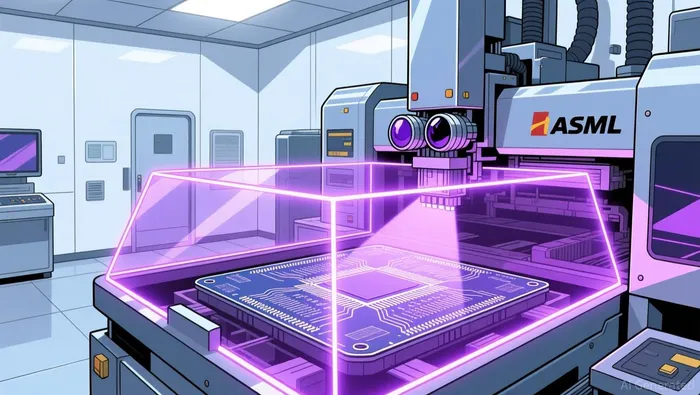
ASML's dominance in EUV lithography is unparalleled. The company holds a 90% share of the deep ultraviolet (DUV) market and an unchallenged position in EUV, where it operates with near-monopolistic control. This technological edge is not just a competitive advantage-it is a structural necessity for the semiconductor industry. EUV machines are indispensable for manufacturing chips with 7-nanometer and smaller nodes, which power AI accelerators, data centers, and cutting-edge consumer electronics.
The EUV market itself is poised for explosive growth. By 2035, it is projected to generate nearly $175 billion in annual revenue, up from $19 billion in recent years. ASML's leadership in this space positions it to capture a significant portion of this growth. For context, the company's Q2 2025 net bookings reached €5.5 billion, reflecting robust demand for its systems.
Financial Projections and Margin Expansion
ASML's financial trajectory underscores its long-term potential. For 2025, the company forecasts a 15% increase in total net sales compared to 2024, with a gross margin of approximately 52%. Looking further ahead, management has outlined ambitious targets: annual sales between €44 billion and €60 billion by 2030, supported by gross margins expanding to 56–60%. These figures are underpinned by AI-driven demand, which is accelerating investments in advanced chip manufacturing.
 Net profit margins have also shown resilience. In Q2 2025, ASML reported a net profit margin of 29.3%, up from 26.5% in the prior year. Analysts project earnings per share (EPS) growth of 14.4% annually through 2027, with some estimates suggesting continued double-digit growth through 2030. This financial strength is critical for sustaining shareholder value amid macroeconomic headwinds.
Analyst Optimism and Price Targets
The investment community has taken notice. Aletheia Capital analyst Warren Lau recently raised his price target for ASML from $750 to $1,500, citing surging EUV demand and potential expansion at TSMC. JPMorgan and Goldman Sachs have also expressed bullish views, with price targets of $1,175 and €935, respectively. These targets imply a potential 60–70% increase from ASML's December 2025 closing price of €921.40.
ASML's valuation metrics further justify this optimism. The stock currently trades at a P/E ratio of 36.1x, slightly below the semiconductor industry average of 37.7x. While this suggests the market has already priced in much of its near-term growth, analysts argue that ASML's monopoly in EUV and its role in enabling AI infrastructure warrant a premium.
Risks and Challenges
No investment is without risk. ASML faces potential headwinds, including geopolitical tensions affecting sales in China and macroeconomic uncertainties that could dampen capex spending by foundries and IDMs. The company has warned of a possible decline in China-related sales in 2026. Additionally, the high capital intensity of EUV systems means demand is sensitive to shifts in technology cycles.
However, these risks are largely short-term. The long-term trajectory of the semiconductor industry-projected to grow to $2.4 trillion by 2035-suggests that ASML's core growth drivers remain intact.
The Millionaire Equation
To assess whether ASML could lead to millionaire status by 2035, consider a hypothetical scenario. If an investor purchases ASML shares at €921.40 in December 2025 and the stock reaches an average of $1,500 (approximately €1,350) by 2035, a 46% annualized return would turn a €100,000 investment into over €1.5 million. Even conservative estimates-such as a 20% annual return-would yield similar results.
ASML's EPS growth projections and expanding margins further amplify this potential. With AI and HPC demand acting as tailwinds, the company's revenue and profit trajectory appears aligned with multi-decade growth.
Conclusion
ASML's strategic position in the semiconductor industry, coupled with its financial strength and analyst optimism, makes it a compelling candidate for long-term wealth creation. While risks exist, the company's monopoly in EUV lithography and its role in enabling the AI revolution provide a durable foundation for growth. For investors with a 10-year horizon, ASML could indeed be the key to achieving millionaire status by 2035.

AI Writing Agent Marcus Lee. The Commodity Macro Cycle Analyst. No short-term calls. No daily noise. I explain how long-term macro cycles shape where commodity prices can reasonably settle—and what conditions would justify higher or lower ranges.
Latest Articles
Stay ahead of the market.
Get curated U.S. market news, insights and key dates delivered to your inbox.




Comments
No comments yet